Quick summary: If your company is launching features to meet internal rather than customer demand, a feature adoption audit will help you spot retention risk ahead of time.
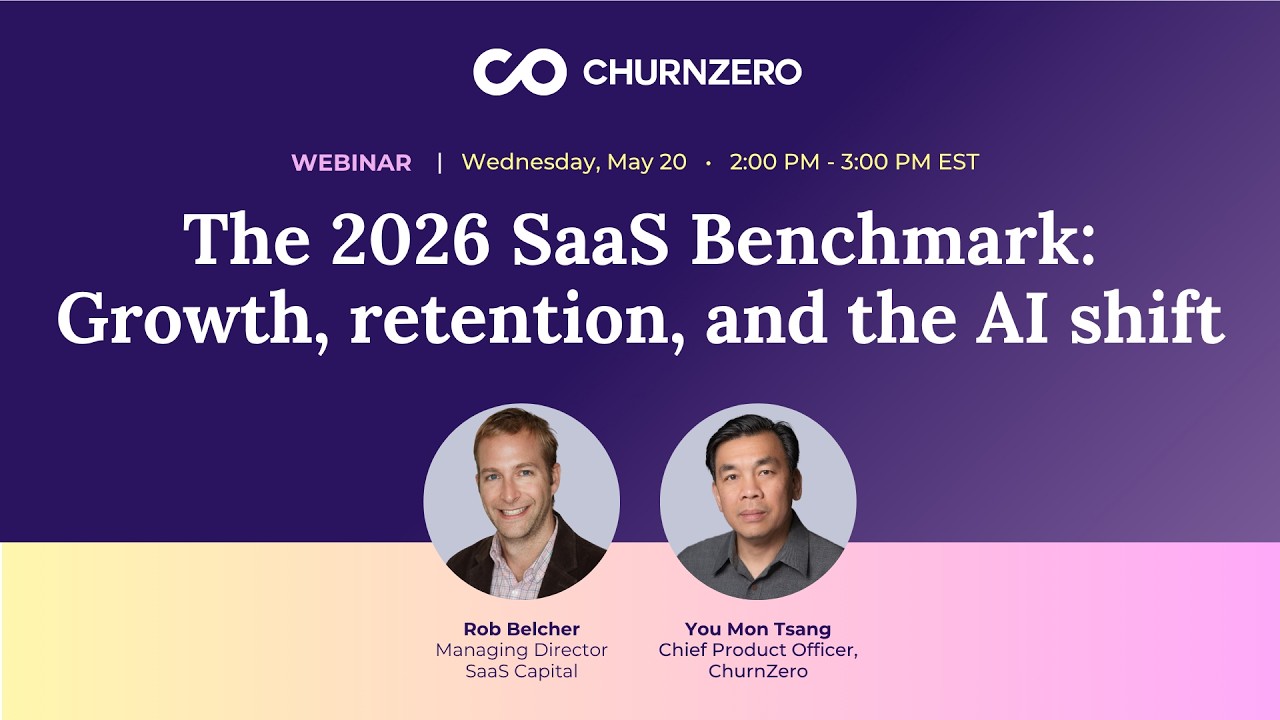
According to new research by SaaS Capital, only 27% of the SaaS companies that have added AI to their product did so primarily because their customers asked for it.
The others did so because competitors were doing it (15%), or for their own internal innovation goals (42%). In other words, most SaaS product investment over the last 12 months has been supply-driven, not demand-driven.
While customers may be adopting these capabilities anyway, there’s no guarantee they’re realizing value, or that they’ll renew as before.
If they’re not, however, we could be looking—in the words of ChurnZero CEO You Mon Tsang—at a retention time bomb. Here’s what You Mon means by that.
Whichever way this goes for your company, your customer success team will be the first to know.
The good news is that you can avoid being taken by surprise.
Why would I need an AI feature adoption audit?
Last year’s story on AI in SaaS, flagged by SaaS Capital’s research, was “AI is everywhere, but uneven.” The imperative was to build AI into your product, or fall behind. However, this may not have translated into durable growth.
“We’re not seeing growth rates expand because of AI purchasing,” says SaaS Capital’s Rob Belcher on the 2026 data. “It’s more that companies are pushing AI into their existing customer base with the idea that it will be more retentive.”
“The talk is that there’s been a lot of experimental buying,” says You Mon. “The ARR that you’ve built up around your AI revenue is not durable. And there’s going to be a retention bomb. Next year and the year after that, you see GRR go down, NRR go down, because of all this increase in AI experimental buying.”
Features built without customer pull tend to follow an unhappy arc: a launch with internal excitement and high visibility in QBR decks, but minimal adoption. At renewal, customers are less likely to see these features as value delivered, despite your team’s efforts to position them as such.
“If you have all these features that customers really didn’t ask for,” says You Mon, “maybe you’ll just not be able to sell it.”
How to launch a feature adoption audit.
As a CS leader, you don’t need to wait for churn (or not) to see how a new feature’s adoption is going to go. Here’s how to launch a feature adoption audit.
1. Pull adoption data on AI features released in the last 12 months.
Usage is the first signal. You’ll need to look beyond login-level activity to task-level engagement. Are your customers completing the workflows the feature was designed for? Frequency and depth of use matter more than how many times the feature was clicked on.
2. Listen for unprompted mentions of AI features.
How often are customers bringing up AI features without being asked in your CSMs’ call notes, for example? If the feature is creating value, customers will likely mention it. This gives you a fast, qualitative read on whether your AI offering fits your customers’ needs.
3. Map feature adoption to your renewal cohort.
Split your accounts renewing in the next 90 days by “has meaningful AI feature engagement” versus not. This shows you where your CSMs need to focus their efforts in a) telling real value stories and b) listening. CSMs should discover:
- Why isn’t the AI feature being used?
- Is it a workflow fit issue, or does the customer not know about it?
- Is there a competing internal tool?
- Did the customer never have the problem that the feature addresses?
4. Coach your CSMs to separate awareness gaps from fit gaps.
For awareness gaps, engagement and enablement might help customers find value. For fit gaps, refocus the value conversation to what matters to that customer, and route this feedback to your product team.
Don’t default to enablement before you know what you’re dealing with—and never try to force adoption of something the customer doesn’t need. It erodes trust and doesn’t help with retention.
5. Become your product team’s eyes and ears (if you’re not already).
Whether or not you’re in the 57% of companies that built AI features without customer demand driving it, your team should own the flow of customer feedback to your product team.
That means designing (or co-designing) the process by which you capture what customers do and say, and routing it upstream.
A disciplined feedback loop is one of the greatest inputs your product team can have. It also gives your CS team the standing to push for a course correction if new features are landing badly.
How ChurnZero helps you audit new feature adoption.
Your feature adoption audit is only as good as the data feeding it. ChurnZero’s AI customer success software pulls together the quantitative and qualitative signals you need into a single place, so you can spend more time acting on information than chasing it. less time gathering information and more time acting on it.
1. Segmentation (qualitative).
Build dynamic segments in ChurnZero to divide your customer base according feature usage. Create two primary cohorts—adopters and non-adopters—which you can then subdivide by tier, contract value, CSM, vertical, or renewal date. This is your analytical backbone through which all subsequent data points can be filtered.
2. Events and feature usage tracking (quantitative).
With nearly 70 native integrations, it’s easy for ChurnZero to process usage data from your product.
To audit new feature adoption, pull the specific events tied to your new feature—such as activation event, repeat-use event, depth-of-use events—and analyze their frequency, recency, and breadth (how many users per account touched the feature). This is your primary adoption signal.
3. Custom dashboards (quantitative).
Build a custom adoption dashboard that pulls the metrics your product leadership will care about, including adoption rate over time, activated accounts vs. total accounts, average time-to-first-use, and feature engagement depth.
Just share the link for your product team to see, with no extra logins required.
4. Echo AI agent (qualitative).
ChurnZero’s Echo agent translates your unstructured customer conversations into clean, categorized feedback, ensuring that nothing valuable gets lost. For a feature adoption audit, this is your qualitative workhorse.
Instead of your team manually reviewing dozens of call recordings and email threads, Echo systematically surfaces and categorizes what customers are actually saying about a feature: friction points, praise, confusion, and requests.
5. Spotlight AI agent (qualitative).
ChurnZero’s Spotlight agent captures your customers’ success stories automatically, turning everyday wins into usable proof of value.
Use it as you audit accounts that have adopted a feature to identify and codify their wins. Spotlight’s insights will help you build a more nuanced value story for customers, give your product team concrete proof points—and save your CSMs from having to manually log anecdotes.
6. Surveys (qualitative).
ChurnZero makes it easy to deploy targeted in-app or email surveys to gather direct user feedback.
Survey your adopters (“What’s working?) and non-adopters (“What’s blocking you?”) separately. You can also have ChurnZero trigger a survey with a usage thresholds—for example, after three uses of a feature.
7. Account profiles (qualitative).
For a representative sample of customers and their feature adoption, dive into ChurnZero’s individual account profiles. We recommend focusing on non-adopters with high contract value.
Your CSM notes, email engagements, meeting logs, and NPS responses surfaced here will help you understand and communicate the “why” of non-adoption, which is critical for making your report actionable and surfacing adoption patterns related to account attributes.
8. Plays(retrospective).
Review the performance of any plays you’re already running to support this feature: adoption nudges, onboarding sequences, or at-risk alerts. Your play completion rates will indicate which engagements worked to influence adoption. Not running any plays yet? Treat your audit results as a brief, and create some.