

Quick Summary: New research shows NRR declining across the SaaS industry while GRR stays relatively flat. Customers are staying, but they’re not expanding.
2026’s customer growth numbers have arrived, and CS leaders should pay attention. Gross revenue retention (GRR) is now holding steady across the SaaS industry… but net revenue retention (NRR) is declining.
“People are retaining customers,” says SaaS Capital’s Rob Belcher. “They’re just not able to upsell and cross-sell and increase prices as much as they might like… or as much as they used to.”
This month, Rob joined ChurnZero CEO You Mon Tsang to explore the findings of the 15th annual SaaS Industry Survey, the definitive retention and AI benchmarking resource based on a survey of more than 1,000 private SaaS companies.
Rob brought this year’s data highlights, while You Mon brought a nuanced read on what they mean, such as why SaaS is absorbing two compounding pressures, and why a return to 2021-style growth probably isn’t on the menu in the form most leaders are expecting.
You can watch the webinar in full here, or scroll down for the five findings from the conversation that CS leaders should pay close attention to.
1. NRR is declining while GRR is staying steady.
The SaaS industry’s top-quartile NRR, which in prior years reached 120%–125%, now sits around 110%, with the industry median NRR just above 100%.

“The upside has been decreasing over the last couple of years, whereas the baseline has stayed mostly flat,” says Rob.
It’s a significant decline, particularly at the top end. The outsized performers, who used to pull the benchmark up, are themselves struggling on expansion compared to previous years.
GRR, meanwhile, tells a different story: its floor has held while its ceiling has dropped.
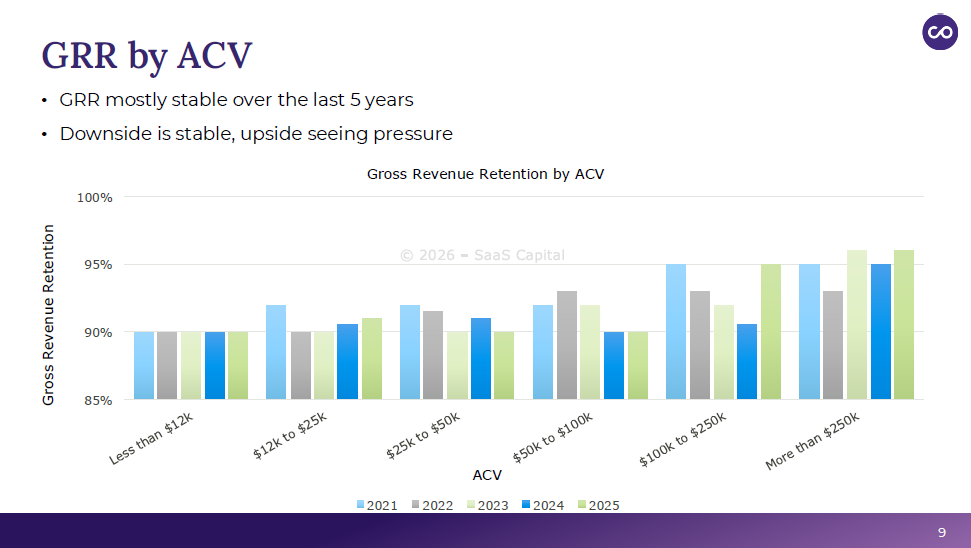
In turn, both trends are feeding into lower growth rates across the SaaS industry—more on this below.
What should I do?
You can’t fix declining NRR with the same approaches you’d use to address churn, which is a retention problem. Declining NRR, when GRR is flat, is an expansion problem. Your customers are there but the revenue growth from them is no longer what it used to be.
While the benchmarking data can’t tell you why expansion might be stalling at individual companies, it can indicate where to look: your upsell and cross-sell workflows, and your pricing.
To avoid managing yourself to the wrong target, keep your market segment in mind, cautions You Mon.
“The one thing I would encourage people to do is really look at your segment,” he says. “In my experience, the difference in NRR between SMB and enterprise is actually an even bigger spread.”
GRR vs. NRR: A quick refresher on the metrics.
GRR measures what you keep. GRR is the percentage of revenue retained from existing customers, excluding any expansion. GRR hits 100% when no one churns; it drops when they do.
NRR measures what you keep and grow. NRR is your total revenue retained, including expansion, contractions, and churn. NRR surpasses 100% when you’re growing revenue from your existing customers alone.
When GRR holds steady but NRR declines, it means your retention floor is solid. Your customers aren’t leaving but your expansion ceiling is dropping.
2. Private SaaS growth rates have halved.
“If half your growth was from your existing customer base, and your NRR is down, that impacts your growth rate,” says Rob.
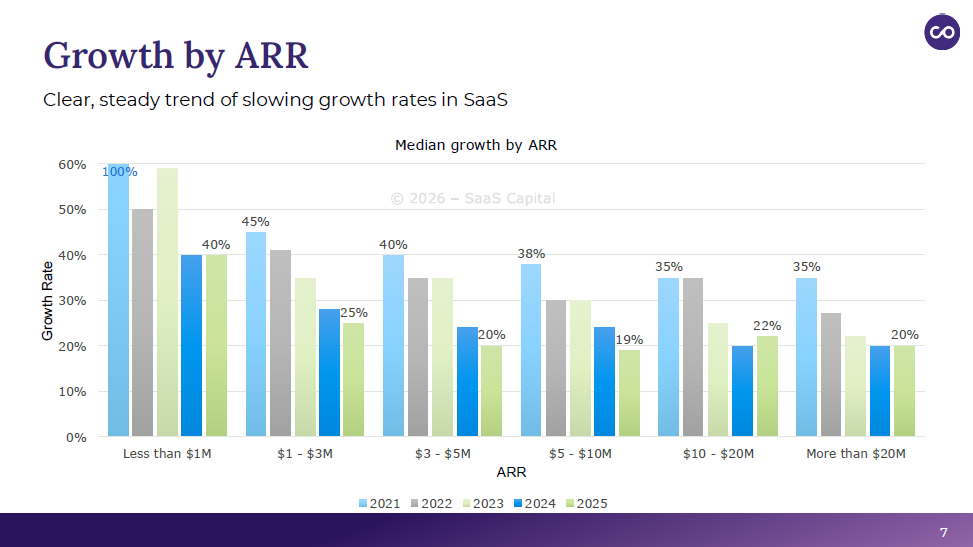
The private SaaS growth rate has declined dramatically from around 40% a few years ago to around 20% today. You Mon sees this year’s data as the second punch in a one-two combo.
“In 2022 to 2025, most of the effect was macro,” he says.
“I think AI is now the second punch. Everyone’s trying to get back to growth. CIOs are asking: do you really need to buy this, or renew this? I think AI is continuing the pressure.”
What should I do?
Be careful about managing your team’s books toward a return to growth that might not arrive in its expected form. The industry isn’t recovering from the 2022 rate shock as it might once have done, and AI is adding a second layer of uncertainty on top of the first.
3. It’s tempting to cherry-pick how you report your NRR. Don’t.
One audience member raised the idea of breaking out NRR reporting into “ICP” and “non-ICP” in order to show a company’s real retention story. You Mon urges caution on this approach.
“When you’re talking to a board, a PE firm, or the public markets, ICP-segmented NRR may not land the way you intend,” said You Mon. “It may or may not be taken the same way you want to take it internally.”
“If the company has pivoted—you used to sell here, and now you sell there—that’s an interesting story, and one that a lot of folks do tell,” Rob added. “But it is a story.”
Either way, be honest with yourself about what your retention is before you try to reframe it.
4. Pay attention to adjustment clauses as a potential NRR lever.
Many SaaS companies, notes Rob, have inflation adjustment clauses in their contracts that they ignored or let slide when inflation was less dramatic.
However, when you compound a 3-5% annual escalator over a few years, you’re looking at meaningful revenue that doesn’t require a new sales cycle or a new product.
“Year over year, with a 5% inflation adjustment? That’s half of this NRR right there,” says Rob.
What should I do?
First, recognize that annual price increases count toward NRR*. Then, start a conversation with leadership about whether to operationalize them.
You’ll need to know a) which contracts have these clauses, b) whether anyone is tracking them, c) how and when they might trigger, and d) which customers you’re prepared to have that conversation with come renewal time.
*You Mon thinks they should also count toward GRR.
5. Audit your AI feature adoption now… before renewals do it for you.
For the second year running, SaaS Capital added AI-focused questions to its survey. One of this year’s most interesting findings relates to why companies add AI to their products in the first place.
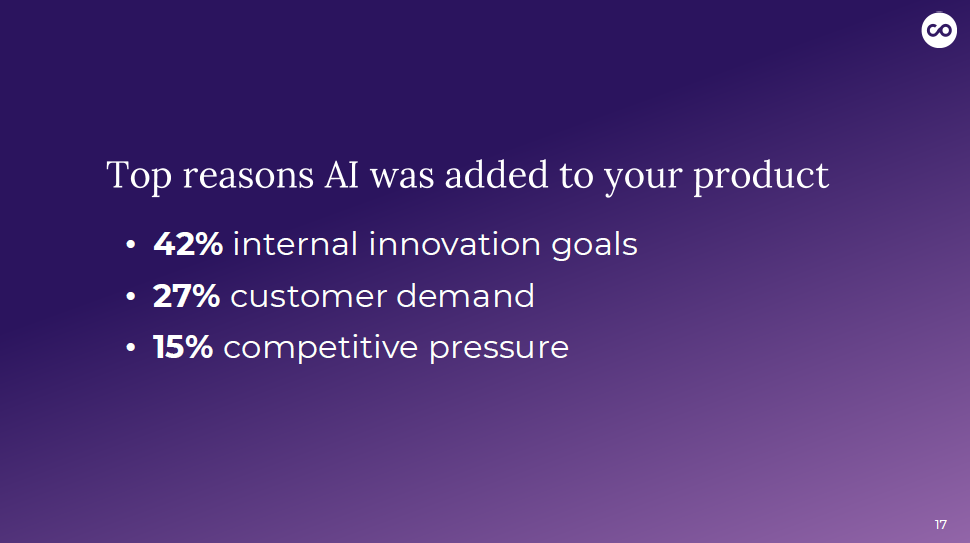
“It’s more of a push than a pull,” says Rob. “Only 27% of people said that customers are asking for it, and that’s why they’re adding it. 42% answered that they’re adding it for their own reasons: for their own goals of adding more AI into their product.”
“Add that first bullet point with the third bullet point,” says You Mon, “and they add up to 57% who did it because they felt they had to, the boss wanted it, it was an internal goal, or because their competitors are doing it.”
“These are not the greatest reasons to build product—but it’s the age we’re in. Hopefully your customers will demand it, and they will come—but right now, it feels top-down rather than bottom-up.”
What should I do?
Whatever the reasons for your company adding AI to your product, it’s worth pulling adoption data on any AI features released in the last 12 months now, then mapping low-adoption accounts against their renewal dates. It’s far better to start asking the question now than to wait until renewal.
Webinar Q&A: What customer leaders wanted to know.
Q: Are annual price increases included in NRR?
You Mon: The answer is yes. Any kind of expansion is included. By the way, I have a gripe to pick with the metrics gods. I think GRR should include price increases. It’s just one person’s opinion, but I know CCOs out there want that as well.
Q: Can the downward pressures, whether on ARR or NRR, be traced to AI or macro? And if so, what’s what?
Rob: It’s a great question. Anecdotally, we are not seeing any direct AI upstart replacing any of our borrowers, nor are we seeing any customers replacing our borrowers’ products with some vibe-coded internal thing. Maybe I’m a late adopter; I’m not a hype machine, but I think that is a long way off, or not happening. We’re not seeing any churn from AI directly, but that’s why I presented the macro. The macro is slower growth, more of a maturing industry. Software is pretty prolific at this point. It’s not a blue ocean as much anymore.
You Mon: I’m more of a one-two punch on this one, Rob. In 2022 to, let’s just say, 2025, most of the effect was the macro, right? It just changed so quickly for those of us in this space that it was a little bit shocking, and it took a while for people to accept it and get through the system. I do think AI is now the second punch.
Q: As the industry as a whole migrates towards profitability, how will that affect valuation multiples?
Rob: Historically, SaaS has been profit-losing, so doing a DCF (discounted cash flow) doesn’t really work. We do a shorthand of the ARR multiple—just a multiple of the annual revenue—driven almost entirely by growth rate. I think SaaS starts to move into earnings. It’ll be an EBITDA multiple, just like the rest of the public markets. Just like railroads, it’s priced on earnings. When a SaaS business becomes profitable and starts issuing dividends, it’ll truly be a mature industry.
Q: Now that competitors can emerge so much more quickly due to AI software development tools, what will this do to valuations in general?
Rob: I don’t know about medium to long-term, but currently it is definitely have and have-not. Companies that are growing, selling a lot, with a fresh product—whether it’s AI or not—are getting decent multiples, high single digits, even 10 or 12. For everybody else, there’s no bid. None. There’s just no capital available. If you’re growing at 10% or less, the market is illiquid. It’s not like 2018, when pretty much any company could be bought for 2X as long as it was growing 10%.
You Mon: Is that a moment in time?
Rob: I have no idea. I think so. Interest rates come down a little bit, AI hype levels out, and we find out what it really is: the AI hype compresses; SaaS kind of comes back up. I think there’s a vision of 3 to 6X ARR as normal, as opposed to 3 and below where we’re seeing right now.
You Mon: Because if 3 to 6 becomes normal again, then 2X for the super-slow-growers becomes doable again.
Rob: That’s right. And highly retentive, mid-market vertical SaaS companies are still great assets. You need to control costs. If I could say anything to operators out there: be in charge of your own destiny. There is no rescue capital. Control your costs and you have options. But there is no market for a money-burning, middling growth company right now.
Q: Should we rethink the title of product managers and move towards product makers who own more of the product: theorizing, prototyping, and building features with AI?
You Mon: I’ve seen more of this. Our PMs are now the new developers. If you’re purely a developer and you’ve always just been told what to do, do you have a place in the organization?
Rob: I have dabbled with Claude and stuff. My kids are making games with Claude; it’s pretty wild. You can wireframe a product pretty easily without being a hardcore developer, and share that with your development team. Can you participate more quickly and be a maker on that front? Can you hear something from a customer on a customer call, then prototype it and hand it off to your dev team? I think so. “Product maker” is great.
Q: Do you (SaaS Capital) depend on your companies getting exits to win? Or do you depend on them just making their loan payments? Or a combination of both?
Rob: It’s a combination. We have been blessed with exits as a great way to get repaid in the past. But our model is term loans with amortization.
Companies can pay us back, but they have to be ready for it and prepared to make those payments and de-lever and pay down debt. That’s how we get paid back in a vacuum if there is no liquidity.
And we are seeing more of that. There is no liquidity. People want to hold on. De-levering helps: you de-lever, and then all that value is available for the equity. So folks are spending a little more time before an exit right now.
Q: How about the format: more money up front, less earnout? Are you seeing that?
Rob: We are not seeing much difference from any other time in history: the standard cash, or cash and stock up front, with some small earnout based on one or two years of renewals. That’s pretty common, even today.
But the companies getting these offers are pretty good companies getting pretty good offers. The companies that are not performing great are not going to market; who knows what they’d get? Most of the deals that are getting done are normal SaaS deals.
For more SaaS industry insights and benchmarking, visit SaaS Capital.


