

Quick summary: When CS teams evaluate AI, they often think they need to automate their entire operation, which actually puts customer relationships at risk. Instead, teams should gradually have AI take over time-consuming administrative tasks and use signal-based AI agents to flag risks and opportunities for CSM follow-up.
CS teams frequently make one major mistake when introducing AI: they try to automate everything all at once. To avoid AI overreach, teams should initially focus on manual, administrative tasks that can easily be automated – giving CSMs time back in their day to focus on the customer.
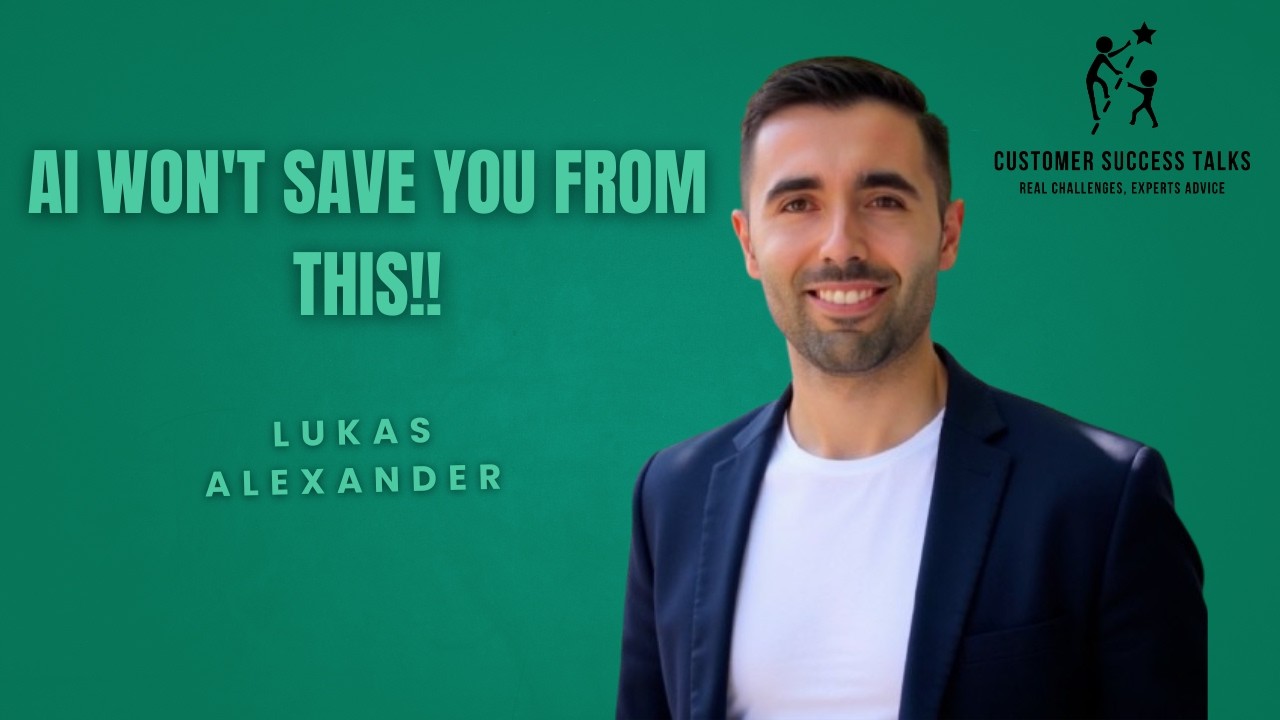
In a recent episode of the “Customer Success Talks: Real Challenges, Experts’ Advice” podcast, ChurnZero VP of Customer Success, Lukas Alexander, explained what CS teams get wrong when introducing AI, and shared some tips on how to avoid these mistakes.
Check out the full episode.
Why CS teams struggle with AI.
According to Lukas, there are two major reasons why CS teams often struggle with AI adoption:
- AI overreach: CS teams often think they need to transform their entire workflow all at once. This approach risks handing too much power and decision-making over to AI, which could damage longstanding customer relationships (not to mention presenting an overwhelming project for CS leaders).
- Balancing AI with humans: Unlike sales and marketing teams, where relationships are largely transactional, CS teams rely on long-term partnerships with the customer. Leaders frequently struggle with how to balance automation with a personalized, human experience that builds customer rapport.
Common AI mistakes that CS teams make.
Some common AI mistakes that CS teams make include:
- Overcomplicating AI implementation: CS teams may treat AI as an all-or-nothing initiative instead of slowly rolling out automations and testing them one-by-one. Lukas likens this to handing a new CSM the entire customer portfolio all at once, which could result in disaster.
- Ignoring easily automatable tasks: CSMs often spend hours on administrative tasks like building PowerPoint decks, writing similar-sounding emails, and doing account prep for meetings. With the kitchen sink approach, CS teams are missing that these tasks are simple to automate and provide immediate value by giving CSMs time back in their day. You Mon Tsang, CEO at ChurnZero, predicts the average CSM will have 25 – 50% more bandwidth in ther day by the end of 2026 using AI.
- Relying on perfect data: Many businesses hesitate to use AI for analyzing customer engagement data because they assume their data isn’t mature enough to make a meaningful impact. This is often not the case, because you’re already generating valuable data with your customer interactions.
How CS teams can tactically implement AI.
Luckily, CS teams don’t need to overhaul their entire operation to benefit from AI. Here are some methods Lukas recommends to implement AI and see an immediate impact:
Start with administrative tasks.
CS teams should pick one painful, time-consuming administrative task and automate it before focusing on complex workflows. Manual tasks AI can automate include creating meeting presentations, doing account research, or writing introduction or summary emails. Each time you successfully automate a task, you can look for the next one that takes up too much of your team’s time.
Experiment with AI prompts.
Before you start handing off workflows to automation, you should experiment with what your AI tools can do. Lukas recommends picking one task this week, writing your first AI prompt for it, and building a library of repeatable prompts over time as you pilot AI tools safely. Don’t add more automations until the existing ones are proven and you’re using them habitually.
Don’t wait for perfect data.
All you need for AI to start analyzing your customer engagement is the data your teams can already access: call records, emails, support tickets, and the other information that gets generated as you interact with your customer. While “our data isn’t good enough” is a common perception, that belief doesn’t hold up when you already have plenty of valuable information.
Use signal-based AI agents.
AI agents can analyze and interpret customer engagement data behind the scenes by reading through emails, meeting transcripts, and support tickets. This data can flag risk signals so CSMs can intervene to avoid churn, and identify buyer intent signals to assist with customer expansions.
For example, AI can capture potential value discussions on a call, such as a customer saying the product helped them grow their revenue by 10%. AI bots have the ability to flag that comment and bring it to the CSM, who can use it as proof to help justify renewals or expansions.
Match AI to your service model.
The way that CSMs use AI should reflect their service model. For example, it could make sense to use AI for generating customer success plans when customers find them valuable, but you may need a different approach when you’re serving an SMB customer segment that won’t look at them. Teams should match AI to the work that they actually do – and not go wild adding new features or services before they’ve automated core functions.
Delegate AI workflows and human tasks.
Over time, AI can take on more data processing, manual tasks, and heavy lifting behind the scenes. CSMs should still handle the relationship-building and social skills aspect of customer success, which Lukas says AI will never be able to fully replicate.
What to do if your business isn’t investing in AI.
If your business simply isn’t investing in AI at this time, Lukas recommends three follow-up actions:
- Ask yourself if the organization is a good fit for you: In three to five years, Lukas believes most companies will be expected to deliver more revenue with the same staff or a smaller workforce, with more generalist roles. Companies that aren’t exploring AI now could be left behind.
- Find the AI objections: In some cases, organizations may resist AI for valid reasons, such as data privacy concerns. Learn about the concerns surrounding AI before you start experimenting with it for your team.
- Create an AI council: You can propose the establishment of an AI council, made up of cross-functional stakeholders, and include non-leadership team members. The group can meet regularly – even just an hour a week – to share knowledge about what they’re doing with AI and bounce ideas off one another.
Avoiding AI overreach can empower your CS team.
The biggest risk isn’t that CS teams are using AI, but the pressure leaders feel to automate too much of their operations. By rushing out automated workflows everywhere without a clear plan, leaders risk breaking their processes or damaging customer relationships.
Start small with manual administrative tasks, let signal-based AI agents handle data processing behind the scenes, and consistently experiment with AI prompts to find the right places where AI can make a difference for your team. You can give your CSMs time back by letting AI handle the tasks that drag them down, so they can focus on building customer relationships and driving long-term growth.


