
Quick summary: When budgets get cut, CS teams tend to reduce headcount before AI, possibly because AI doesn’t always have a dedicated budget line item. Before reducing staff, CS leaders should give AI its own budget line, separate AI from human tasks, and prove that AI can handle the work.
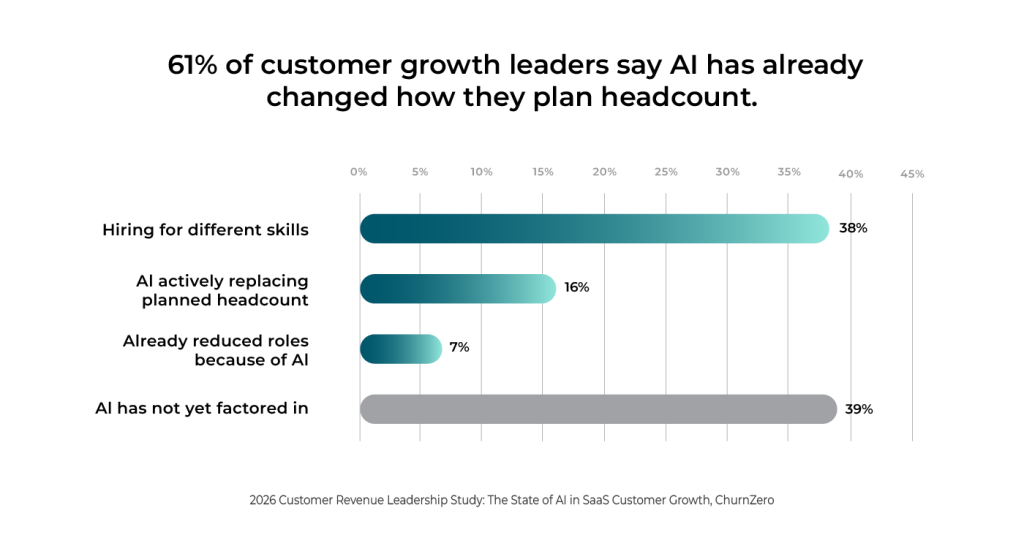
When CS teams face budget cuts, they tend to reduce headcount before they slash AI spending. A small percentage of teams have already eliminated roles directly because of AI, while others are planning ahead by using AI in place of roles they would have hired for.
These findings are based on responses from 580 CS and revenue leaders for ChurnZero’s 2026 Customer Success Leadership Study, which focused on how AI is impacting CS teams now and in the future.
While these trends could understandably make CSMs fear for the future, AI is best suited for time-consuming, administrative work. Using AI to take manual tasks away from CSMs frees them up to focus on the high-value work of building customer relationships — which is ultimately what they were hired to do. That’s why teams cutting staff today may find themselves rehiring tomorrow to drive growth.
How CS budget cuts affect headcount vs. AI
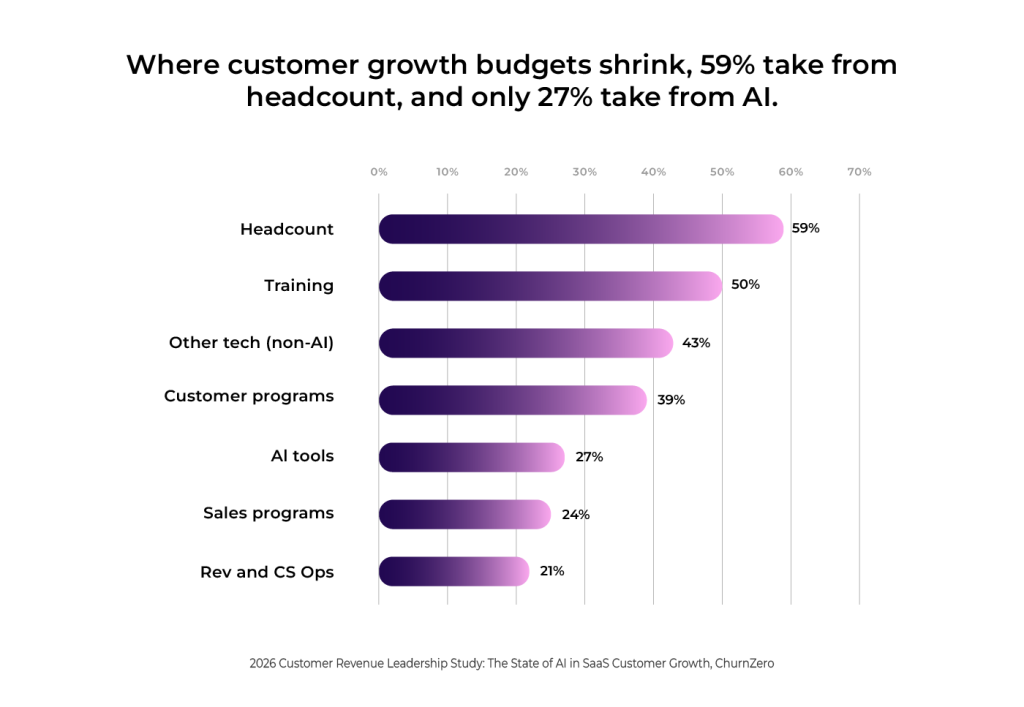
Survey responses painted a clear picture of priorities when budget cuts hit:
- 59% of teams facing budget cuts reduce headcount
- 27% of teams reduce spending on AI tools
- 16% of CS leaders say AI is actively replacing planned headcount
- 7% say they have already reduced roles because of AI
- Only 15% of teams have a dedicated budget line item for AI as a core investment
- 31% of teams embed AI within their tech budget
- 20% have no formal AI budget and spending is ad hoc
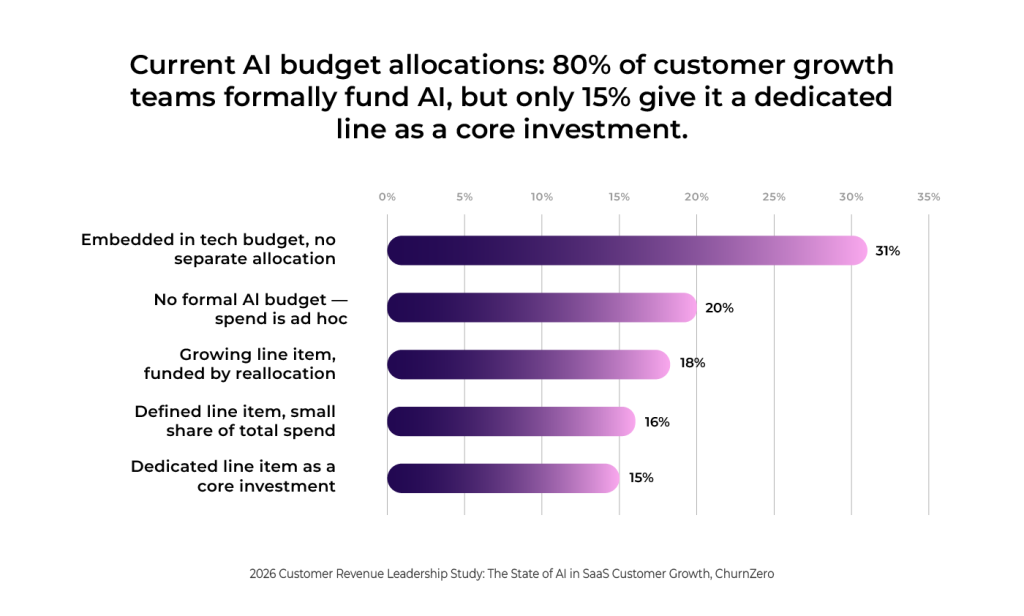
This suggests that AI often exists as a hidden line item in CS budgets, which may protect it from budget cuts when headcount is a more quantifiable expenditure. Another potential explanation is that headcount represents a much larger portion of the departmental budget, and is the more obvious target for reductions. No matter the reason, it’s clear that AI is not absorbing the brunt of spending cuts.
How to make smarter decisions around AI and headcount
Use these strategies to manage your AI spending during the lean times:
Create a budget line for AI
Hiding AI in your general budget, or having no idea how much you’re spending on AI at all, isn’t a justifiable position — especially when you’re making decisions that affect your team’s ability to support your customers. You need to know how much you’re spending on AI for these reasons:
-
- Budget allocation: If you don’t know how much you’re spending on AI compared to everything else, you can’t make accurate allocation decisions when budgets contract.
- Accountability: If leadership can see how much you’re spending on AI, it creates accountability for you to show how the money was spent and report on the ROI.
- Strategic deployment: If you know how much money you spend on AI, it can help you strategically roll out automation where it makes the most impact, based on the amount of money you have to devote to it.
Separate AI tasks from human tasks
Before you reduce headcount in favor of AI, you should have a clear separation of duties between the two resources. Human beings can serve the customer in ways that AI will never be able to do, while AI can handle manual, repetitive tasks that gobble up your CSMs’ time and attention. Having this separation can help you identify where reductions should actually happen.
“My question is: if AI is increasing efficiency, where did you put the time? Part one is getting the time back. Part two is deciding what goes into it, which bridges time saved and flat NRR … If you’re going to maintain the headcount, these people need to be doing something meaningful and measurable. It’s making sure the folks who are on your bench are doing the most impactful strategic work, and giving AI the rest.” – Lukas Alexander, VP of Customer Success, ChurnZero
Over time, AI can take over data processing and analysis, repetitive communications work, and other heavily administrative tasks. Your CSMs should still manage the strategic and relationship-building work that AI cannot do.
Don’t reduce headcount before proving AI can handle the work
Before you cut staff, test your AI capabilities to make sure it can actually handle the work it’s taking over from CSMs. Otherwise, you risk losing the team members you need to do the work that humans can do better than AI, leading to a degraded customer experience.
“I’d separate two things that look identical from the outside: teams restructuring around a capability they have actually demonstrated, and teams using AI as the acceptable reason for a cut they were going to make anyway. Only the first is a forecast. The second is a cost decision wearing a strategy costume, and the risk lands on the people who are gone by the time anyone checks.” – John Gleeson, Founder, General Partner, Success Venture Partners
Gartner recently predicted that half of all firms that reduced customer service staff because of AI will need to rehire to rebalance automation and human support in 2027. This presents a costly problem: laying off staff now to save money can actually lead to an expensive rehiring campaign later. By then, you’ve lost the organizational knowledge and experience of your terminated employees.
Let AI take work without removing the human element
When budgets get tight, CS teams cut headcount first: 59% reduce staff, while only 27% trim AI spending. This is partly because AI can hide inside the broader budget, while headcount is the more obvious target. But cutting staff members before proving AI can do the work could lead to lost knowledge, operational disruption, and an inferior customer experience.
Give AI its own budget line, separate AI tasks from human ones, and test AI capabilities before you make staffing decisions. While AI can handle some of the work that people used to perform, it can’t replace the human element that great CSMs bring to the table to keep customers happy.