Sales teams outpace CS on AI adoption and measurement
Quick summary: Sales teams lead ahead of CS when it comes to using AI and quantifying its performance. CS leaders are under pressure to adopt AI, and they can use sales as a blueprint for AI implementations that deliver measurable, impactful results.
Sales departments are outpacing customer success teams on AI adoption and measurement. They’re more likely to turn to AI first when solving problems, they track performance more consistently, and they can often connect AI to revenue outcomes when CS can’t.
ChurnZero’s 2026 Customer Success Leadership Study surveyed 580 CS and revenue leaders to find out how they’re using AI, and the results clearly show the gap between sales and CS. Leaders should take note because the mandate to adopt AI is growing stronger: according to a recent Gartner Survey, 91% of customer success and support leaders are under pressure to implement AI.
The upside is that CS teams can catch up to what sales is already doing. By automating the right workflows, measuring results from the start, and using CSP-embedded AI tools, CS teams can run more efficiently and make a bigger impact on revenue.
Sales AI adoption vs. CS AI adoption by the numbers:
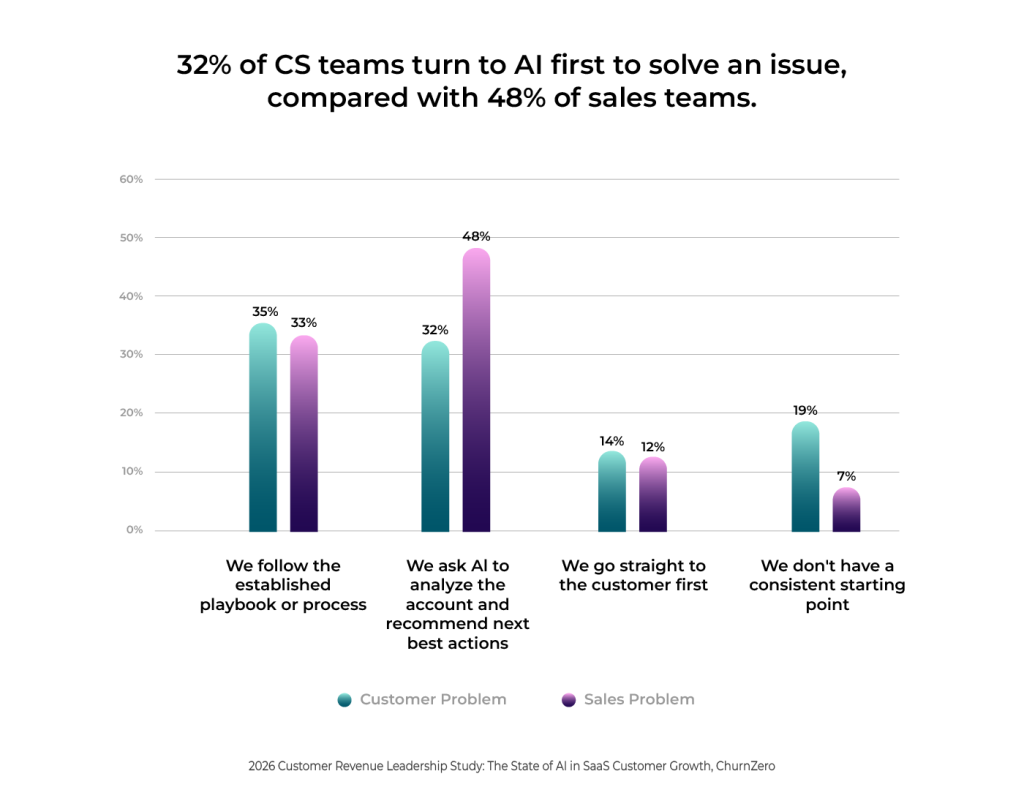
- Nearly half (48%) of sales teams turn to AI first to solve a problem, compared to 32% of CS teams.
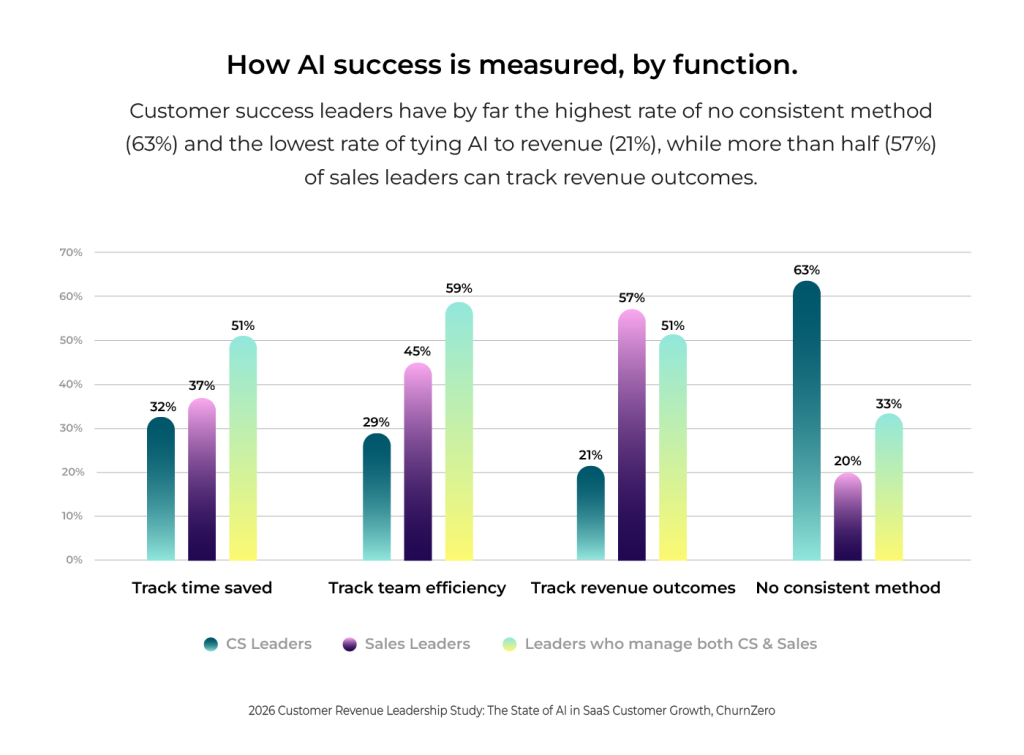
- More than half (57%) of sales leaders can tie AI to revenue outcomes, compared to less than one-quarter (21%) of CS leaders.
- CS leaders also lag behind sales leaders in measuring AI by functions, including time saved and team efficiency.
- Only 20% of sales leaders have no consistent method to measure AI success, compared to 63% of CS leaders.
“CS is generally tracking behind sales in tech adoption, and, [to be honest], I think that will always be true. Whatever sales is doing now is what customer success will be doing in 12-24 months.” – YouMon Tsang, CEO and Co-founder, ChurnZero
How CS teams can close the gap with sales on AI adoption
When CS leaders feel pressured to adopt AI, they risk automating too many processes too quickly, without a clear strategy or any way to measure the results. Use these strategies to deploy AI to your team without losing the value your CSMs bring to the table:
Roll out AI workflows that matter
Start working on AI-automated workflows that actually make a difference for your team:
- Begin with administrative tasks: If you’re just getting started with AI, prioritize the automation of simple, repetitive tasks that eat up your team’s bandwidth. This could include building QBRs, researching account activity, or writing emails.
- Play around with AI prompts: Don’t roll out AI automations across the department without testing them first. Experiment with prompts a little bit at a time, keeping the ones that work well and piloting them with small customer segments.
- Leave relationship-building to the humans: With less time spent on manual work, your CSMs can focus on building relationships with their customers, which AI can’t currently replicate.
Start measuring AI performance
Most CS teams can’t measure AI performance at all, but you need to show results if you want AI in your budget:
- Define what AI success means: Figure out how you will measure AI impact. Meet with sales leaders to find out what they’re tracking. Look at the workflows you’re automating and determine the metrics that show how AI changed them. Consider how you’d defend your AI spending when it comes time to submit your departmental budget.
- Put AI in your budget: Identify what you’re spending on AI and separate it from your general technology spend. This creates greater accountability because you may be asked to defend the expense in the future.
- Tie AI to revenue: CS lags far behind in pegging AI to revenue outcomes. You should be defending revenue-related AI activities by their impact on renewals, expansion, and any other team responsibilities that drive NRR.
Use AI tools embedded in your CSP
Rolling out AI to your CS team may not require as much testing and development time as you think. ChurnZero offers native AI tools and agents that can help your teams automate tasks, increase personalization, and find risk and opportunities faster.
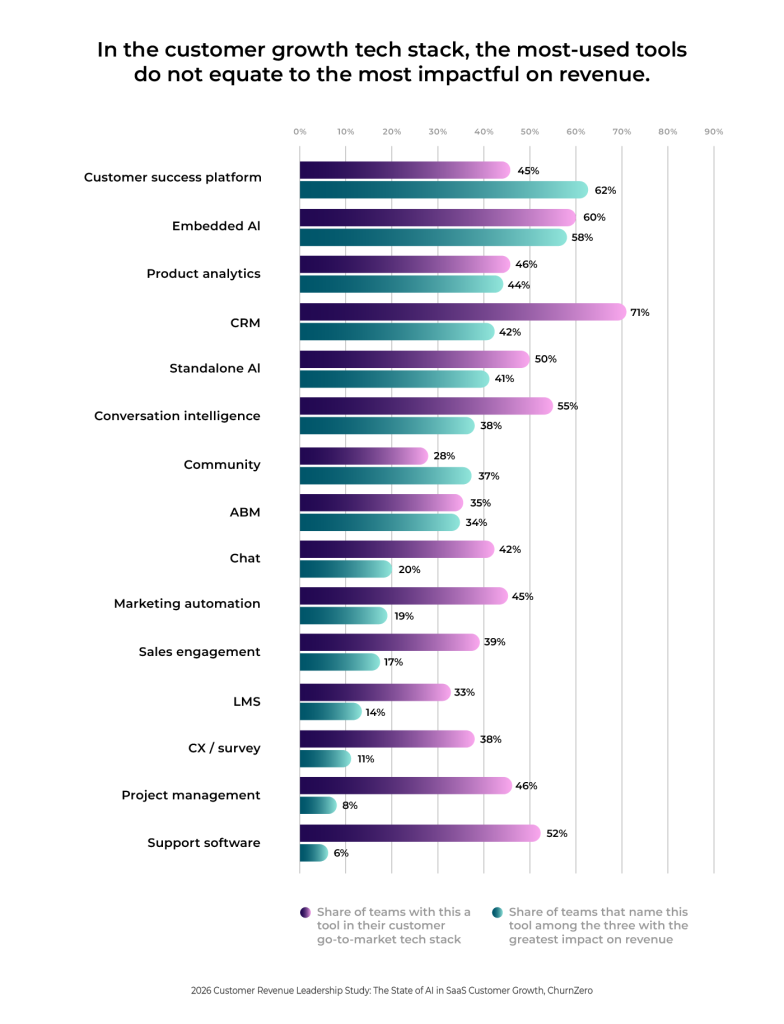
CSPs reside in 45% of tech stacks, but 62% of teams that have one name it as one of the top three tools for growing customer revenue. You may already have a number of AI resources at your disposal right in your CSP, including:
- AI agents that automate manual tasks, summarize activities, and identify churn risks or expansion opportunities.
- Intelligent reporting on customer data that provides fast and consistent access to relevant account insights.
- AI assistants that support CS tasks across the entire customer book, from writing and analysis to recommendations and customer service.
CS teams should prioritize AI adoption and measurement
Sales may be leading on AI adoption and measurement, but CS teams don’t have to get left in the dust. With 91% of CS leaders under pressure to adopt AI, teams should replicate many of the same strategies sales is already using to show AI results.
Closing the gap starts with automating repetitive administrative tasks. CS teams should measure performance from the start by tying AI to metrics like time saved, renewals, and expansion. And you don’t need to build everything from scratch — many CSPs now provide native, embedded tools that make it easier to scale AI adoption. With these strategies, CS teams can turn AI into a revenue driver.