
What your customer success team looks like will largely depend on your organization’s size, solution complexity, and go-to-market strategy. If you’re standing up a customer success function for the first time, you may only have one or a handful of customer success managers who do it all. Whereas, if you’re a fast-growing team, you’re likely ready to bring on more specialized roles such as operations and onboarding to drive greater productivity and efficiency.
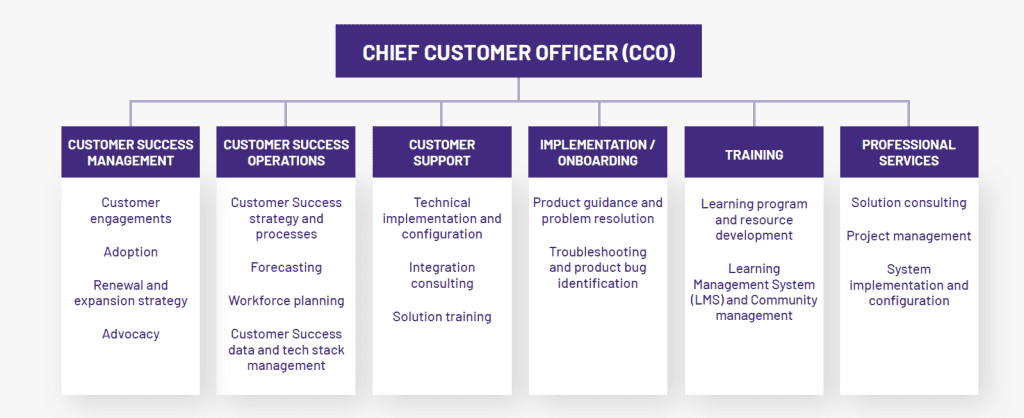
We won’t delve into the specifics of workforce planning due to the many organizational nuances at play. What we will cover is the basic structure of a customer success team so you can understand the types of roles and skillsets needed to maintain high performance as your team grows. The org chart below shows an overview of roles grouped by functional area within customer success.
As mentioned above, depending on the maturity of your Customer Success organization, some of these functional areas, and the roles within them, may be combined or broken out even further. It’s also worth noting that the role titles within these functions can widely vary. For that reason, we’ve focused on the broader descriptions of these roles as opposed to their labeling.
What does a customer success team do?
At its core, a customer success team helps customers achieve their desired outcomes while using your product. The team focuses on driving adoption, building relationships, and ensuring retention and growth through proactive, value-driven engagement. From onboarding to renewals, customer success acts as a strategic partner, guiding customers through their lifecycle and helping them maximize value.
Internally, CS teams are also instrumental in advocating for the customer. They surface insights to help shape product development, inform marketing messaging, and improve support processes. In this way, customer success becomes both a revenue growth engine and a cross-functional bridge within the organization.
Key roles in a customer success organization.
The chief customer officer (CCO) owns the revenue number for an organization’s customer base and oversees all customer activities. They’re also responsible for creating a strong, customer-centric company culture with accountability and ownership of the customer experience at all levels. The CCO has a direct line to the CEO as a member of the C-suite.
Customer success management often accounts for the largest share of the team. This function is comprised of customer successs managers who work alongside customers to ensure they realize value from your solution. In addition to acting as a trusted advisor, customer success managers also set customer expectations and facilitate change management to drive product adoption and renewals. They’re responsible for the prioritization and time management of all customer goals, tasks, and objectives. Customer Success operations works closely with Customer Success managers to build out repeatable processes and set performance metrics to measure their effectiveness. They also help advance strategy initiatives around the customer experience, as well as manage renewal forecasts, process implementation, and the team’s tech stack.
As the reactive arm of the team, customer support handles inbound customer queries by providing product guidance and resolving product problems. While customer success advises the customer on product matters related to strategy and use case, customer support focuses on the more technical side of usage, such as investigating product bugs and troubleshooting issues. It’s essential to define role boundaries between these two customer-facing functions to maintain a positive customer experience.
Who else is on the team?
Depending on the complexity of your solution and the capacity of your Customer Success team, you may have a function dedicated to onboarding new customers. Implementation (also referred to as onboarding), oversees the entire customer onboarding process. Implementation consults with customers on their goals and priorities and then assists in applying the ideal product configuration to achieve those goals. But a customer’s learning shouldn’t end after onboarding.
Training teams design and develop learning programs and supportive resources for your solution. If you have a Learning Management System (LMS), knowledge base, or community platform, this function is also often responsible for its administration. When a customer’s training, consulting, or resource needs extend beyond your standard offering, they can use professional services to fill these expertise and capacity gaps – typically at an additional cost.
Professional services handle a range of customer initiatives, such as project management, solutions consulting, configuration, and service enablement, in support of customer adoption and value attainment.
How should you structure the team?
There’s no single way to structure a customer success team, and the “right” approach often depends on your customer segments and engagement model. Many teams organize by customer size or revenue—such as high-touch support for enterprise accounts and tech-touch or pooled coverage for smaller customers. Others structure around the customer lifecycle, with distinct roles for onboarding, adoption, expansion, and renewal.
The most effective structures align with how your customers experience value. That might mean layering in digital programs to scale engagement, adding specialization to reduce CSM bandwidth strain, or refining ownership boundaries between CS, support, and services.
What’s the ideal size?
There’s no magic number, but a useful starting point is to establish CSM-to-account ratios. In high-touch models, a ratio of 1:10 may be appropriate. In more scaled or digital-led approaches, a single CSM or digital program may serve hundreds of accounts. The goal is to give each customer the level of engagement they need without burning out your team or sacrificing outcomes.
As your organization grows, it’s important to revisit your team size and structure regularly. What worked for 100 customers may not work for 1,000. Investing in CS operations and automation early can help extend your team’s reach without compromising the customer experience.