Quick Summary: To define customer value effectively, shift from activity metrics to outcomes. Align on customer pain, objectives, and ROI, then manage both realized and perceived value to drive predictable renewals and eliminate surprise churn.
When you’re hyper-focused on doing more with less, it’s remarkably easy for a CS team to get bogged down in operational details and metrics. However, when you’re preoccupied with how many meetings you held, how many tickets were closed, or what a health score says today versus last week, you miss the point. These are outputs, not outcomes.
Customer leader Chris Sachs, the VP of value enablement at seoClarity, believes that the core function of customer success can be boiled down into two lines:
- Convince customers to renew, and
- Tell your CFO early if they won’t.
“If a client churns, and it’s a total surprise… that should be a fireable offense,” says Chris.
At the most recent ZERO-IN conference, Chris outlined how to redefine the value of CS through pain and objectives, then launch a new CS model that enables strategy rather than fire-fighting.
Why is the way you define customer value so important?
Teams who stick to defining success internally and operationally tend to create a cyclical “surprise churn” environment with all kinds of knock-on effects, says Chris.
Predictive failure: When a CS leader can’t explain why a customer churned, it signifies a failure in the team’s ability to predict revenue for the CFO and executive team.
Wasted resources: Surprise churn (at any cost or level) is a direct hit to resources already allocated for things like hiring, product development, and growth.
The auto-renew illusion: a customer auto-renewing is not an indicator of success. In fact, this fallacy can hide underlying dissatisfaction.
How to understand each customer’s true pain.
Because every customer is different, Chris recommends taking the time to run a “pain and outcomes workshop” where the CS team essentially shuts up and listens.
“There’s a reason why they decided to pull the trigger and purchase,” says Chris, “so you can’t just use a best practice when defining success.
The essential outcomes of your workshop are threefold:
1: Name the pain. The customer should share their specific pain points (which can vary wildly from org to org), and your goal should be to listen and dig down into what really matters. Do not assume best practices.
2: Ask for and understand customer objectives. How does the customer plan to measure success for this program? Again, don’t recommend or guess – ask and discuss.
3: Define ROI for everyone. Be transparent from the start: “What do I need to do to convince you to renew your subscription?
“When an executive hears, ‘We’re here to get you ROI,” they lean in—because you’ve connected the engagement to the business,” says Chris
The dual value model for customer (and business) outcomes.
There’s a winning customer growth strategy in the intersection of two kinds of value: realized and perceived.
Realized value includes measurable outcomes like cost savings, revenue lift, and risk reduction. Think of them as the receipts that satisfy budget owners and CFOs.
Perceived value encompasses relationship quality, product experience, and overall engagement. They’re the reasons the customer’s day-to-day users advocate for you.
Chris boils it down even further. “Realized value is business outcomes that you can actually measure,” he says. “Perceived value is what all of your client success managers are chasing”.
“The more you can define and conquer the different types of value, the better you can calculate what success really has been.”
Should you continue to map other KPIs within a dual value model? Absolutely—but Chris recommends a tiered approach.
- Primary (Executive): conversions, revenue, CAC reduction. These are the business outcomes your company leadership lives by.
- Secondary (Practitioner): performance drivers that show the program is working
- Tertiary (Execution health): usability, adoption, and process metrics deep in your user base.
Remember: these are not your drivers; they’re directional equipment. It’s far better for your CS team to stay focused on the dual value model and where customers are sitting within it at any given time.
This is where a matrix and scorecard come in handy.
The customer success value matrix and scorecard.
The matrix here visualizes the dual value model with simple categories for customer health based on the intersection of measurable business outcomes (realized value) and the strength of the customer partnership (perceived value).
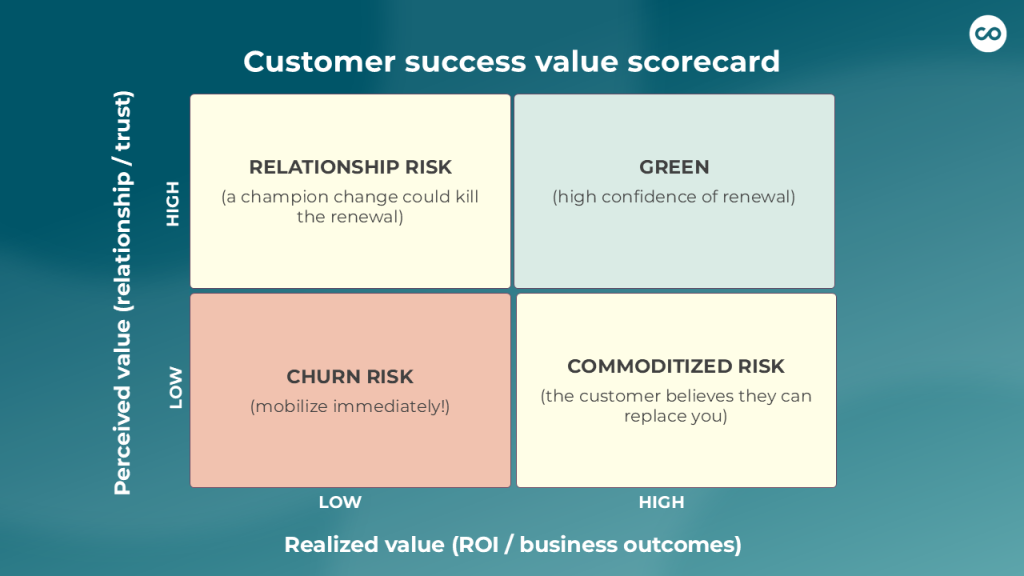
To maintain a predictable revenue model and avoid any “surprise churn,” CS teams can ensure they deliver and communicate both types of value. Use the matrix as a living scorecard to gauge customer health.
1. Realized ↑ + Perceived ↑ → THE GREEN ZONE.
This is the gold standard. Your customer is seeing measurable ROI and the relationship is strong. The takeaway is high renewal confidence.
2. Realized ↑ + Perceived ↓ → COMMODITIZED RISK.
You are delivering results but there is no “perceived” relationship or unique value. Your customer may be thinking about replacing you with a cheaper alternative—after all, they feel they’re doing the work themselves.
3. Realized ↓ + Perceived ↑ → RELATIONSHIP RISK.
The customer “loves” your CSM but the business outcomes aren’t there. This makes your deal highly vulnerable—if your customer champion leaves, for example, the new boss may cut you immediately to save money.
4. Both ↓ → CHURN RISK
No measurable value and no relationship? Mobilize immediately—you’re on the fast track to churn.
Redefine customer value with your new scorecard and roadmap.
Once you’re realigned on the definition of customer value—great job!—how do you ensure your customers move into the green zone and stay there?
As with the matrix, it’s good to keep things simple.
Implement a scale of 1-10 at kickoff, with no 7s allowed. Force customers to grade specific areas of their program and goals on a scale of 1-10 during the kickoff. Prohibit the safe response of a 7 (it doesn’t enlighten, or move the needle, or tell anyone much of anything, really).
Revisit that scoring every quarter. Re-grade with the customer so they can witness progress (e.g. “We’ve moved up from a 3 to a 6 in that category—wow.”). This fits nicely into the dual value model: they celebrate their success with you, and you justify the renewal.
Advocate out loud for your POC. Tell an executive sponsor how amazing your customer POC is, in front of them, to boost that perceived value.
Finally, treat each account as a promise.
Chris urges that if you can adopt just one mindset shift from the framework above, it should be to stop treating success as a collage of activity metrics.
Instead, treat each customer as a promise given: we will produce ROI you can measure, and we will earn confidence you can feel.
Once you turn this mission statement into a discipline that your team can practice and revisit every week, renewals become a natural next step.