Many CS leaders are not being held back by a lack of data. They are being held back by the belief that the data must be perfect before AI can do meaningful work.
AI adoption is no longer the story. The real story is whether AI is being used in ways that change customer outcomes, protect revenue, and strengthen the standing of the leaders responsible for both.
In a recent ChurnZero pulse survey, CS leaders said they are using AI today in exploratory ways: summarizing calls, drafting emails, and recapping meetings. Those use cases save time, and time matters. But when the same survey asked where CS leaders most want AI to make a measurable difference, 53% pointed to renewals and churn prevention—the work that directly protects and grows revenue. That leaves a meaningful gap between how AI is being used today and where it could create real business value. Closing that gap starts with a more honest look at what is holding organizations back.

Why waiting for perfect data keeps CS organizations stuck.
If AI has not moved deeper into your workflows, this may sound familiar: the data does not feel ready. Nearly half of respondents in our pulse survey cited data quality as their top concern about expanding AI use, with accuracy and trust close behind. The good news is that LLM models are getting better and better, so hallucinations will continue to decrease. However, generic AI tends to miss the mark more often than not. If you want reliable outputs, reliable outputs depend on reliable inputs. So the work gets delayed until the systems are cleaner, the fields are more complete, and the picture feels more dependable.

The problem is that this kind of waiting carries a cost that often goes unmeasured. The Sixth Annual Customer Revenue Leadership Study, based on responses from 793 customer leaders, found the same pattern playing out at scale year after year. CS leaders continue to cite data cleanup and systems unification as top priorities, yet those priorities remain unresolved year after year. In other words, many teams are postponing one of their most impactful opportunities, waiting for a condition that will likely never materialize.
Start with what you have and let AI help.
The more useful reframe is this: you do not fix your data first and then use AI. By using AI, you begin to understand your data more clearly.
The CS teams making progress have already started. The signals already moving through the business every day—emails, calls, support tickets, meeting notes, and product engagement data—are enough to begin. When AI reads that interaction layer, it does more than surface isolated insights. It starts extracting and maintaining the relationship intelligence that teams have been trying to track manually for years: who owns the relationship, how the customer actually feels, which accounts are strengthening, and which are beginning to drift before the risk becomes obvious.
Used well, AI can help expose where data gaps. What once looked like a reason to wait becomes a clearer reason to begin.
Of course, generic AI will not do. This is customer data. It is private and critical. Your AI tools need to be embedded, integrated, secure, and sanctioned by your IT team.
What real AI readiness looks like.
The better question about AI and data readiness is whether your data is sufficiently connected to give AI something real to work with, and whether your team has defined the workflows in which AI can create immediate value.
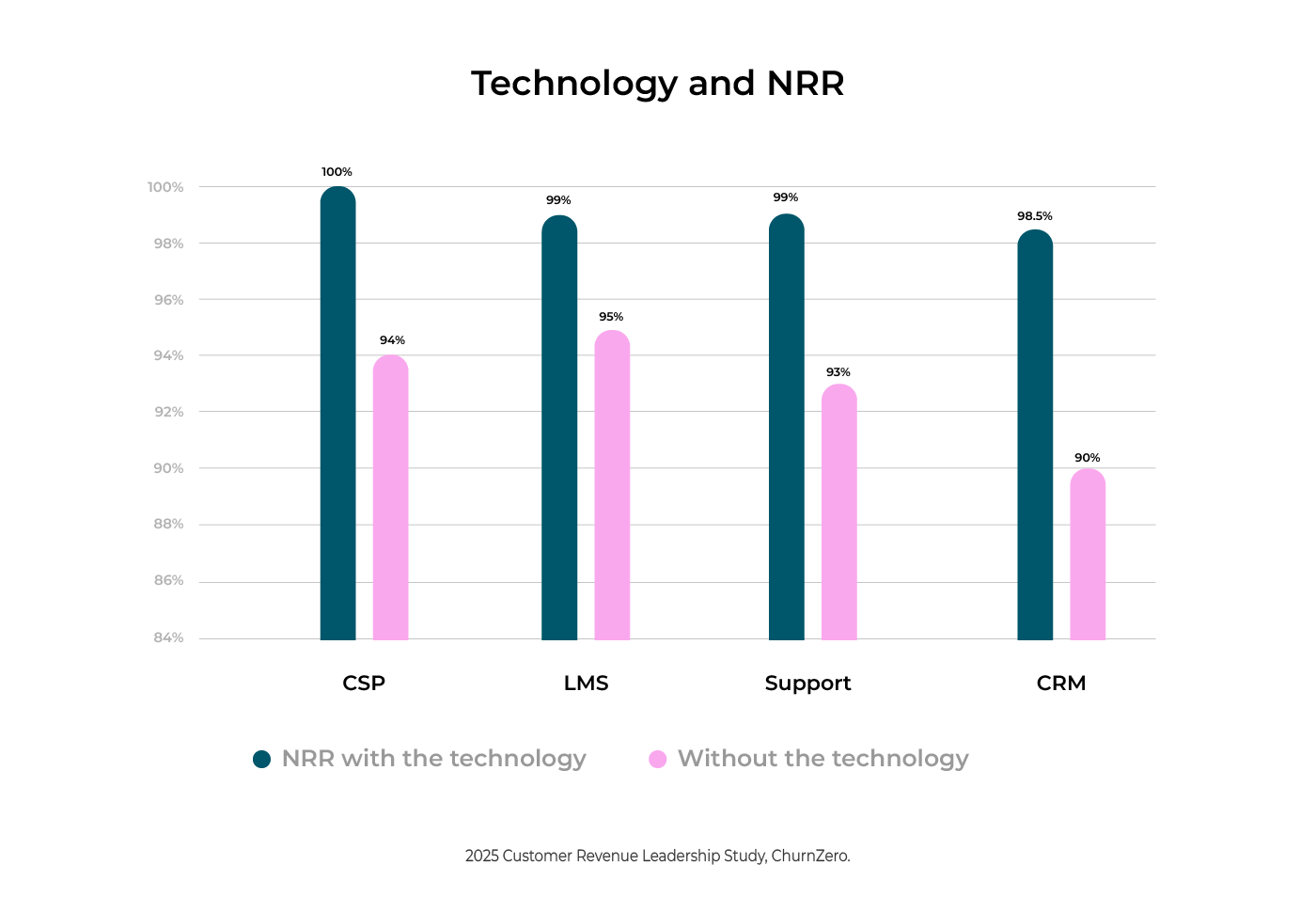
The Customer Revenue Leadership Study found that teams with a connected, customer-data-centric stack report materially higher NRR than teams without one, and that advantage grows as AI matures inside their workflows. Operational readiness is what turns interest into impact. It is what allows a leader to move from experimentation to repeatable performance.
That readiness begins with a few straightforward questions.
- Are your customer accounts, contacts, and commercial terms in one place, or are your CSMs still pulling from three different systems before every renewal conversation?
- Does your team have real visibility into product usage trends, support volume, and executive engagement, or are they still piecing together an account story from disconnected sources and hoping it is accurate
- If a CSM left tomorrow, would the account context remain accessible, or would it leave with them?
Those questions reveal whether your operation is designed to scale judgment or depend on heroic effort.
The next question is where AI should go first. The strongest starting point is not a broad transformation plan. It is two or three workflows where the insight-to-action gap is most expensive: early risk detection, renewal preparation, or expansion identification. If you are thinking through what a modern, autonomous CS function looks like in practice, that clarity of use case is where it begins.
When AI moves beyond efficiency.
Most CS teams are still using AI at the tactical level, mainly for productivity gains such as summarization and account research. Fewer than one in six have moved into revenue-driving applications such as predictive expansion indicators, intent-based outreach, or lifecycle automation at scale.
But there is a great opportunity to have a bigger impact. When your goal is to tie your team’s work directly to NRR and GRR, AI is what makes that connection repeatable and scalable across the entire customer base.
This is also where the narrative around AI begins to change inside the organization. When your team can act earlier and lead with more consistency across a book of business that no human team could ever do on its own, and their actions drive more revenue, business data will be reviewed to see how it further improves results.
Why now.
NRR and GRR have stabilized. Budgets are holding. The external pressure that once masked the impact of day-to-day execution has eased. What happens next is up to you.
Your customers are generating activity every day. The question is whether those indicators are being read and turned into action your team can take, or whether your CSMs are still assembling account context manually and reacting only after risk is already visible.
If you want to build durable credibility, take action. It is the difference between overseeing a function that works hard vs. building one that can show its impact on revenue and customer satisfaction.
For a more detailed look at where the industry is heading, the 2026 customer success trends from CS leaders offer a good view of what’s coming.
Need help getting started with AI?
ChurnZero AI is built around the data you already have. Talk to us to find your highest-impact starting point and activate your first agent, no cleanup required.