

As a customer success leader, it’s your job to construct the best team model with the CSMs you have. This is a puzzle, because every CS team is made up of disparate, unique, and sometimes conflicting personalities, who each bring different experiences and skillsets to their roles.
One way to solve this puzzle is to audit your CSMs’ strengths and skillsets. It helps you bring clarity to which CSMs can provide the most value in any area of your team’s responsibilities.
What were your CSMs’ previous roles, and how did they excel in them? Who loves chatting with customers about the upcoming product releases, and who prefers to dig into the product itself to resolve issues? Is one person the pinnacle of task efficiency, while another in the same role helps keep everyone else motivated and on track?
There’s a lot to consider and it can be hard to get started, especially if you’re new to the team or new to management. To make it easier and more systematic, try assessing each CSM through three different lenses:
- What past experience and hard skills does your CSM have?
- What soft skills do they have, and how do these align to your CSM models?
- Where does each CSM fit best on a spectrum of strategic to automated?
Combined, these assessments help you better arrange individual team members into different specialties or traditional CSM models. There won’t always be a neat and tidy fit for every CSM’s strengths, but the point is often in the progress. Think about it as micro-adjustments for each CSM rather than sweeping changes. With a team led by strengths, you’ll know how to stay agile and divvy up responsibilities that match skillsets. You’ll also be readier to adapt to strategic changes in future.
Assessing CSMs for past experience and hard skills.
Product whiz. Project manager extraordinaire. Sales machine. Marketing master. Given that customer success is a newer discipline, many of your CSMs probably came from a different team, specialty, or industry entirely. This is already a strength!

In 2018, Dave Kellogg identified three primary CSM types – product, process, and sales-oriented. This still feels spot-on, but we’ll take things a step further and say a CSM’s strength could be any previous role, experience, or skill set that sets them apart. Perhaps one CSM team member excelled at building out marketing campaigns and A/B testing for how to optimize customer emails. Your CS team will benefit from their passion and expertise in automating customer communications.
Examples of past experiences and what they mean for CSMs’ hard skills:
- Business development rep. Can keep customers informed and interested in new product releases and updates (company benefit: upsell/cross-sell)
- Small creative agency account manager. Can keep a high-volume list of customers on track with customer journeys, including feedback surveys, performance reviews, and product resources (company benefit: updated customer journey mapping)
- Online community manager. Likely excels at mitigating churn and high-risk customer issues (company benefit: increased Customer Lifetime Value)
- Data analyst. Grasps the importance of metrics like NRR; can keep the team organized with regular reporting (company benefit: retention and revenue growth)
- Product developer. Can manage a strong implementation process; thrives on technical questions from customers (company benefit: consistent customer satisfaction and loyalty)
- Content creator. Can point customers to the right place in the knowledge base, training courses, and product resources instantly (company benefit: smoother onboarding, faster product adoption)
Of course, your team may comprise three former sales reps and a content creator. Or everyone’s from an agency background and they all thrive on a long to-do list. However, this exercise is beneficial both in discovering who you have and what you need. You’ll have a better idea of how to bolster their existing skills with offer training and support where there are gaps (more on training later).
Assessing CSMs for soft skills and fitting them into your CSM model.
Past experiences are often built upon a foundation of inherent soft skills. People join sales teams because they love meeting new people, others learn to code because they love puzzles (and maybe don’t love meeting new people as much). This second assessment helps you to further home in on each CSM’s strengths, and guide their work and customer accounts accordingly.

Most CSM teams work within a certain structure or model (high vs low touch, automated, or allocated by seniority or customer segments). A lot depends on customer ACV and expansion opportunities, as well. A CSM’s soft skills provide a nuanced look at where they could fall in the spectrum of your company’s model.
Which soft skills best align to CSM model types?
- All CSMs
- Communication
- Active listening
- Teamwork
- High Touch CSMs
- Public speaking and presentation skills
- Relationship building
- Confidence
- Initiative
- Assertiveness
- Empathy
- Strategic CSMs
- Critical thinking and analysis
- Verbal reasoning
- Problem solving
- Self-guided learning
- Dedicated CSMs
- Time management
- Expectation setting
- Empathy
- Decision making
- Difficult conversations
- Stress tolerance
- Low Touch/Automated CSMs
- Writing
- Attention to detail
- Self-guided learning
- Time management
Soft skills overlap, so it’s not always be the best choice to sort solely based on skills when there are many other factors like experience, seniority, and your CSMs’ own professional goals to consider. Remember also that hard and soft skills can be learned and improved upon. For a deeper look into CSM placement, check out our webinar with CustomerGuru CEO Lynn Tsoflias, who deftly outlines the benefits of high-touch versus digital-focused CSMs.
Assessing where CSMs fall on a spectrum of strategy to automation.
Which tasks do your CSMs prefer? Do they love talking strategy or thrive on setting automation in motion. Sometimes it’s hard to see the CS forest for the trees, so let’s look at some trees.

The following chart separates CSM strengths across strategic and automated tasks. Where do your CSMs fall?
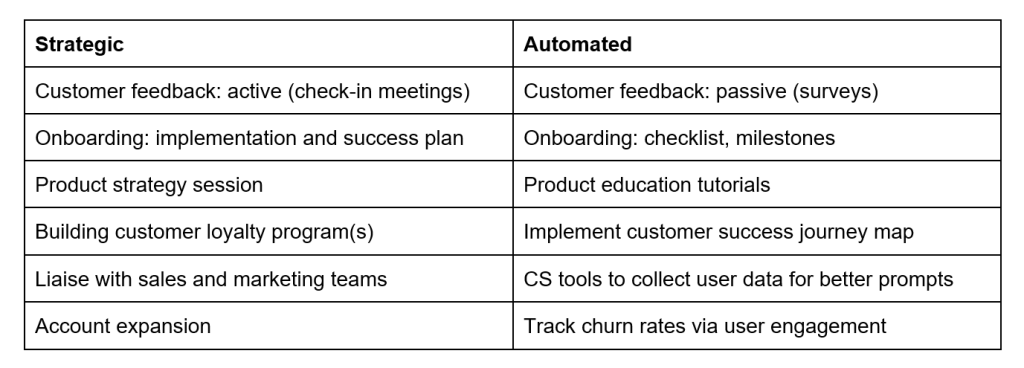
Let’s say you have two different CSMs: One enjoys building out efficient follow-up and notification sequences for their list of accounts. The other prefers to dig into survey data and churn rates to assess the customer journey overall. Both are important elements in customer success, but the first CSM may not thrive in the world of analysis, and the second could flounder if faced with that high volume of customer follow-up to parse through. One excels at automating a task, and the other thrives in a strategic environment.
Aligning career and company growth goals for your CS team.
Armed with these three buckets of insight on your CSMs, it should be a little easier to align team priorities with individual strengths. You should also have a more agile perspective on your team, and know how to encourage individual CSMs to step up when it comes to specific hurdles or their own career goals.
It’s always good to look for balance. Do your CSMs have what they need to support individual customers while tackling broader company goals? Are they challenged and supported, in order to advance both those goals and their own careers? And are you equipped to lead your CSMs to success?
Remember: perfect CSMs don’t exist. Not everyone has a specialty or niche, and a generalized, “dedicated” CSM role can be effective as long as it fits into your broader CS strategy. Likewise, some CS teams are smaller and divvying up tasks and roles is already part of the plan. Fluidity can be a strength, especially as your team grows alongside the company.


