Quick Summary: The top 2026 customer success trends point to AI-embedded teams, stronger revenue ownership, and outcome-led journeys, say our industry-wide panel of customer growth experts.
2026 is shaping up to be a defining year for customer success. Not because the function is under threat, but because your opportunity has never been bigger.
AI is powerful enough to change how work gets done. Boards are paying closer attention to retention, expansion, and profit. Your customers are no longer impressed by activity, but expect clear, measurable outcomes.
For ambitious leaders and teams, it’s a moment to step forward, not sit back. You won’t win by waiting for permission to evolve your role, but by moving first on the new tools and operating models that will turn CS into a true growth engine.
Which 2026 customer success trends will help the leaders separate themselves from the laggards? We asked ChurnZero’s network of industry partners, operators, and SaaS experts to share their predictions, which fall into three major themes.
Trend 1: Forward-thinking leaders rethink team roles with AI in mind.
Does AI belong in the CS workflow? That’s last year’s question. This year, it’s a matter of how deeply AI is embedded, and how it changes the way your team operates. As automation takes on more of the repetitive and reactive work, our experts expect the role of the CSM to expand and change for the better.
“Leadership will realign CS orgs around assistive and agentic AI,” says David Ellin of Winning by Design. “The focus will be on using tools to drive insights, and actions will be split between the CS team and agentic AI bots. Staffing models will change, as will CSM-to-customer ratios, and AI processes will be embedded into our operating models as AI agents are onboarded with as much company information as possible.”
“By the end of 2026, the average CSM will have 25–50% more bandwidth,” predicts ChurnZero CEO You Mon Tsang. “Not by working longer hours or staring at more dashboards, but by working differently. The shift is from people managing systems to people leading them. Smart humans, paired with smart systems that already know what to do.
“AI can now take on the repeatable work: role mapping, drafting outreach, deciding the next best action. That changes the CSM’s role. Instead of chasing signals or stitching together workflows, they orchestrate outcomes through judgment, context, and true partnership with the customer. Anything that once required manual setup, rigid data models, or fragile triggers can be reimagined.
“For leading teams, this does not replace CSMs,” says You Mon, “It elevates them. AI agents absorb the operational load. CSMs become executives of their own books of business, focused on what CS was always meant to be: trusted advisors who guide customers and orchestrate durable, autonomous growth.”
“The teams that win in 2026 will automate their admin work and shift that time into deeper customer conversations,” agrees Anika Zubair of The Customer Success Pro. “This will raise the bar for every CSM. Leaders will expect stronger discovery, clearer ROI stories, and more strategic engagement. AI will not replace CSMs, but will replace the teams that never learn how to use it.”
“As AI becomes embedded in CS workflows,” says De’Edra Williams of Customer Success Revenue Frontier, “leaders will intentionally redefine people’s roles around judgment, empathy, and strategic decision-making—elevating employee experience while avoiding over-automation. In a hybrid, AI-driven era, elevating the employee and human experience will be key.”
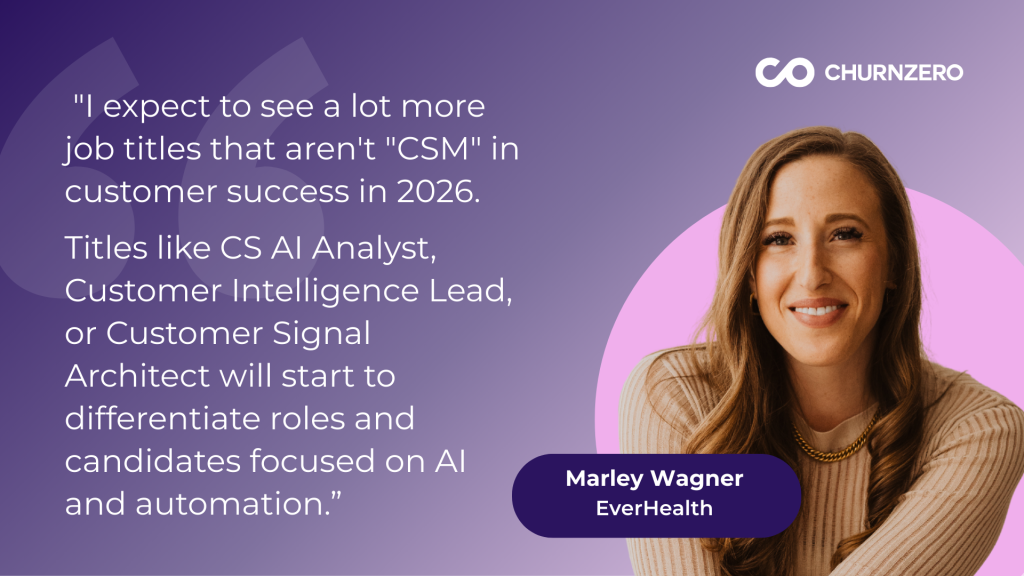
“I expect to see a lot more job titles that aren’t “CSM” in customer success in 2026,” says Marley Wagner of EverHealth. “Specifically, titles that reflect how the work is actually done, not just ‘owns a book of business.'”
“Titles like CS AI Analyst, Customer Intelligence Lead, or Customer Signal Architect will start to differentiate roles and candidates focused on AI and automation. We’ll see Retention & Expansion Specialists, or even Customer Revenue Leads, whose behind-the-scenes work will accelerate CS’s broader role in driving, protecting, and predicting revenue. Finally, roles like CS Enablement Lead, Customer Solutions Architect, and CX Systems Admin will continue to rise in popularity as more and more organizations realize the criticality of crafting an intentional customer experience.”
“Customer success roles are evolving faster than most job descriptions,” says Swati Garg of Melo Associates. “In 2026, CS leaders will hire less for task execution and more for decision-making under pressure. AI will surface risk and opportunity faster than ever, but renewals and expansion will still depend on people who can interpret signals, prioritize correctly, and act with confidence.”

“The next frontier for AI in CS is not just automating a CSM’s day-to-day workflow, but operationalizing AI to serve as a front-facing, embedded coach for customers themselves,” says Naomi Aiken of Techtonic Lift. “AI-driven Embedded Success Agents could deliver hyper-contextual, prescriptive adoption pathways directly within the product interface.”
“This model will make product adoption instantly prescriptive: as a customer configures a new feature, AI agents will automatically surface aggregated data—informing them of industry benchmarks, presenting the typical configuration settings used by similar successful companies, and even providing a projected outcome based on those choices. This automated, peer-driven guidance eliminates common setup friction, drives customers toward proven value paths without CSM intervention, and fundamentally changes the role of the CSM to focus purely on strategic, highly complex relationships.”
“AI will evolve from a reactive data analyst to a real-time interpretor of customer value,” says Ejieme Eromosele of Quiq. “CSMs will rely on AI to qualify outcomes using frameworks like “What, So What, Now What?” This is a storytelling bridge I use with my team, but now, with AI, these insights come to life faster.
“What grounds the conversation in facts, So What clarifies impact in customer language, and Now What drives alignment and action. With AI, this becomes instant, automatically turning feature usage, support patterns, and deeper operational signals into clear, strategic value narratives.”
“AI fluency will become a leadership requirement in 2026,” says post-sale growth consultant Rod Cherkas. “CCOs and post-sale executives will be expected to show, not just tell, how they use AI to make faster decisions, run more efficient teams, and deliver stronger results. Boards and hiring managers will look for evidence of real, practical workflows that leaders have integrated into their daily operating rhythms.”
“Leaders who invest in practical, hands-on AI skill-building will be the ones who stay relevant and lead the next era of post-sale excellence.”
Trend 2: Customer success steps up to take revenue accountability.
Customer success has moved closer to revenue for years, and in 2026, that relationship only becomes more explicit. Your board and executive teams will expect you to drive, protect, and predict growth with sharper renewal forecasts, clearer expansion signals, and a stronger grasp of commercial fundamentals. To succeed, embrace revenue accountability as a core part of your role, using better data, tighter alignment with sales and finance, and AI-powered insights to prove your impact where it matters most.
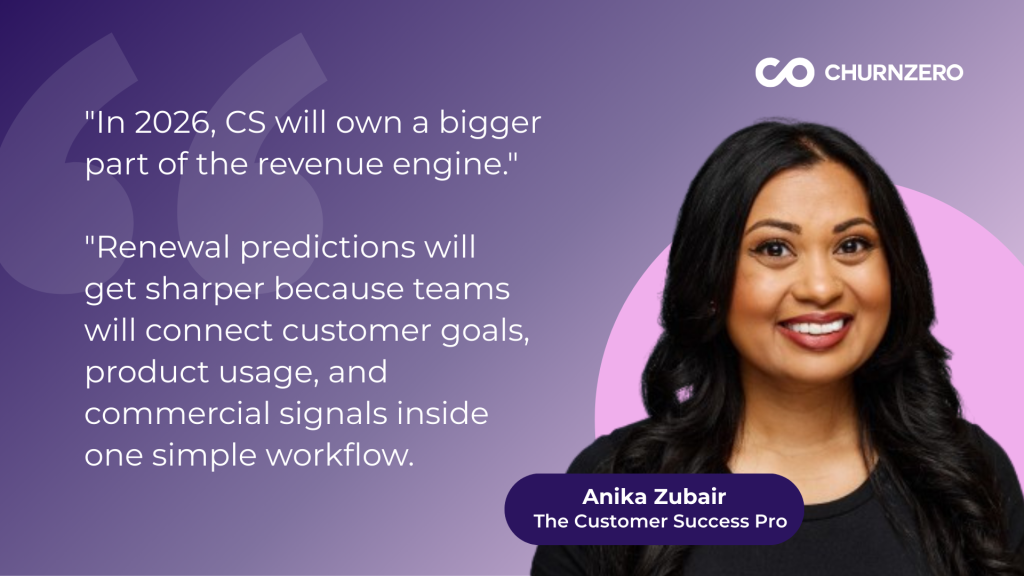
“In 2026, CS will own a bigger part of the revenue engine,” writes Anika Zubair. “Renewal predictions will get sharper because teams will connect customer goals, product usage, and commercial signals inside one simple workflow. Expansion will come from deeper discovery, not last-minute pitches. Leaders will expect every CSM to understand where value sits in the account and how to turn that value into renewal proof points.”
“In 2026, Customer Success will move from monitoring churn risk to actively predicting renewal and expansion outcomes,” predicts Emma Lo of Deepgram. “AI models will analyze historical churn, usage patterns, and engagement signals to forecast revenue risk and upside months in advance. This allows CS teams to intervene earlier, prioritize the right accounts, and focus on actions that actually move renewal outcomes.
“As prediction becomes more accurate, CS and RevOps will operate from the same revenue model, aligning segmentation, forecasting, and renewal strategy around shared data instead of lagging indicators.”
“The largest force reshaping renewals and expansion is the shift in pricing,” says John Gleeson of Success Venture Partners. AI-native companies are increasingly pushing toward consumption-based — and in some cases outcomes-based — models. In these models, expansion is continuous: the more a customer uses, the more they expand, and the more renewals become far less of a calendar event.”
“This fundamentally changes CS’s role. The motion becomes more consultative, more technical, and more embedded in the customer’s day-to-day decisions. In many ways, it’s the North Star vision we always had for the function — accelerating value delivery and partnering deeply with customers in a way that feels natural rather than contractual.
“In 2025, we saw more CROs take on CS teams, giving a clear indication of a revenue focus for CS,” writes Parul Bhandari of CustomerXSuccess. “However, I still heard many revenue leaders hesitate to give CS a full commercial seat. This has to change. With optimization from AI, CS can really take hold of commercial responsibility… or we may see AMs swoop into our roles.
“AI will shed a light on all the crevices and cracks, so if there are CSMs not delivering value, it will show. However, we need trust, enablement, operationalized processes to support us, and clear incentives to succeed. So, until all leaders can advocate for this, some roles may be at risk.”
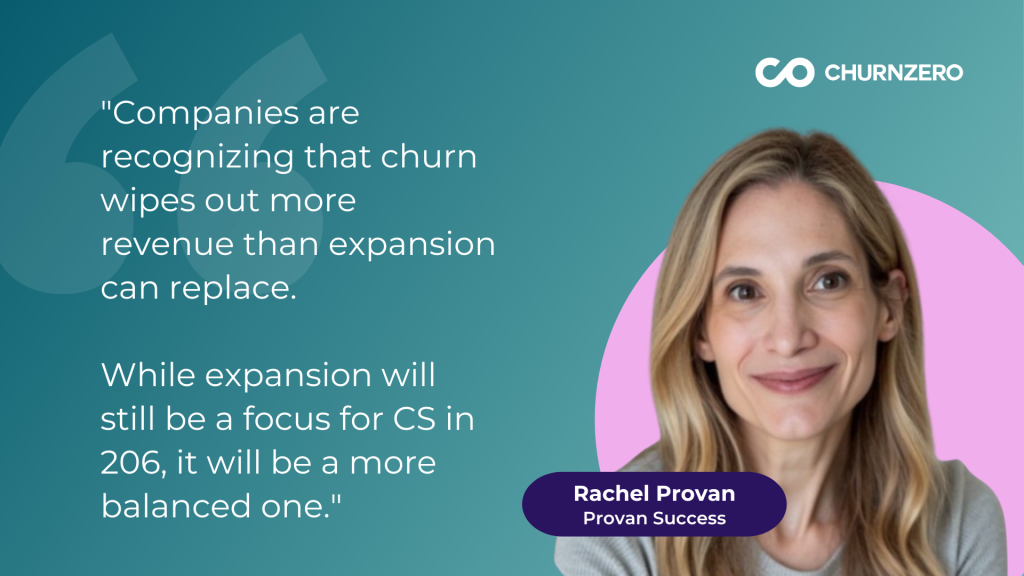
For the past few years, CS teams have been pushed hard toward expansion, but boards are now putting much more weight on NRR, especially the retention side of it,” says Rachel Provan of Provan Success. “Companies are recognizing that churn wipes out more revenue than expansion can replace. While expansion will still be a focus, it will be a more balanced one.”
“This creates a real opportunity for CS leaders. When you give your executive team clear retention strategies and risk insights they can take into the boardroom, you make their job easier. That’s when CS starts getting pulled into rooms where decisions are made.
“Last year, we saw a dramatic shift in CS responsibilities from retention to broader commercial ownership of expansion,” says ESG‘s Sheik Ayube. “With SaaS growth rates declining at alarming rates, CS team will continue to receive new board-level directives summarized as “CS must have a larger impact on top-line results. While many are still struggling with “the how” of last year, a new board-level directive is quickly emerging: CS must directly contribute to bottom-line results.
“CS leaders will need to develop deeper commercial discipline and operational rigor in the year ahead and translate their impact in terms of profit, margin contribution, and EBITDA. It is through this directive that AI, automation, and other operating model optimizations will command board-level attention in the year ahead.”
“In 2026, it will be important for CS leaders to acknowledge that the revenue side of the job is here to stay,” says The Success League‘s Kristen Hayer. “In order to effectively drive revenue, CS leaders need a solid understanding of sales management best practices like managing a forecast and coaching their teams on selling skills like negotiation and uncovering opportunities. The best CS leaders will embrace learning from their sales colleagues, while also bringing their own leadership and relationship-building skills to the table.”
“Customer success is the frontline of survival for both traditional SaaS and AI-first startups, shifting the mission from simple adoption to high-precision Value Engineering,” says Jan Young of Jan Young CX. “To win, leaders are replacing generalists with specialized GTM squads, using Forward-Deployed CSMs and Consumption Leads for high-touch growth, while AI CS Ops and Program Managers architect the data-driven systems that power scaled, touch-free renewals and expansions. As AI agents automate the routine, the human CSM role will become elevated, requiring the deep EQ and business acumen necessary to turn experimental AI budgets into the predictable, profitable revenue our boards now demand.”
Theme 3: CS realigns its workflows around customer outcomes.
A “good enough” customer experience? No longer enough. In 2026, your customers want to see their investment paying off in real time. Our experts expect the shift toward outcome-led customer journeys to accelerate, replacing feature adoption and vanity metrics with measurable business impact. While AI makes this possible at scale, the real differentiator is how you design your CS programs around customer goals.
“In 2026, CSMs will experience a great perspective shift,” says Sabina Pons of Growth Molecules. “CSMs will move from relationship owners to outcome architects, fully adopting tools for precision in delivering customer needs, rather than focusing on being proximate. When CSMs trust their own systems, value progress more than presence, and measure success by results, not responsiveness, customers win, and so too does the CSM’s renewal and expansion performance metrics. CSMs will thrive with the outcome architect vantage point.”
“In 2026, leading B2B companies will finally abandon feature-led “adoption” and fully shift to outcome-led customer lifecycles,” says Ross Fulton of Valuize. “Customer journeys will be centered on prescriptive, measurable customer outcomes (outcome journeys) and supported by integrated processes, systems and data designed to deliver and verify each outcome (outcome blueprints).”
“AI will accelerate this shift by enabling companies to dynamically adapt journeys to each customer’s context—surfacing the next best milestone, predicting value gaps before they occur, and validating attribution between product adoption and business impact. Companies will treat customer value realization as a measurable operating system, and vendors will succeed based on their ability to prove value, not just promise it.”
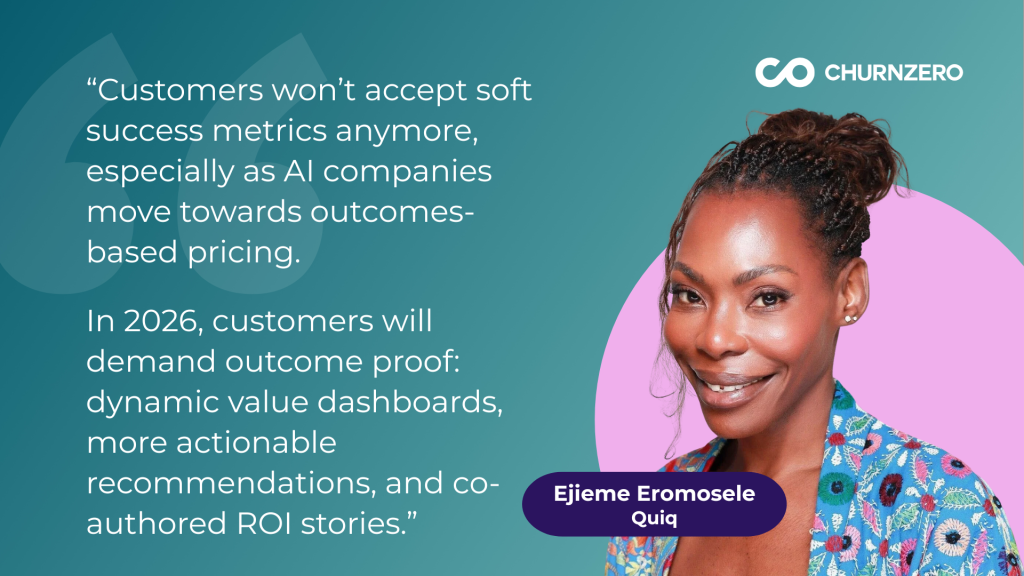
“Customers won’t accept soft success metrics anymore, especially as AI companies move towards outcomes-based pricing,” says Ejieme Eromosele. “In 2026, customers will demand outcome proof: dynamic value dashboards, deeper insights and more actionable recommendations, and co-authored ROI stories. CS teams will use AI to track, refine and confirm these outcomes continuously, shifting value demonstration from an annual exercise to an always-on capability.”
Too many B2B SaaS leaders think that their customer experience is top notch, when in fact the experience is just okay,” says Kristen Hayer. “Customers expect the best of consumer-like experiences from their B2B partners now. Touchpoints that don’t make customers repeat themselves or include customized communications are now table stakes, not impressive. Companies and CS leaders need to invest in building experiences that echo the kind of CX that consumers now expect; automated, tailored, proactive, and data-driven.”
One thing is certain: there’s no going back.
By the end of 2026, the shift in what is expected of customer success professionals will be unmistakably underway, says Abby Hammer, ChurnZero’s chief customer and product officer.
“The job of being a project manager, status quarterback, or human glue between systems will rapidly fade as AI takes on coordination, follow-ups, signal detection, and execution. The profession will increasingly diverge; those who cling to operational ownership will struggle, while those who evolve into strategic, consultative partners will thrive. What customers and companies will need are professionals who can think strategically, advise with confidence, and guide decisions rather than simply manage motion.”
“As intelligent systems increasingly determine what should happen next, the human value in CS shifts to why it matters and whether it is right. CSMs will be expected to help customers prioritize initiatives, navigate tradeoffs, and connect product usage to real business outcomes. This requires commercial awareness, product fluency, and business judgment that AI alone cannot provide. Success will no longer come from managing tasks, but from shaping decisions. That shift demands stronger consultative skills, deeper business acumen, and comfort making decisions in imperfect conditions.”
“This evolution raises the bar while expanding the opportunity. 2026 will reward CS professionals who invest deeply in consultative capability, executive presence, and decision-making under ambiguity. The role is moving away from coordination and toward influence, away from running plays to advising on strategy, CS will be measured less by how well teams manage complexity and more by how effectively they help customers navigate it.”
Need a hand as you navigate 2026’s latest customer success trends?
Our award-winning team of customer success experts is here to partner with you. From in-person events to on-demand online masterclasses, we’re dedicated to your success. Try these resources to stay one step ahead:
- Sign up for an upcoming ChurnZero webinar or pick one to watch on demand.
- Browse these insightful guides on customer success leadership, strategy and best practices.
- Subscribe to our Fighting Churn newsletter for weekly tips, tactics, and useful insights.
- Follow ChurnZero on LinkedIn for the latest news, thought leadership and more