2026 SaaS Capital Benchmark
About this Webinar
SaaS Capital’s 2026 benchmark survey pulls from 1,000+ private B2B SaaS companies, and the picture it paints is more complicated than the headlines. Growth is slowing. Expansion is compressing. AI is starting to show up in the financials — not just the pitch decks.
For the second year, the survey includes AI-specific findings. In 2025, the data showed AI already functioning as a profitability driver. This year’s results show whether that held and what it means for how SaaS companies are being built and evaluated heading into H2.
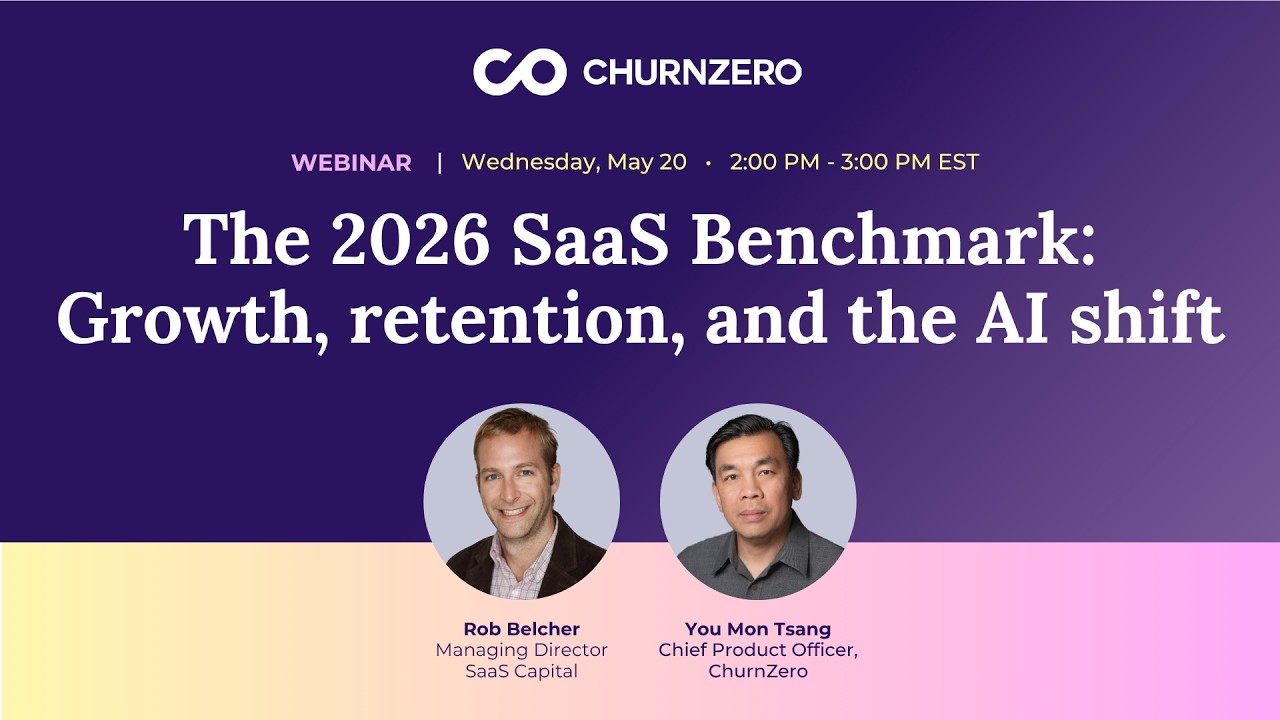
Rob Belcher, Managing Director at SaaS Capital, brings 15 years of experience evaluating private SaaS companies as a lender. You Mon Tsang, CEO and co-founder of ChurnZero, brings the operator’s view. They work through the numbers, challenge each other’s reads, and give you the context to benchmark your own business — and make better decisions with what you find.
Key takeaways:
- The latest 2026 benchmarks for growth, retention, profitability, efficiency, and revenue-per-employee trends, with context on how your company compares
- New year-over-year AI insights on operational use, product integration, and whether last year’s investment plans became a broader market shift
- How SaaS leaders can use benchmark data to guide resource allocation, product strategy, retention priorities, and efficient growth in a market where profitability expectations continue to rise
Full Transcript: 2026 SaaS Capital Benchmark
Please note: This transcript was generated using an AI-assisted transcription tool and may contain errors, omissions or mistranslations
YouMon: Hey everyone, this is YouMon from ChurnZero. Thanks for joining us for our webinar. Today’s webinar is going to be about SaaS benchmarks. Rob, is this our ninth year doing this?
Rob: Many, yeah. At least eight, I think maybe ninth.
YouMon: Yeah, so ninth year doing this, maybe eight. Anyway, we have a big anniversary coming up.
Anyway, we’re gonna be talking a lot about what SaaS Capital does, the survey that they do annually. We’ll dig into the benchmarks and the metrics. That’s the goal today, and we’ll have a Q&A session at the end as well. But Rob, hey, great to have you here again. So Rob’s managing director of SaaS Capital. They’ve been in the SaaS business for many years. But Rob, why don’t you just tell a little bit about what SaaS Capital is all about?
About ChurnZero and SaaS Capital
Rob: Yeah, absolutely. Thanks, YouMon. Great to be here again. This is, like YouMon said, I think eighth or ninth year. We do this every year, and it’s great. Love chatting with YouMon, and he can say a little bit about what he does too, but our two perspectives are often really fun to talk about what’s happened over the last year since the last time we did it.
We are a lender. We provide growth debt to SaaS companies. We lend single digit millions up to ten to B2B SaaS companies with three million of ARR and up. So folks use us in lieu of an equity round or to push one off a little further into the future and use us to grow using debt instead of diluting themselves with equity.
And as part of our just general work, we have fifty-ish portfolio companies, and then we talk to hundreds of prospective borrowers throughout the year. So we get a pretty good survey, just generally anecdotally. You’ll hear me say anecdote a couple times today. But then additionally, every year we run a survey about twenty, twenty-five questions of SaaS metrics that we ask out to you all.
Many of you probably participated, so thank you. And then we’ve aggregated all the data and present it here for you so we can get some kind of a survey of the private market on things like growth rate, retention rates. Those are the big ones for today. There’s other things too. And for the last couple of years, we’ve asked some AI questions, so we’ll go into those.
That’s been really interesting to watch and follow over the previous years. YouMon, do you mind doing just a quick… So we invited folks from our side too, so there might be people who aren’t familiar with ChurnZero.
YouMon: You bet. So I’m YouMon Tsang. I’m the CEO and co-founder of ChurnZero, and we have a customer success platform.
So we work with B2B subscription companies to help them really optimize their customer experience, and that’s, of course, through onboarding, adoption, renewal, expansion, and making sure you really understand your customers and talk to them at the right time with the right offer, with the right action so that you have the best customer experience throughout their lifetime.
And like SaaS Capital, we work with hundreds of B2B firms, and so we really have a good sense of what’s going on in the market as well. So this is always a great conversation because both of us, I think, are very interested in the metrics, but we’re also just interested in what the vibe of SaaS is all about as well.
Rob: Yeah. Yeah, that’s great. Yeah, so obviously you have a vested interest in the retention numbers. We do as well. Retention’s a key component of our underwriting and getting paid back, ’cause if you can’t retain your customers, what are we doing? How are we gonna get paid? How are we gonna get our money back?
SaaS Growth, Profitability and the Rule of 40
Okay, so I wanna start. This is a little unusual, but one of my partners has been doing some really interesting work looking at the public SaaS industry and comparing that and drawing it down into the private. This year, I wanted to start with some public metrics and public sort of the macro view on everything, which kind of shapes or can inform the private market, and so we can understand if the private market is way out of whack or if it’s following the general macro trends.
And the answer to that, I’ll short-circuit it, is the private market, as almost always, is following the public market. So the things we’re feeling, the things we’re seeing are being felt throughout the up and down the sort of stage and stack of capital. So this is what we call the SaaS Capital Index.
It’s, I think, 80 or 90 public SaaS companies that look and feel like our prospective borrowers, but for the fact that they’re much larger and public. So there’s no VoIP. There’s very little cybersecurity. These are pretty pure play, almost all vertical B2B software companies. Obviously, Salesforce is in there, Workday. I’m trying to think of other things. It’s your standard B2B public SaaS companies.
And so this is their growth rate, and this is their operating income or profitability over time. Basically, the rule of 40 components, right? And so the trend I wanted to show here is that, generally speaking, for the last ten years or more, growth rates in public companies are declining.
So 10, 15 years ago, forty percent growth in the SaaS industry overall median, and now it’s more ten or 15. So that’s something we’ll get back to on the private side. I wanted to share that’s happening, except for the COVID bump, that’s happening across the board. Interestingly, and we’ve got more on this, the profitability has been increasing.
So this just tells me that the SaaS industry is maturing. We’re going from high growth, high burn, to lower growth, more profitable. And interestingly, the rule of 40 has actually been increasing since COVID because of the profitability. Profitability has been growing faster than growth rates have been declining.
YouMon: Yeah, quick thing about this. For those of you who are new to rule of forty, it’s essentially your growth plus your profits. And if you have negative profits, of course, that takes away from the forty. And it’s called rule of forty because excellent companies, when you combine growth and earnings, get to forty.
And you can see, actually, a couple interesting things that I see here is that in twenty twenty-two, this is when the interest rates went up. Everybody’s rule of forty went to heck, right? It was like rule of five there. So that’s the bottom of the dotted line.
And actually seeing profitability is amazing to even say this. This is probably the first time software as a whole has been profitable, right? In at least my work lifetime, which I think implies what you’re saying is that maybe we’re entering into a new phase of our industry. So this will be a good topic for us.
Rob: Yeah, first time in our history that it’s profitable. Yeah.
YouMon: Yeah.
Rob: Yeah, that’s a good point. And sorry, generally speaking, there’s gonna be a lot of acronyms. We’ve been doing this for eight or nine years. We assume a lot of you have seen this before.
This will be recorded. You can pause, go back. You can pause and go research our acronym if you don’t know it. We won’t define everything, but the rule of forty is great to know more about. As you can see, very few companies actually hit forty. It was a number that a private equity investor declared as, "If you’re a rule of forty, you’re very investable, and we’d like to buy your business."
And so that’s a target. We call it the rule of forty even though most of the time it’s like, "What’s your rule of forty?" "It’s fifteen," or, "It’s twenty." That’s right. But it’s rule of forty. Yeah, it’s a funny thing.
All right, YouMon mentioned interest rates, so this is fascinating. My partner Evan has been digging into, like I said, the macro kind of side of what’s happening in SaaS. This first chart, you gotta bend your brain a little bit. The right axis is upside down, so it’s interest rates inverted. And the purpose of showing this, so when interest rates are zero, that’s kind of the COVID era there.
You can see they reached the top of the chart, but that’s actually zero interest rates. And so there’s two things going on there. You’ve got this double whammy of free money, and so there’s liquidity everywhere looking for a home, so valuations are driven up. Plus the digital transformation of COVID and everybody’s going remote, everybody’s going touchless, this, that, everything software.
High demand of SaaS, and so you get this giant bump in valuations. We go from sort of long-term historical six to ten x up to sixteen. Inflation, interest rates spike up to five, and valuations come crashing down. As any VC or private equity investor will tell you, liquidity vanishes, right?
And so the last four years have been pretty quiet on the liquidity front, and valuations have been in that six to eight times range. And then we’ve got sort of this, we’ll talk about this too, the more recent valuation drop starting kind of Q3, Q4 last year, and really January, February we saw a drop-off in valuations with the SaaSpocalypse and AI and all that, which we’ll talk about too.
So interesting to see that shape and how interest rates drive the macro world, right? They drive economic… And I’ve got growth up here. I don’t mean SaaS growth, economic growth, right? That’s sort of the economic engine. And then on the right side, we’ve got interest rates back right side up, so zero’s on the bottom here.
And this is what YouMon was just talking about. Free money, grow at all costs, right? You can exactly see it. So there’s a little bit of a lag as SaaS companies figure it out. Free money, COVID, what are we doing? Are we growing? Are we batten down the hatches?
And then it’s grow at all costs, interest rates spike, and companies react. A little bit of a lag again, but they get profitable ’cause there’s no liquidity in the market. Capital’s expensive again. It’s pretty great to see the real, rational actors getting profitable with no money. That’s the backdrop.
YouMon: Yeah, we tend to look backwards here at the last year, but I’m gonna ask you, Rob, by looking forward. So our current administration, the US, wants lower interest rates. Let’s say they get it, right? Somehow it happens. Do you expect maybe on the left, that blue line to follow interest rates as well, that those multiples would go up?
Rob: Yeah, it’s a good… History would say so. Like I said, there were other impacts or factors driving that big valuation bump. But does it bring us back up to sort of historical trend of five, six, seven? Maybe. Maybe. Maybe. It would certainly be an economic growth for sure.
YouMon: Yeah.
Rob: Now how real that hypothetical is, is a big question. Inflation is still at a high point, and maybe oil continues to go up and… So I don’t know. It’s a tricky thing to forecast and think about, but…
YouMon: Rob, I didn’t ask you to bring reality to any of this. Wow. We’re just having a conversation about…
Rob: Just dreaming about…
YouMon: SaaS.
Rob: Yeah.
YouMon: All right. Yeah.
Rob: All right.
YouMon: No, I agree. I’m with you that it’s gonna be very hard to predict, but history…
Rob: Does show that. Yeah. The interesting thing, if you look at the left-hand chart and the old history, ’14, ’15, ’16, it’s not as… I mean…
YouMon: I can see there’s no clear trend.
Rob: Yeah. But the COVID thing certainly, that’s an obvious trend. So I don’t know how to answer your question. It’s a good one, but we’ll have to see.
YouMon: We’ll have to see.
2026 SaaS Growth Rate Benchmarks
Rob: Yeah. Dollar cost averaging. Okay, into the actual benchmarks.
So like I said, this is a survey out to, we usually get a thousand or fifteen hundred private B2B SaaS companies. They range from pre-revenue all the way up to several hundred million of ARR. The bulk of them, just ’cause of our own kind of reach and our voice, tends to be that five hundred K or one million of ARR up to maybe fifty million.
That’s the bulk, but there is a shape there. And we ask them a bunch of questions. So the first one is growth rate. And like I showed with the public companies, the private trend is a decrease in growth rates from forty percent a couple years ago down to around twenty percent this year.
And when I say this year, twenty twenty-five. We do this survey in January and February of every year, and it’s reacting to the previous year close, right? So December twenty twenty-five. So it’s twenty twenty-five growth. And as usual, it’s pretty typical to see smaller companies growing faster just ’cause the denominator is smaller.
Larger companies usually growing a little slower, but with SaaS, it’s pretty great to see twenty million dollar companies still growing twenty percent a year. So that’s the trend. Slow progress. Yeah, yeah.
YouMon: Everything’s going down and to the right, which is not fun, right? Many people in this audience, they’re probably backed by venture, backed by PE, and we all worship at the altar of growth. So having this number slow down over the years has probably put a lot of pressures on folks. But like you say, Rob, it kind of mimics the public market as well.
Rob: Yeah. And anecdotally, I don’t have the profitability, but from our own portfolio and from the companies we’re talking to, mimicking the public, again, rational actors, board members and management teams are becoming more profitable. They are driving maybe less growth at all costs.
There’s not capital freely available. VCs and private equity firms are waiting on their distributions from their overhang of COVID when they did all these deals in twenty twenty-one, twenty-two. Those need to get through the system before they can raise another fund. And there’s just this huge waterfall of the venture capital industry being really quiet right now.
And also, obviously we’ll talk about this too, but the elephant in the room is AI and that kind of sucking up all the oxygen in the room too. Yeah. Yeah. So folks are becoming more profitable as growth rates decline too. Again, rational actors.
Net Revenue Retention (NRR) Benchmarks by ACV
Okay, so NRR, this is net revenue retention. This is upsells, cross-sells, that kind of thing to your existing customer base, declining over the last several years, generally speaking. A little messy, but the general trend you can see there is a decline. That green bar is generally lower for each ACV.
Oh, and we like to do retention by ACV mostly because companies tend to orient themselves and build themselves around their product price point. And so, like, you think of a very cheap credit card self-service product, that’s gonna be a very different looking organization than a five hundred thousand dollar deployment with a lot of pro services and stuff stacked onto it. So it’s just very different companies.
So we look at retention, and how you retain and support those customers is very different between those two. So we like to look at ACV. So these are our ACV buckets. Like I was saying, the green bar generally flat to down across all ACVs over the last several years.
YouMon: Yeah, the one thing I would encourage people to know is really look at your segment. In my own experience, actually the difference in NRR between SMB and the enterprise is even greater than this, right? It’s actually a bigger spread. But note that, compare yourself to your peers when it comes to NRR.
Rob: Yeah, this is self-entered survey data, right? So we’re not verifying it with financials or anything like that. So it’s, you know…
YouMon: Directionally correct, though.
Gross Revenue Retention (GRR) Benchmarks
Rob: Yeah, correct, but the takeaway number there is one hundred and five to one ten is what you should be shooting for across the board. And so on gross revenue retention, ninety to ninety-three is about what you should be shooting for. And interestingly here, it’s messy again, but the general trend is more flat on gross revenue retention.
So what’s interesting is your upside has been decreasing over the last couple years, whereas your baseline has been staying mostly flat. And so that’s, and we’ll see that, we got another chart here in a second, but that’s the takeaway I’ve taken from this, is people are retaining customers, they’re just not able to upsell and cross-sell and increase prices as much as they might like, or as much as they used to.
YouMon: Yeah, this is actually fairly steady compared to NRR. It’s interesting to see.
Rob: Yeah.
YouMon: Yep.
Rob: Yeah. And when you’re benchmarking, you always wanna know the best. So medians are great and helpful and all that, but we also break it up by quartile so you can get a sense for, again, the best.
And so the story with this one has always been, gross retention is capped at one hundred. You can’t retain better than a hundred percent on a gross level every year. So that’s always been pretty tight up against a hundred there. And then it’s more of what are we looking at each year on the lower quartile, and how are the bottom performers doing, and where am I relative to that?
The interesting thing on net revenue retention, it’s the opposite usually. There’s usually a pretty nice floor around ninety percent, and then you get some outsized performers that are doing quite well. And this year that’s very muted. I feel like the top quartile is much lower than it has been in the past, more like one twenty, one twenty-five.
And here it’s not gangbusters, right? One ten for top quartile is pretty normal in most years. Median being just above a hundred and one ten, that goes back to the growth rate, right? Growth rates are declining. And if half your growth was from your existing customer base and your NRR is down, that impacts your growth rate.
YouMon: Let me get some questions here from the audience while we’re on the NRR topic. One question from Joseph is, are annual price increases included in NRR? And the answer is yes. Any kind of expansion, including price increases, selling them more, cross-selling, adding another sort of division, oftentimes those things are all included in NRR.
Rob: Fun anecdote was, our portfolio had to revisit their contracts a couple of years ago. A lot of them didn’t realize, hadn’t really paid any attention to the inflation adjustments before we had three, five, six percent inflation.
YouMon: Yes.
Rob: And something to consider, ’cause you build those in your contract year over year. Yeah. A five percent inflation adjustment, that’s half of this NRR right there.
YouMon: By the way, I have a gripe to pick with the metrics gods. I think GRR should include price increases.
Rob: Oh, really? Okay. Interesting.
YouMon: I think so. It’s just one person’s opinion.
Rob: Okay.
YouMon: And then, by the way, I know CCOs out there want that as well. All right. SaaS segments. So when you think about… Do you ask about verticals or any other types of segments besides size? And do you see any differences between other types of segments?
Rob: Yeah. I don’t know if that was a question from the audience, but they led right into the next slide.
YouMon: From the audience. It’s from the audience. Yep.
Rob: Okay. Yeah, great. Way to go. Whoever asked that question, you read my mind. This is my last slide on retention, actually. And it’s a bit of a summary.
So we do segment it by actual size of customer, and the trend there is that as you grow in size, you get better at upselling your existing customer base. So these are small numbers, one hundred to one hundred and one to one hundred and two, but you can see the trend there is, again, directional. The idea is that as you gain scale, your sales team gets more experienced, it grows, you have more folks that can reach out to customers and go visit them, whatever, and you just get better at selling to them, and so your NRR goes up.
The gross retention goes down as you grow, which is counterintuitive, but I think it actually makes sense. First off, when you’re small, you’re less than a million in ARR, you’re young, probably, more often than not. You’re just a year or two or three old. Your customers haven’t had a chance to churn yet.
Maybe you do three-year contracts. They haven’t even come up for renewal yet, so they renew year over year at a very high rate. And then over time, as you grow and as you become older, you settle into your real gross retention rate. And also, you’re gonna experiment with ICPs and different markets and different products, and so you’re gonna churn out some of those older customers as you refine and hone in on your true, your core ICP.
I’ll pause there. I’ve got a couple other ways to slice and dice retention, but I’ll pause. YouMon, if you had a question or if you had a comment?
YouMon: Yeah. So actually there were a whole bunch of questions. Like Jimmy had an idea that you actually show NRR by your ICP. Not necessarily with your survey, but maybe as a company you say, "Hey, here’s NRR by ICP, here’s NRR by non-ICP." Yeah, as a maybe founder-CEO point of view, that’s a kind of interesting stat, but there’s, there feels like a lot of cherry-picking that can go on in there.
So while it may be an interesting stat, I think when you have to go out to public markets or talk to a PE firm or talk to your board, it may or may not be taken the same way that you want to take it internally. Any thoughts about other ways to talk about NRR?
Rob: Yeah. A hundred percent. I would say I’ve seen management teams bend in very contorted ways to try to make retention something. Like you said, cherry-picking. So you got to be honest with yourself and be honest with your investors. It is what it is. A dollar is a dollar wherever it comes from, right?
YouMon: I think it’s fair to say that, hey, if the company has pivoted and I used to sell here and now I sell there, you can… That story, I think, is an interesting story. And that’s a story that a lot of folks do tell. But it is a story, right? And so just understand that.
Jorge asks, some of the downward pressures, whether it’s on ARR, NRR, is that traced to AI or macro? And if so, what’s what?
Rob: Yeah, it’s a great question. And so we’ll get into AI in a second. Anecdotally, again, we don’t have data on what is causing retention or what is causing churn, but we are not seeing any direct AI upstart replacing any of our borrowers, nor are we seeing any customers replacing our borrowers’ products with some vibe-coded internal thing.
So we’ll talk about that. That’s like the headline is, oh, Starbucks is gonna just vibe code their own ERP in a weekend. And maybe I’m a late adopter, I don’t live in Silicon Valley, I’m not a hype machine, but that’s, I think, a long way off or not happening. But we’re not seeing any of the churn from AI directly.
But that’s why I presented the macro. The macro is slower growth, more of a maturing industry. Software is pretty prolific at this point. It’s not a blue ocean as much anymore.
YouMon: Yeah, I’m more of a one-two punch on this one, Rob. In twenty twenty-two to, let’s just say, twenty twenty-five, most of the effect was the macro, right? It just changed so quickly for those of us in this space that it was a little bit shocking. And it took a while for everything, people to accept it and get through the system.
I do think AI is now the second punch, right? ‘Cause we’re all trying to get, everyone’s like, "Hey, when do we get back to growth? When do we get back to growth?" And now we’re at year four almost, and we’re not getting back to growth.
I do think maybe AI is just… Maybe there’s no replacement, but there’s definitely a pausing, like a, "Do I really need this?" Your CIO is asking, "Hey, do you really need to buy this or retain that?" So I think the pressure continues with AI a little bit, and whether or not that has actually had long-term impact, I think that remains to be seen, but I do think there’s some uncertainty.
Rob: Yeah, uncertain. We do letters out to our investors, we do blog posts and stuff, and uncertain… I feel like I’ve typed the word uncertainty a million times in the last year. That’s the word, is AI is uncertain. It might end up being a big churn issue. It might be a productivity increaser for SaaS companies. Anyway, so we’ll get into some of that. We got some data.
YouMon: Yeah, let’s look into the AI.
Rob: Oh, just quickly, last on other ways to think about retention. Bootstrap company, again, these are small numbers, but directional. It’s interesting that bootstrapped had slightly better retention than equity-backed companies. A hundred and three net retention versus a hundred and two. Again, one percentage point, but the story is there. And ninety-two gross versus ninety.
And my thought on that, this is just my brain bubble, is usually founders, they come… But it’s true for VCs and bootstrap, but bootstrap is gonna be slower growth, more focused on a customer. It might be a former employer that came from that industry. They used to work in that industry. They’ve built their product all around that maybe core company or a core set of companies that they know really well.
So just their retention and their focus on customers is a little higher than an equity-backed company that’s mandate is literally go grow as fast as you can.
YouMon: Yeah.
Rob: And go take on new markets and things like that. And then vertical is similar. It’s better retention than horizontal, and that’s pretty obvious also. Again, focused, narrow, very tailor-made to a certain customer. Horizontal, you’re trying to be all things to all people. That’s harder, higher churn, bigger market. There’s always that play, but…
YouMon: Yeah. Choose your pain, right? In this case.
Rob: Yeah. Yeah, that’s right. Yeah.
AI and the SaaS Market
Rob: All right, so onto the topic that is the uncertain topic of the day, AI and SaaS. Wanna step back again and do a quick macro check. This slide is my Mark Twain, "The news of my death has been greatly exaggerated." The news of the death of SaaS has been greatly exaggerated.
The black line is the SCI index since going all the way back to two thousand and fifteen, and it’s been just gangbusters. SaaS, it’s been the main growth engine for Nasdaq. It’s been blowing everything out of the water. SaaS, SaaS. Up until Q4 of last year when that light green line, that’s the Nasdaq index, and then the light blue line is the S&P. But the Nasdaq passed the SaaS Capital Index in November. This only goes through November. We haven’t updated it, but it got even worse since then. January, February, there was a big sell-off in SaaS, so it’s even worse now.
So it was a big deal the Nasdaq broad index has surpassed the SaaS index. What does that mean? It’s actually, I don’t… Again, news of my death has been greatly exaggerated. It’s mostly 10 companies, and you guys are in this market, and you probably read the same things I do. But it’s Tesla, it’s NVIDIA, certainly for sure, right? And all the other, Nasdaq or sorry, Microsoft, Apple are all, they’re the ones driving this.
And so if you look at the Nasdaq and the S&P on an equal-weighted basis, it is gaining. SaaS is definitely, and especially after January and February, SaaS is definitely flat, declining, and the equal weight is growing, but it’s way less. SaaS is still performing pretty well. So that’s what I wanted to share.
YouMon: Yeah. This is the, I’m gonna give the Debbie Downer view of this, Rob. Okay. All right. Your turn. Okay, you’re cherry-picking here, right? You started way back. Imagine starting this chart in twenty twenty-one, right?
Rob: Yeah, sure.
YouMon: And we zero at twenty twenty-one, it’s gonna feel horrible. Actually, the SaaS Capital Index will be, like, the lowest one, right? If you look at twenty twenty-one.
Rob: SaaS was driving a lot of the Nasdaq, so they both went down also.
YouMon: Yeah. It’ll be an interesting experiment.
Rob: We’ve…
YouMon: Oh, no, I’ve done that work. It is… All right. I think it’s the vibe. All to say that you really do have to think about, especially for those of you out there who’ve been in this game for a long time, the horizon matters, right? In the long-term rate business, in the short term, it’s been a struggle, right? That’s all this is what it says. But it’s real to see what’s happening here. Anyway, so I do… Yeah. The horizon matters. I think this is a very interesting chart, for sure.
Rob: I think the horizon matters is a great point, YouMon, because I don’t know if those of us who’ve been doing this a long time and were in SaaS in two thousand sixteen, you can see this tiny blip over here on the left. January twenty-sixteen, I remember it, and I remember blogging and tweeting with Jason Lemkin about the death of SaaS. Like, we thought it was, like, a death knell, and there was a huge sell-off in SaaS. And that’s this little tiny blip over here on the left. And look where we got.
Buyer beware, eyes open. AI is a big change. But yeah, horizon, I think horizon matters is a great way to put it.
AI Adoption in SaaS Products
Okay. So on that, let’s talk about AI. All right, this is a bit of a busy chart. The right way to think about it is if you can block off most of it. These are in pairs, right? So are you using AI in your product? Do you have AI built into your product twenty twenty-four to twenty twenty-five for these size companies, right? So a million, million to three million, three to five, five to ten, ten, twenty.
And so it’s a bit of an eye chart, but if you can kinda… You got those little, those faint blue lines, and they’re in pairs. What you wanna see is, or what we are seeing, I don’t… I’m neutral to the data, but what we are seeing is that blue is predominantly an AI product. Green has significant AI functionality in it. And so you’re seeing generally among the pairs that blue and green are growing just between twenty twenty-four and twenty twenty-five, right?
If you look at companies that are ten to twenty million of ARR, it’s more than doubled between a pure AI product and something that has a lot of AI functionality. And then the other thing to look at is the share of the pink or the red is decreasing almost in half for each pair also, generally, which is having no AI features. So the big takeaway here is everybody’s adding AI into their product.
YouMon: Everybody’s adding AI to their product, absolutely.
Rob: Yeah.
YouMon: Yeah, it’s good to see. I mean, a few years ago we actually didn’t see enough of this, I thought.
Rob: This is the same kind of thing, just for twenty twenty-five, but by ACV. Which, it’s again messy, but the interesting thing to me is that there’s more AI in that mid-range, mid-market ACV, and maybe a little less at the smaller and the bigger end. I don’t know too much to take away, but I wanted to share this with you all. It’s interesting, I thought.
YouMon: Probably slightly faster-moving folks than the enterprise and more sophisticated than the SMB, right?
Rob: Yep. Yep, I like that.
YouMon: Yep. Sorry.
Rob: But basically…
YouMon: Aren’t we all AI companies at this point, right?
Rob: So that’s a question, is like, okay, what is SaaS these days, and what is AI too? So I have a strong opinion, I guess I’d call it an opinion, that AI is not significantly different from SaaS. AI is a tool that software companies can use. Anybody can use it, but a lot of software companies are using it, especially in your product and in operations. We’ll talk about operations in a second. Are you using it internally for your own development? And so I have a strong opinion that it’s not either/or, but it’s kind of a blend or there’s a migration or an evolution.
YouMon: I agree.
Rob: This was interesting to me on that point. So we asked, why are you adding AI into your product? And this goes back to the push-pull, and this I can’t help but think of Clippy, the little Microsoft helper guy, and then you’re writing a letter, "Do you want some help?" Only twenty-seven percent of people said that customers are asking for it, and that’s why they’re adding it. Whereas forty-two percent answered that they’re adding it for their own reasons, their own goals to add more AI into their product. So this is more of a push than a pull, is what I’m getting out of this.
And only fifteen percent are saying that’s why. I’m gonna add…
YouMon: I’m gonna add that first bullet point with the third bullet point and those, like, that will add up to fifty-seven percent. So basically, because we had to is double the amount as because the customers ask, or the reasons why AI was added to your product, right? Because we had to, because the boss wanted it, it was an internal goal, or that we had to do it because our competitors are doing it. Which is not the greatest reasons to build product, but I’m just assuming. This is the age that we’re in, right? Like, it feels impossible not to do it.
And so whether it’s, hopefully your customers will demand it, right? And that you built it and they will come. But right now it does feel like a top-down type of initiative rather than a bottoms-up type of initiative.
How SaaS Companies Are Using AI Internally
Rob: Yep, yep. As opposed to, and we’re gonna look at using AI internally, it’s very clear that’s, this is where I think AI and SaaS are gelling. Virtually everybody’s using AI internally. And everyone’s planning to increase their amount of AI internally for operations next year too. You can see it’s over, almost ninety percent, over ninety percent are planning to increase. Very few are planning to keep it the same, almost none. And eighty-five, eighty percent are using it today.
And anecdotally, again, from our portfolio, the interesting thing, and love your perspective, YouMon, is most of our portfolio are using AI to do the same roadmap and the same pace with less people and higher cost savings…
YouMon: Oh, no.
Rob: Lower costs and more profitability.
YouMon: Actually, before we dig into that, maybe let’s go to the audience poll on that one, okay?
Rob: Sure.
YouMon: So we have a poll. Actually, why don’t you… Okay, so this is Rob’s question. For your dev team with AI, are you gonna do the same as you’ve done in the past with a smaller team? Or are you gonna keep the team same size, the only two choices, same size team and you’re gonna do more. What do you think is gonna happen to your dev team? And you think you’re hearing, by the way, Rob, that folks are trying to save money, right? Do more, do the same with less. That’s what you’re hearing.
Rob: Do the same with less. Do the same and save money with less, fewer developers. Yep.
YouMon: Okay. I’m gonna end the poll here, okay? And then maybe you’ll get surprised.
Rob: Yeah.
YouMon: And hopefully folks can see it, and basically you’re in a minority. Only 14 percent of those on the call who’ve answered this question, basically they’re gonna just kind of do the same with a smaller team. 86 percent of you are gonna keep the same team and try to do more. You know what that means? This is an arms race. Everyone now has these really sophisticated weapons, right? To push out features and innovation at a much faster pace. It’s gonna be very interesting, for sure.
Rob: Yep. Yeah, I think, so that’s where I, that’s back to my… I think it’s an amazing tool, and folks are using it in various different ways, and I think that’s what it… That’s for me maybe a half-empty view, but it feels like the new Python, Ruby on Rails. It’s just another developer tool that folks are using to be faster and better and build more product. I don’t know. I don’t see it yet in the end product making Starbucks faster, better, whatever, right? Making coffee better, faster, cheaper. I don’t see that yet.
YouMon: You don’t think your coffee is gonna get faster and cheaper?
Rob: No, not under our current inflation and all that.
YouMon: That’s right. That’s true. It’s gonna be a ton more slower and more expensive.
Rob: Again, I’m driving the bus here. I’m gonna close that. Hopefully it doesn’t wreck anything.
YouMon: Yep.
Rob: And I wanna do that. All right. Yes. Yep, here we go.
YouMon: Let’s talk about this. This is actually… Why don’t I set this one up?
Rob: Okay, sure.
How AI Could Affect SaaS Retention and Expansion
YouMon: This is actually mostly to all the AI buying, and this affects some of us who got AI features in early, and then also perhaps AI native companies, and that is, the talk is that there have been, there’s been a lot of experimental buying, right? And so that the ARR that you’ve built up around your AI revenue is not durable, and there’s gonna be a retention bomb, right? So therefore, the GRR trends, if you include… So next year and the year after that, Rob, like you should see GRR go down, NRR go down, right? Because of all this sort of increase in AI experimental buying. What’s your thought on that concept?
Rob: Yeah. I would say, again, I think we’re seeing more… How do I explain this? I don’t know that I’m seeing experimental buying. I think it’s more coming into the product, and I don’t think we’re seeing growth rates expand because of AI purchasing, if that makes sense. It’s more that, again, we’re pushing AI into our existing customer base as an idea that it will be more retentive, maybe we can upsell them down the road. So it maybe, I think, might show up in higher NRR next year and higher growth rates, but I’m not seeing, at least in my day-to-day job, that companies are rolling out new AI products, and those are the ones taking us into the…
YouMon: Right.
Rob: Into Valhalla, right?
YouMon: But you and I had this conversation during our prep, is that your ICP for SaaS Capital tends to be a few more years mature. So maybe you’re not yet seeing the AI native companies that would use your service. Would that be fair for your own kind of…
Rob: Yeah, totally. And they are… I think this is a great question for next year because I do know many of them are rolling out new modules, new things, and so it’s early days also. By the way, but then I think it’s back to that eighty-five, ninety, ninety-five percent are doing it for sure. So that’s…
YouMon: Sure. But we also said that fifty-seven percent was doing it because they have to, not because the customers asked, right? And so if you have all these features that the customers really didn’t ask for, maybe you’ll, maybe actually, I guess maybe you’ll just not be able to sell it. Yeah. So you’ll get an ARR bump. Okay, fair enough. All right. Yeah, what’s next? Oh, yeah, this is… This is interesting to me.
Look, maybe I’ll say from a sort of a, from an operator point of view, when everyone’s deploying AI, you have ninety-nine percent of enterprise deploying AI, increasing that, that’s got to change your company structure, right? Because there will be some places where AI will have a huge impact. Everybody says they’re gonna do more with the same number of devs. How is that going to change, right? If you push so many new features, will the new bottleneck be product managers? Will the new product, the model, will your bottleneck now be QA? Would it be product enablement, customer education? Like, where is that changing? I don’t know. Have you seen any of that, Rob, in your portfolios? Oh yeah, our mix of expenses between departments will be changing because of AI. Have you seen that yet?
Rob: Yeah, I haven’t seen the numbers, but this is amazing, by the way. This is a great concept and really interesting. I would say board members, VC, you should… This is something to think about, and you can credit YouMon for thinking of it because it’s amazing. It’s totally true. We recently underwrote a company that has three developers. They have a CTO and two developers, and that’s it. And they’re mid-market, serving hundreds of customers, and they are structured very differently than 10 years ago, a SaaS company of 10 years ago.
And I don’t have a great answer for you other than this has got my eyes open of, yeah, QA or product or how is… Maybe it’s better. Maybe the bottleneck, maybe I guess what you’re saying is instead of the dev team and the roadmap being the bottleneck…
YouMon: That’s right.
Rob: If we can push out products so fast with AI, yeah, is it you’re not talking to the customer fast enough and getting features? What is it? Where is that new…
YouMon: Hey, mothers and fathers, have your children be product marketers maybe. I don’t know. I’m just… Don’t quote me on that. But is the bottleneck going to change where, in fact, the human’s going to be needed elsewhere in the organization? Yeah. So I think this is definitely changing. This is absolutely changing. How it changes, once again, too many time-will-tell comments here, but I think time will tell on this one.
Rob: Yeah. It’s still, I think, uncertainty. We’re still figuring it out, and absolutely, it’s early days. Everyone keeps talking about AI like the internet boom. No one knew what a website was for initially, right? What is this even for? And so it took a while to figure out what it’s for. And there were some cycles to it, and I think AI’s kind of the same. I think it’s very similar. I do think it’s a tool, but it’s certainly changing a lot.
AI Risk and SaaS Business Resilience
Okay. What’s next? Oh, okay. This is great. So speaking of AI, we recently… So we have an underwriting guideline for SaaS companies, right? Things like growth rate and retention rates and all that stuff are very important to us. You don’t have to be venture-backed for us to lend to. A lot of venture debt providers require venture financing behind you. We don’t, so that’s an underwriting criteria, things like that. We have our guidelines.
Starting in about November, starting over the summer last year, we started hearing and having these conversations around AI and AI risk. Is an AI startup or even internally, an internally built vibe-coded AI product gonna replace SaaS, right? And then the SaaSpocalypse TechCrunch article, which actually, just like all articles, by the way, the last three paragraphs flip it on its head and say, "Actually, SaaSpocalypse isn’t really gonna happen." So go read the article and pay attention to the last part. Everyone’s latching onto the top part. It’s like AI’s gonna kill SaaS, but it’s actually pretty neutral.
But anyway, starting about a year ago, we started thinking more about AI. And so we built an underwriting guideline, and we’re making it public. We think it’s pretty important and interesting for other folks to think how we’re thinking about AI, and we have heard corroborating evidence from other investors that they’re thinking about it similarly.
There’s no rocket science here. This is just competitive analysis. This is not any kind of top secret or mind-bending thoughts here, but just things that are important for a SaaS company to be resilient to, yes, being replaced internally or even just a new competitor that can be built quickly with AI that could come in and eat your lunch, right?
So is it a system of record? And I’m not gonna read all this stuff. You can go back and read it. But is it a system of record? Is it like a very important thing? QuickBooks is pretty important. Is anybody gonna AI code their own accounting software? Probably not. So system of record. Does it have a non-software component? Does it have hardware, a scale or cameras or whatever that just goes with the thing, right? Or the POS, the card tap reader or whatever. Those are important and you can’t AI a piece of hardware.
And then user usage is a little softer, but it’s back to retention and who’s using it, how much are they using it, and is it invisible? Is it behind the scenes, or is it something you actually log into every day? That’s the thought behind user and usage. But so this is our SaaS Capital AI risk assessment, or the SCAIR assessment, if you will.
YouMon: I didn’t even know it was called SCAIR. SCAR or SCAIR? SCAIR. Anyway.
Rob: SCAIR. Yeah.
YouMon: So how many… So this is an additional, besides your general, yep, hey, you got to hit these metrics. You got to pass… Now you got to pass this, you got to pass the credit…
Rob: And now…
YouMon: This too, yeah. Okay. Yep. And you were telling, we’re talking about, like, what percentage of companies got through the metrics and then hit the wall here, you think?
Rob: I would say it is not its own hard filter. It is another layer, and it adds to the, there’s something not great about this business. And then you do this analysis and you’re like, "Yep, that confirms it. We’re gonna pass on this one." So we haven’t ever had one that’s like, sails through, bright green, all metrics, it’s great. But for this, it’s more of an extra filter that, if it’s a yellow, red… We don’t actually use colors, but I’m using that. It adds to that and gives you extra confidence that this might be a pass, or it’s great, it passes this. It’s like you can only do worse. This is like you’re either neutral or worse, I would say, is how we think about this.
Okay. Oh, and that kind of leads me to, like I said, the evolution of SaaS and how I’ve been thinking about AI, how we’ve been thinking about it internally, and software as a service, I think Marc Benioff coined it. We have internally been saying, "Look, AI is not… AI and software are not different." They’re the same, and mostly because software companies are using AI internally. That’s the majority of the overlap today. That might change. We’ll see. That’s the uncertain part. But in the meantime, these are subscription AI and software companies. They’re SaaS companies. They’re subscription AI and software.
Let’s make…
YouMon: This happen. Let’s…
Rob: Make this happen. That’s my contribution. Yeah. Yes. Me and Marc Benioff. There you go.
YouMon: Yes. No, honest to God, let’s, everyone in the audience, let’s make… We can retire the word SaaS, which is often what would happen, but let’s, we can also evolve it. But that’s the…
Rob: Name of my company, so let’s not do that.
YouMon: That’s true. That’s true.
Rob: But I think software as a service is so tired. There is platform as a service, infrastructure as a service. We’ve, people have used it, but it is the service. Back to the cloud early on, no one wanted to put their data in the cloud. They wanted to stay on-prem. So as a service. Anyway, evolution. It’s okay. We can evolve. We can all grow. It’s all right. Awesome. Yeah.
YouMon: All right. Let’s go to Q&A. And by the way, let’s actually, let me do… Let’s go to one more slide, because I will forget to do this, because I will get deep into the questions. But before we head into questions, we do want to say ChurnZero, we have an annual conference. It’s an industry conference. We’re focused on customer success leaders. This year is going to be in Nashville, so that is going to be tons of fun.
And so get your early bird pricing. And we’re gonna do a call for speakers. So those of you who have concepts that you want to share with folks, we’d love to hear from you. Would love to put you on stage. So join us. It’s really a great time, and because it’s gonna be in Nashville, it’s gonna be even more fun.
SaaS Valuation Multiples and Market Liquidity
All right, let’s get to questions. Michael asked, this is an interesting question. This is a good question. So as the industry as a whole migrates towards profitability, and let’s just say that actually is a trend that will continue, how do you think that will affect multiples, valuation multiples?
Rob: That’s a great question, and something we’ve been thinking about is historically, obviously, we all know this, SaaS has been… SaaS is losing money. They’re profit-losing, money-profit-losing companies, and so doing a DCF doesn’t really work. You can’t do, what’s the discounted cash flows of a company that’s negative cash flows? So we do a shorthand of the ARR multiple, just a multiple of the annual revenue, and that’s kinda how we get there, and, like, how many years’ worth of revenue are we willing to pay for, driven somewhat almost entirely by growth rate.
I think SaaS starts to move into earnings. It’ll be an EBITDA multiple, just like the rest of the public markets.
YouMon: Oh, wow.
Rob: It’ll be just like railroads and whatever, right? It’s just, it’s priced earnings. Market cap will be driven by earnings. And so our… Like, when Salesforce issues its first dividend, I don’t know if it, maybe it already does, but don’t quote me on that. But when a SaaS business becomes profitable and starts issuing dividends, it’ll be truly a mature, true industry.
YouMon: It’s once again back to your, have we crossed a line in our industry to become a mature company, right? Yeah, a mature industry, because once it matures, those are the attributes of a mature industry.
Okay. How about… Let’s see. Oh, do you think SaaS valuations will stay, I’m gonna use the word mature, okay? Because now competitors can emerge much more quickly due to these AI software development tools. This is to your point, Rob, like when you were talking about a team of three doing, sounds like doing quite well selling into the mid-market, right? Normally, that would require, just to be able to do that, a legitimate product selling in the mid-market, you would have to have a big team, raise a lot of money. There’s going to be so many more of these. What’s that going to happen to valuations in general? This is a question from Dave.
Rob: Yeah. I don’t know about medium to long term, but I can tell you current is it is have and definitely have not. So those companies that are growing, are selling a lot, maybe they’re new and have a new product, and whether it’s AI or not, it’s fresh, right? It’s not stale and legacy, are getting bought and invested in at decent multiples, high single digits, even 10, 12.
For everybody else, there’s no bid. None. There’s just no capital available. Nobody’s interested in buying it. If you’re growing at 10 percent or less, there’s… It’s just the market is, like I said, illiquid. Unlike 2018, pretty much any company could be bought for 2X no matter kind of what its metrics look like, as long as it was growing 10 percent. Even if it was burning, there was hopes and dreams there. There’s nothing right now.
YouMon: Is this a moment in time?
Rob: I have no idea. I think so.
YouMon: Okay.
Rob: Interest rates come down a little bit. AI hype levels out, and we find out what it really is, and the AI hype compresses, SaaS comes back up. I think there’s a vision of three to six X ARR as normal, right? As opposed to three and below, where we’re seeing right now.
YouMon: So if three and six becomes normal again, then the two X for, say, the super slow growers becomes, that’s doable again, right?
Rob: Yeah. That’s right. And they’re still, highly retentive mid-market vertical SaaS companies are still great assets, right? You’ve got to control costs. That’s the… If I could say anything to operators out there, you need to be in charge of your own destiny. There is no rescue capital. Be in charge of your own destiny, control your costs, and then you have options, but there is no market for a money-burning, middling-growth company right now.
YouMon: I was talking to a banker the other day, for what it’s worth, one person, also another investor, and one was more optimistic than the other in where the M&A space is. So one’s glass is half full, and then the other one’s glass was not completely empty. And then in both cases, I think it’s better than it was a few quarters ago. Maybe. Maybe it’s gonna rebound.
Hey, Kate had an interesting concept. We talked about the new bottlenecks and product managers and whatnot. She would have us rethink the title of product managers and move towards product makers. You know, basically owning more of the product, right? Theorizing, prototyping, building the features with AI. By the way, I’ve seen more of this, right? Are PMs now the new developers, or if you’re just purely developers and you’ve always just been told what to do, do you have a place in the organization? Have you thought about this at all?
Rob: Yeah. I don’t have much other than, I have dabbled with Claude and stuff. And my kids are making games with Claude and stuff. It’s pretty wild, right? You can wireframe a product pretty easily without being a hardcore developer and share that with your development team, maybe. Yes, can you more quickly participate and be a maker on that front, right? You hear something from a customer in a customer call, and can you prototype it and hand it off to your dev team pretty quick? I think so. I think it’s a great… I love it. Product maker’s great.
YouMon: Yeah. All right. Let’s see. Valuations. Oh, okay. Are you seeing, Rob… Rob, do you actually depend on your companies getting exits to win, or do you just depend on them making their loan payments to win? Or is it a combination of both?
Rob: It’s a combination. We have been blessed with exits as a great way to get repaid in the past. But our model are term loans with amortization, so companies can… But they have to be ready for it and be prepared to make those payments and de-lever and pay down debt, right? But that’s how we get paid back in a vacuum if there is no liquidity.
And we are seeing more of that. There is no liquidity. People want to hold on. De-levering helps, right? You de-lever and then all that value is available for the equity. And so folks are spending a little more time before an exit right now.
YouMon: Okay. So when you do see an exit, takes more time, you’re probably getting a lower multiple. How about the format of offering, say, earn-outs, less money upfront, structure, if you will. Are you seeing that?
Rob: Yeah, it’s a great question.
YouMon: This is Mark, by the way.
Rob: Okay. It’s a good question. We are not seeing much difference from any other time in history. Sort of the standard cash or cash and stock up front with some small earn-out based on one or two years’ worth of renewals or something like that. That’s pretty common even today.
But I will say that the companies that are getting these offers, like I said, are pretty good companies that are getting pretty good offers. So the companies that are not performing great are not going to market because who knows what… And so that’s where you might see what you’re talking about, Mark. But most of the deals that are getting done are normal SaaS deals.
YouMon: Okay. All right. Hey, Rob, we’re gonna end there. Okay. We’re at the top of the hour. Happy ninth anniversary.
Rob: You too.
YouMon: What is it? Is it paper? It’s not paper. That’s our first. It’s…
Rob: Yeah. I don’t know. Ninth is probably something weird. Yeah, I don’t know, like…
YouMon: Zinc. How many can we give each other? Yeah, I was gonna say silicon. Maybe it’s silicon. Maybe it’s silicon. Anyways, silicon chips.
Rob: I’ll get you an NVIDIA chip.
YouMon: Oh, that’s such a great… That would be a great one. It’s worth a lot. Yeah. Put it on a nice ring. I love it. Yeah.
Hey, thanks, Rob. Thanks for joining us, and thanks for sharing your findings and doing this survey every year. It is not only helpful, but it also forms the basis of a great conversation. So I really do enjoy doing this with you, and I will see you here, I think it’s for our 10th. So let’s just make sure, let’s get that right. Our podcast with annual episodes, right?
Rob: That’s right. Our podcast.
YouMon: Hey, thanks everyone for joining us. And once again, we will get you a copy of the slides as well as a recording within 24 hours. So thanks for joining us, everyone. And hey, Rob, thanks again. We’ll see you soon. Okay. Bye-bye.
Rob: Thank you.