

As SaaS products become more powerful and sophisticated, customer education grows ever more essential to your company’s success. The more complex your product, the more skills your customers need, and they expect the tools to learn them.
If you’re not already providing a customer education program, this is the time to start, says Darren O’Connor, director of client advocacy at Absorb Software.
Recently, Darren hosted a ChurnZero webinar on how to create a program that boosts product usage and adoption, builds customer loyalty, streamlines support requests, and unlocks new revenue streams. You can watch Darren’s webinar in full here, and find a summary of the key takeaways, plus his answers to attendees’ questions, below.

While 80% of organizations think they provide superior customer service and training, reports Customer Think, only 8% of their customers agree. Here are Darren’s tips for getting your own customers on board.
Takeaway 1: Think beyond the “how”.
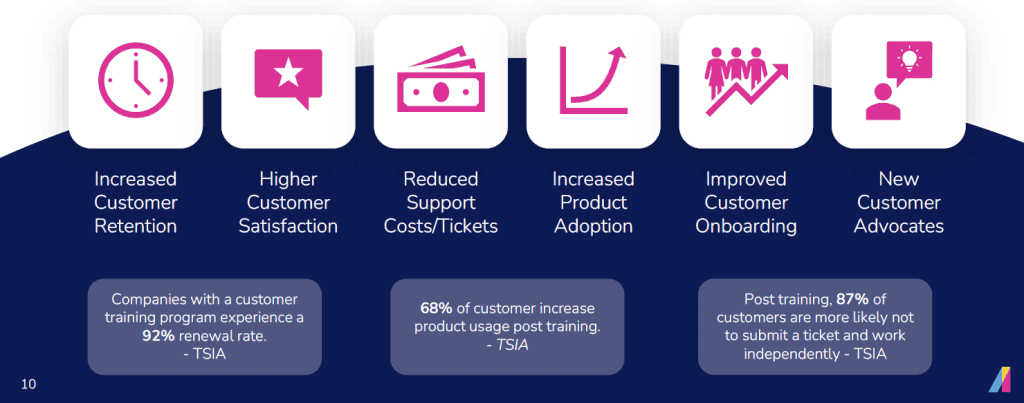
When your customers are trained and educated on how to get the most value from your product or service, they are 92% more likely to renew, according to TSIA. Your organization will also experience:
But don’t stop at how to use your product. Focus also on the ‘why’ behind the usage.
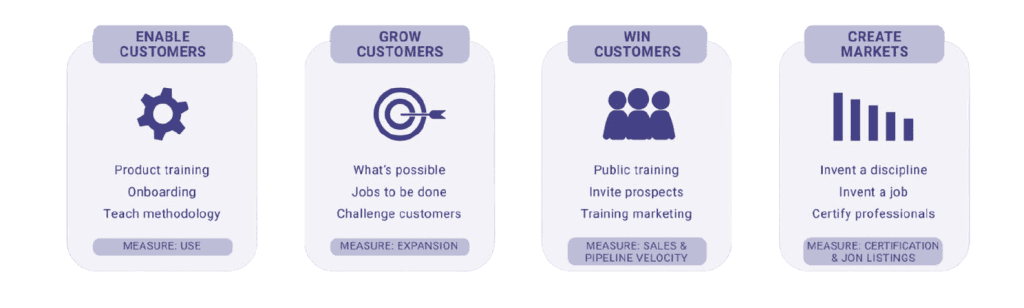
Here, Darren referred to the customer education framework created by Service Rocket. It’s a simple, four-step framework that can help any organization get started with creating effective training and education processes for their customers. Onboarding customers with all the technical acumen (the ‘how’) is just step one. Steps two to four are all about educating your customers so they grow and remain loyal and successful.
Key Takeaway #2: Be agile and iterate throughout.
There isn’t a one-size-fits-all approach to customer education. Every organization is different based on their customer’s needs, the products and services they offer, and what their goals are.
Before launching a customer education program, goals need to be set internally. Begin with the end in mind. Aligning the goals with the metrics of success from start to finish will set any organization up for success. From there, it’s important to allocate content, teams, and resources to the program. Your internal tools and teams allocated to this will help design most, if not all, of the program.
Once this is done, it’s time to launch. A strong communication plan is key for launching an education and training program for your customers. Remember, this is for them and their benefit. Communicate this as you see fit.
Key Takeaway #3: Measure business impact as well a not just program usage.
Course completion rates, webinar attendance, and content usage are great ways to start tracking the impact your education program is having on your customers. However, Darren’s team also looks at business impact, with measurement of support tickets and whether certain subjects covered in their programs are being asked about at a lower rate.
Surveys sent to customers who participate in your training and education programs are also a great way to get real-time feedback on the value your customers are seeing. Feedback is what allows any organization to fix what isn’t working and capitalize on what is working.
Darren shared the full map of a successful customer education program in his webinar:

Got questions on starting a customer education program?
Our webinar concluded with audience questions on everything from driving engagement to the right time to invest in an LMS. Here’s what Darren said:
Q: What are some ways to drive better engagement in customer education programs?
A: Know and cater to your audience by offering an array of different ways to be trained. You can also gamify the training with badges and leaderboards. Also, reinforcing the ‘why’ behind the training as often as possible is important. To help with messaging and engagement, get your marketing and product teams are involved.
Q: How do you keep your resource library up to date when you have a product with a UI that’s constantly changing?
A: Try to find a formal process and get buy-in from all involved. You can look to AI tools that can possibly help with the automation, but before you do, make sure you have a process in place to address product changes and updates that should be included in your training.
Q: What is your favorite method for delivering educational resources?
A: It all depends on your business model. Understand your broad customer base, be creative, and don’t just rely on knowledge base articles. It’s also worth speaking to your CSMs and asking if they find your education content helpful. They can help you identify the gaps, and generate ideas.
Q: At what stage/size of a company should you invest in an LMS, instead of just doing live trainings for your customers?
A: It depends on your use cases and what objectives you have for your customer base. Look at your data, talk to internal teams, and figure out what the current needs of your customers are.


