Quick Summary: Churn in 2025 looks different. The biggest risks are often subtle, strategic, and often outside your product’s control. Meet “DIY”, ChurnZero’s newest Churn Monster, and get re-acquainted with five others who are especially relevant this year.
Customer churn risks in 2025 aren’t coming from where they used to. Yes, effective onboarding still matters. So does product adoption. But, in today’s economy where budgets are tight, AI is everywhere, and teams are under pressure to “do more with less”, churn is evolving.
It’s also getting harder to see churn coming, which is why we created the Churn Monsters, to help customer teams identify and stop churn before it happens. This year, we’ve added a brand-new monster to the mix: DIY.
Meet the DIY Churn Monster
Your customer isn’t unhappy. They’re just convinced they can build it themselves. One internal tool here, a quick integration there—and suddenly, your product is getting replaced by spreadsheets and scripts.

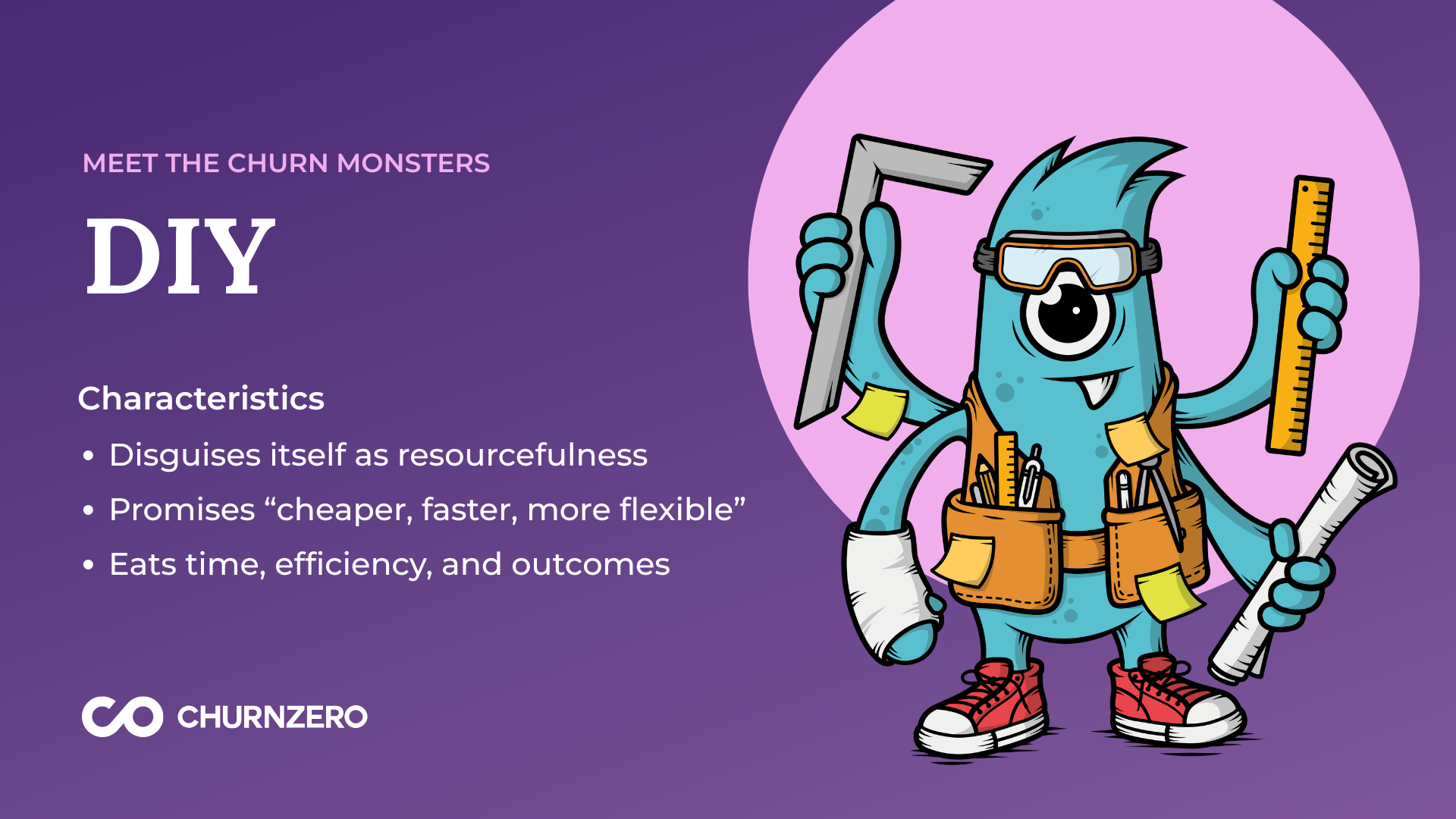
DIY is the Churn Monster that disguises itself as resourcefulness. It whispers that “building in-house” is cheaper, faster, more flexible. But behind the scenes? It’s eating time, efficiency, and long-term outcomes.
Why it’s a 2025 churn risk: With low-code and AI tools booming, more companies believe they can replace SaaS with internal builds. That DIY approach often backfires—creating clunky systems and higher support costs in the long run.
What CS can do: Help customers compare true total cost of ownership (TCO). Use platform data to highlight inefficiencies. Share stories of teams who tried DIY and came back to purpose-built platforms.
Which other Churn Monsters are on the loose in 2025?
DIY isn’t the only urgent customer churn risk we’re seeing this year. Here are five other Churn Monsters to be on the lookout for through the second half of 2025.
1: Headwinds
Your customer is facing pressure from every direction—shrinking teams, slowing revenue, frozen budgets. And there’s no clear end in sight.

Headwinds is the Churn Monster that moves in when market conditions stall progress. It doesn’t mean your customer is unhappy—it means they’re overwhelmed.
Why it’s a 2025 churn risk: Headwinds often follow larger disruptions (think: banking crises, VC pullbacks). Even solid accounts may pause initiatives or delay outcomes, making it harder for CS to show impact.
What your CS team can do: Don’t over-engineer the solution. Break big goals into small wins. Keep expectations realistic—and engagement high—even when growth is on hold.
2: Cash-Strapped
The customer still believes in your product—but finance just sent a mandate: cut 20%. Suddenly, even strong relationships are under pressure.
Cash-Strapped is the Churn Monster that turns loyalty into liability. When budgets collapse, great products still get cut.
Why it’s a 2025 churn risk: Economic uncertainty continues. SaaS buyers are being asked to prove ROI early, often, and convincingly—especially mid-market companies balancing growth with cost control.
What your CS team can do: Help your champion build a bulletproof business case. Provide usage data, ROI calculators, and flexible renewal options to keep the deal alive.
3: Disengaged
Your customer hasn’t canceled. But they’ve stopped logging in, stopped replying, and stopped seeing value. You’re on the contract; you’re just not in the workflow.

Disengaged is the Churn Monster that hides in plain sight. It doesn’t yell. It fades.
Why it’s a 2025 churn risk: In the age of vendor rationalization, exec teams are asking: “What are we actually using?” If your platform isn’t active and visible, it’s likely on the chopping block.
What your CS team can do: Track usage closely. Automate alerts. Reignite the relationship with new features, fresh value, and quick wins that feel personal and relevant.
4: Championless
Your best contact left. You didn’t know until their email bounced. Now, the renewal is in someone else’s hands—and they don’t know who you are.
Championless is the Churn Monster that emerges when relationships disappear. Your product hasn’t changed, but your internal support just vanished.
Why it’s a 2025 churn risk: Layoffs and reorgs continue to reshape SaaS orgs. Without visibility into champion churn, CS teams lose influence—and sometimes the account.
What your CS team can do: Use tools to detect role changes and usage drop-offs. Proactively build multiple champions inside each account. And be ready to re-sell internally—fast.
5: Ghosted
They didn’t churn. They just stopped showing up. No replies. No logins. No updates. One day, your customer’s gone—and you don’t know why.

Ghosted is the Churn Monster that feeds on silence. There’s no complaint. No warning. Just a slow fade-out while your product slips into the background.
Why it’s a 2025 churn risk: With teams stretched thin, inboxes overflowing, and buying committees expanding, many customers deprioritize vendors without ever saying so. You didn’t lose the deal—you just got forgotten.
What your CS team can do: Stay proactive. Vary your touchpoints. Use in-app messaging, not just email. Send something personal if needed. Don’t wait to be invited back into the conversation—earn your way in.
Want to beat the Churn Monsters? Get ahead of them.
The biggest customer churn risks in 2025 aren’t just about onboarding or support tickets; they’re about context. The macro factors. The quiet fades. The well-meaning workarounds. That’s what makes these six churn monsters so dangerous.
But once you know what to look for, you can get ahead of the risk and strengthen your customer base, even in a tough market.
Learn how to recognize each churn monster, arm your CS team with retention strategies that work, and spot the warning signs before it’s too late in ChurnZero’s Churn Monster Playbook: your free guide to spotting and mitigating the causes of customer churn.