Quick summary: Without clear CS-sales rules of engagement, your CSMs are navigating commercial moments without a framework to stand confidently on. Here’s how to fix it.
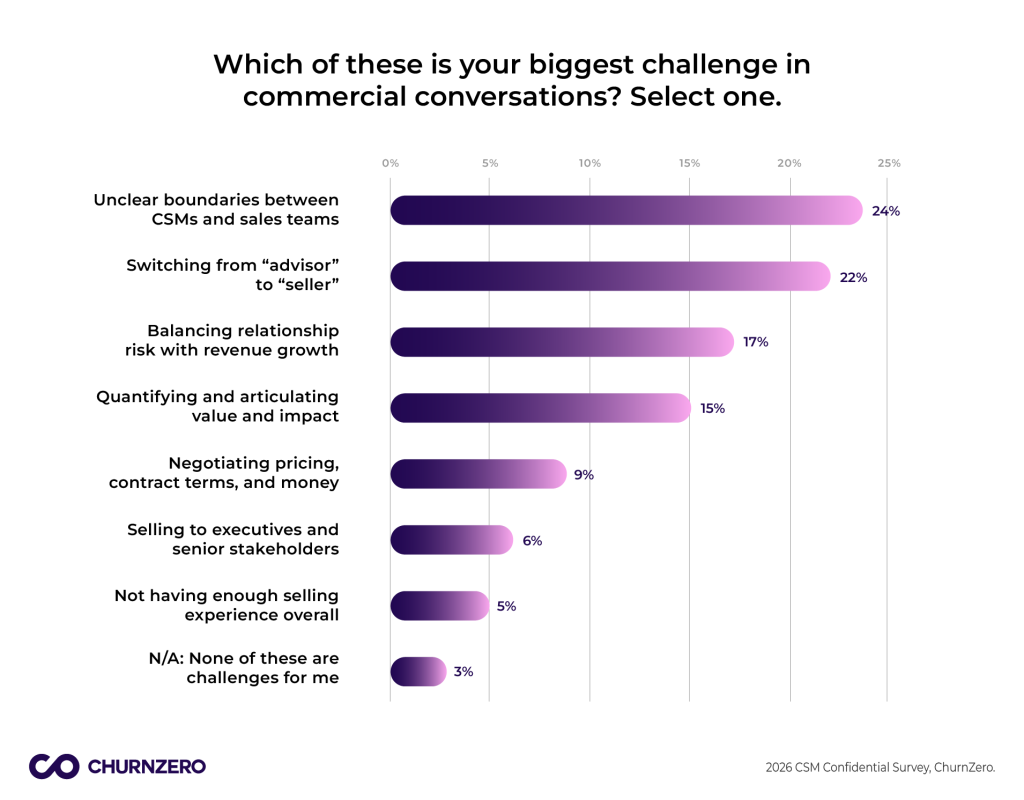
In this year’s CSM Confidential Survey, we asked CSMs to identify their single biggest challenge in commercial conversations. 24% pointed to unclear boundaries between CS and sales teams. It’s the top answer, ahead of every skill or experience deficit on the list.
Elsewhere in our survey, one-third of CSMs said that clearer CS sales rules of engagement would help them feel more revenue-ready (LINK TO BLOG 1) overall.
It seems that one of the biggest obstacles your CSMs face in owning revenue isn’t something a training program can fix.
If your CSMs are struggling due to having to make split-second judgment calls about their roles and commercial authority in the middle of QBRs, or whenever customers signal interest in expansion, it’s a structural problem that belongs to you as their leader.
Why CS-sales alignment breaks down.
CS and sales grew up as separate functions with separate incentive structures and definitions of what they own. When CS gained revenue responsibility, those structures often weren’t resolved, leaving an unclear boundary for both teams to interpret on their own.
The downstream effect is predictable. “Left to CSMs and account executives, each group will come up with a different plan,” says report contributor David Ellin of Winning by Design.
“The company ends up with no standard operating process, and no clear RACI on which to build KPIs and comp plans.”
When CS takes on revenue targets without a corresponding shift in how commissions and accountability are structured, the conditions for friction are baked in. In the worst cases, individual AEs and CSMs end up negotiating boundaries account by account, creating as many versions of the rules as you have customer-facing employees.
How to establish CS-sales rules of engagement.
A CSM who doesn’t know where their lane ends brings that hesitance to every commercial conversation, with a knock-on effect on commercial confidence and ultimately on NRR.
Because the boundary problem tends to compound with any skills problems present, resolving the structural issue first is the key to unlocking commercial confidence quickly.
The good news is that you can resolve it almost entirely as the leadership level—as long as both sides are willing to sit down, define what they own, and formalize it.
1. Get aligned at the leadership level.
“Unclear rules of engagement between CS and sales are a leadership failure,” says Rod Cherkas of HelloCCO. “CS leaders and sales leaders should address the issue in three steps.”
“One: hold a dedicated alignment conversation to define who owns renewals, expansions, and introductory conversations by customer segment and deal size,” says Rod.
The emphasis on segmentation and deal size matters. “Who owns the renewal” has a different answer for a $50k account than for a $500k strategic account, so ask in both instances to avoid creating confusion down the line.
“Two: document and communicate those rules to both teams in a simple, accessible format,” says Rod.
For illustration, here’s what that might look like for mid-market accounts:
- CSMs own the renewal conversation.
- CSMs can initiate expansion discussions up to a defined ARR threshold.
- Anything above that threshold triggers a joint process with a named AE, with credit shared according to a pre-agreed split.
“Three,” says Rod, “treat edge cases and account-specific conflicts as opportunities to refine and update the rules, rather than one-off escalations to manage.”
2. Align compensation to accountability.
If you don’t support your rules of engagement without a corresponding compensation design, they won’t hold.
“Compensation and incentives drive behaviors for sales, and should also do the same for CS teams,” says Parul Bhandari of CustomerXSuccess. “Without a clear comp plan tied to CS revenue, CS is led to feel less important and sales is left to view them as such.”
If CSMs are responsible for expansion revenue but aren’t measured or rewarded for it, the responsibility feels like extra work, because it is. The gap signals to everyone—CSM, sales team, and customer—that the CSM’s commercial accountability isn’t real.
3. Hold managers accountable for making it work.
Finally, your rules of engagement and compensation design require active management reinforcement to hold. Even the most carefully designed rules erode quickly without it.
“You can have the best structure and perfect compensation plans,” says Kristen Hayer of The Success League, “but if the leaders of both teams aren’t bought in, your structure will be disregarded and won’t work.
“Managers need to be trained to be good managers, should be bought into any structure that’s developed, and must hold their teams accountable for not overstepping their roles. Managers who aren’t aligned, or who have weak management skills, are a big source of sales-CS friction.”
Don’t neglect to make this management reinforcement cross-functional. For example, setting up a quarterly CS-sales manager sync, with a standing agenda item for edge cases and boundary conflicts, creates the feedback loop that keeps rules top-of-mind.
Additionally, when CSMs and AEs both know their managers will discuss last quarter’s friction points, they’ll be more inclined to work within the structure rather than around it.
4. Start now. This problem doesn’t solve itself.
Unclear CS-sales boundaries persist because fixing them requires initiative and hard work.
It takes a cross-functional leadership conversation, a compensation design review, and management accountability held by leaders on both sides.
And—because none of these things are within your CSMs’ power to do—the responsibility rests with you.
Your CSMs are commercially motivated and ready to perform. Now, give them the structural clarity to act on that confidence. As well as building a strong renewal and expansion pipeline, it could be one of your most impactful leadership moves ever.
Find out more about the 2026 CSM Confidential Report
The 2026 CSM Confidential Report is an annual survey designed to help customer leaders build revenue-ready CS teams. Download this year’s report to explore the skills, training, and organizational clarity that turn revenue ownership into revenue performance.