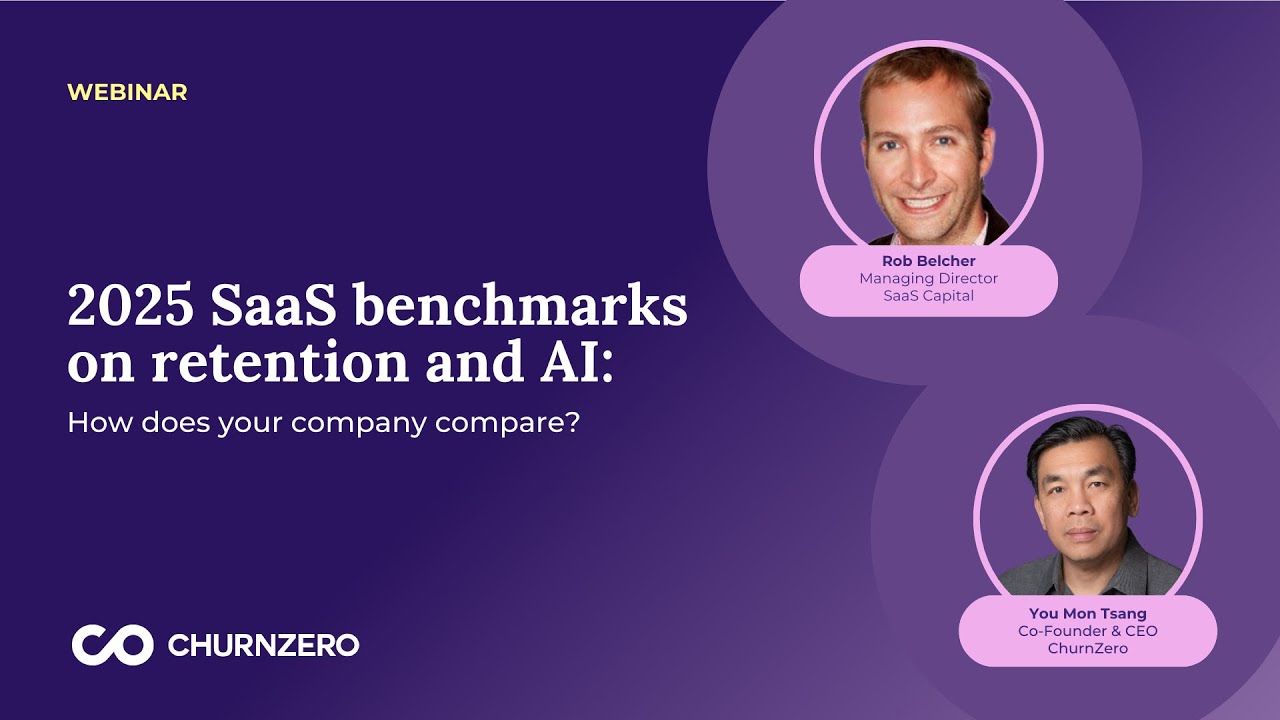
2025 SaaS benchmarks on retention and AI: How does your company compare?
About this Webinar
Macroeconomic uncertainty and the proliferation of artificial intelligence are the two market drivers most impacting SaaS at the moment. Revenue retention is more important than ever, and it is not clear how important AI is or will be.
Join us for our annual webinar with SaaS Capital, where they will share findings from their 14th annual B2B SaaS benchmarking survey. This is the industry’s most comprehensive dataset on SaaS metrics, including net revenue retention, gross retention, and for the first time, detailed insights into how companies are adopting and scaling AI in their products as well as in their own experiences.
We’ll explore how AI adoption, evolving go-to-market strategies, and shifting customer expectations are influencing retention. You’ll walk away with data and context to shape your growth strategy in 2025.
Key takeaways:
-
The latest 2025 retention benchmarks, including net revenue retention and gross retention, with insights on how your company compares
-
Brand new data on how companies are using AI in day-to-day operations, how it is being integrated into products, and how investment levels are expected to change in 2025
-
How today’s top CROs are leveraging customer success to drive expansion, align post-sale teams, and turn retention data into revenue
Full Transcript: 2025 SaaS Capital Benchmark
Webinar Introduction and Speaker Overview
You Mon: All right. People coming in. Lots of attendees. By the way, just for those of you, you know, who are attending some of you are from the SaaS sort of CS customer success side, and some of you are from the finance side. So it’s a good mix of folks.
We’ll try to bridge the gap on our conversation today. In fact, let’s go ahead and get started. But before we get super started, I just wanna remind everyone, we will be recording, we are recording today’s session, and there will be a link both to the recording and you’ll also get a PDF of these slides.
And we’ll do this I think in about 24 hours. If you take notes, great. If you just wanna focus on what’s on the screen you’ll get the transcript, a link, as well as the PDF.
So I want to just introduce Rob Belcher. Rob is the managing director of SaaS Capital, and I’m You Mon Tsang. I’m the CEO and co-founder of ChurnZero. We are at, I think this is the seventh year we’re doing this, Rob?
Rob: I was trying to remember actually where we were. I knew it was more than five. Okay… I could’ve heard six or eight and been okay with it.
Seven sounds great. Yeah.
You Mon: By the way, look, all to say that it’s really great for us to have this really conversation.
About SaaS Capital and the Benchmark Survey
Let me ask you, actually, let’s talk a little bit about what SaaS Capital does first. So Rob, give us a sense of SaaS Capital, what you do, what the company does, and really the perspective you’re bringing to the topic today which is about benchmarking, right? Benchmark data. So why don’t you give us a quick insight.
Rob: Yeah, sure thing. And that’s the webinar is related. That’s why we do these kind of things. So that’s a good point, good starting point. We’re a lender. We provide growth debt to B2B SaaS companies. We lend between $2 and $15 million to B2B software companies with 3 million of ARR and up. We are geographically constrained as a lender – companies have to be banked and registered in the US, UK, Canada, or Ireland.
And the way to think about us is growth debt. You’re an up-and-running existing business. Things are going great. You want to raise some money to continue the growth or invest in maybe AI, we’ll talk about or something else sales and marketing, and you could go raise equity but maybe avoid dilution and borrow the money instead.
So that’s the way to think about us. We work with venture-backed companies. We work with bootstrapped companies. It just depends on the situation. And so as part of that, we only work with B2B software companies. And so we’re hyper-focused on that, and we work with them day in, day out, both existing portfolio companies and prospects.
And so their growth rate, their retention rate, their burn rate, CAC, payback period, all this stuff is very important to them and us. It’s what we analyze when we’re both doing an investment and then as companies grow and maybe need more financing or whatever. And so we run a survey every year where we reach out to our database.
It’s not just portfolio companies, it’s the whole universe of folks that we interact with, and we typically get around 1,200 to 15 or 1,600 folks respond. All stages from pre-revenue all the way up to several hundred million dollars of ARR and they provide… it’s anonymous but they, it’s… as good a data as you can get on private company metrics. And so very excited to be here for the seventh year with You Mon, thanks for having us to talk about mostly retention, benchmarks but for the first year, we asked some questions around AI, so it’ll be really exciting to share those.
I guess, quick comment, if you don’t mind, You Mon I think we work best and this presentation works best conversationally, so if you all have questions along the way there’s a Q&A button. Go ahead and hit that, and we may get to it. We may keep rolling and then get to it at the end, but if it’s relevant to the slide we’re on, happy to try and weave it in.
You Mon: Absolutely. And I’ll watch out for that, Rob. And by the way, just to put a pin in that I’ve, I spent many years as an entrepreneur starting companies and, there’s equity financing and then there’s debt financing. Rob is in the business of debt financing. If like it’s actually a really good way to go, gives you lots of flexibility.
It’s non-dilutive, right? Employees get to maintain a higher percentage of the company ownership, so really a great way to go. And our two companies started on this endeavor together because we share similar types of customers. We are also B2B subscription companies.
Rob: Yeah. Share a little bit more about ChurnZero. Yeah. I know a number of the attendees came from sort of our invite. We sent an email out they may not… be familiar, so yeah.
Why Revenue Retention Matters
You Mon: In fact, in many ways if you look at the pre-revenue… actually we don’t do pre-revenue. We basically focus on folks who have product market fit.
So we sell a customer success platform to B2B subscription companies. So if you are managing customers and you need, you worry about their onboarding, you worry about their adoption, you worry about the renewal and expansion, and need a system to manage them through that customer life cycle, we are the ones for you, right?
So it’s really a combination of data integration, workflow, reporting and automation to help your customers have the best customer experience. And we share a lot of similar types of customers and, our customers are really hyper-focused on revenue retention.
And Rob, I imagine, over the years like the focus on retention’s only gone up as an important metric for you to see if your customer’s going to be successful or not. Is that a fair statement?
Rob: Yeah, I’d say VC… retention is very important for VCs too, but for VCs and private equity firms, growth rate probably comes first. ‘Cause they’re doing value creation investing, right?
We’re doing value preservation. As a lender, we wanna get paid back, so retention is number one for us,
You Mon: Awesome.
Gross and Net Revenue Retention: Key Definitions
Rob: So yeah, to that point quick definitions. A lot of the first several slides talk about net and gross retention. These have gotten to be pretty standard across industry. When we first started doing this, everyone had a different way of doing it.
So good news is it’s standardized some. Gross retention is no upsells, no cross-sells, no price increases. The best you could possibly do year over year on gross retention is 100%. Net retention includes all of those things, upsells, cross-sells, feature upgrades, all that stuff, inflationary adjustments, whatever.
And so that can be infinite. That can be much higher than 100%. So those are two things that are important. And we always do year over year. Some folks do month to month or whatever, but all of these calculations are, what did your customers do for you a year ago, what’d they do today, and compare those two.
So that’s the bottom bit.
2025 SaaS Growth Rate Benchmarks
Okay, all that said about retention, let’s start with growth rates. So here we are. I actually wanted to start with growth rates because I think the story is really important this year from a macro perspective. It is pretty interesting to see both, practically with our portfolio companies and prospects and then in the data, that growth rates really are coming down year over year.
There was definitely a post-COVID bump. We saw the sort of digital transformation, the push to Zoom and webinars and remote work. SaaS boomed, right? Both actual growth rate usage, all that stuff, as well as stock prices and investments and all of that kind of thing. What’s been fascinating to watch is the vibe has been that growth rates were coming down, and then here in this chart, which shows the last five years, you can see the growth rates actually have truly from the data, been coming down, and are now for many of these segments of companies by scale below 2019 levels.
So they’re actually growing slower than they were pre-COVID. So the bump is over and then some is the highlight here. And it’ll flow through to the rest of the story on retention as well.
You Mon: Yeah. No, we’re, we see that as well among our customer base. But my question to you, Rob, is
Look, growth has slowed for all the reasons that I think we all understand. But many of the folks I still talk to still feel the pressure of growth, right? So maybe my question to you is, have investors’ expectations of growth are now in line with what’s actually happening in a marketplace where growth is harder?
Like, where do you think… ’cause investors really want growth, right? We all they pray on the altar of growth. Where do you think, what’s their mindset? Has that changed the last few years?
Rob: SaaS is growth. That’s been the story for 15 years… I think that is still the case.
We still see forecasts and plans that call for 30%, 40% growth that often call for more growth than there is today, which is raises eyebrows. But I do think that everyone is being pragmatic, and that growth expectation, which is about the same as it’s been for the last five years, even though we can see the data growth rates have slowed.
Thing that has changed is the expectation around profitability. And so there’s an honest reflection that these companies should become more profitable as growth rates come down. So that’s where we’ve seen the change. Whereas there’s maybe some unrealistic optimism around growth, but some realism around spending and cutting costs because the equity markets are less active than they have been,
You Mon: That is this new thing of, cost-effective growth or, not growth at all costs. Focus on CAC and all that. I do have a quick question from the audience. Daniel asks “Are these growth rates based on revenue or booked revenue, which could be lumpier, right? With multi-years and things like that.”
Rob: Good question. Been doing this survey for 15 years, so I have the questions just, and the metrics and everything dialed in. Good to check me on the definitions. For one, ARR, annual recurring revenue, and the way we ask this question is, what is your annual recurring revenue at the end of December of 2024, and what was it at the end of December 2023?
So it’s year over year ARR… just divided by each other. And, A quick point. You can obviously see it, but it’s this has been the trend forever, and it’s just an interesting one is and your board should be aware of this, that growth rates do come down as companies grow simply because it’s harder to maintain the same growth rate over a larger base.
That’s my main bullet here at the top, but we got right into the macro trend, but just wanted to share that data point.
You Mon: Yeah, the consistency is actually pretty interesting here, right? That is actually, steady now. Okay. Makes sense.
Gross and Net Revenue Retention Benchmarks by ACV
Rob: All right. So here, now we’re getting into the core retention rates. ACV we like to spread retention by ACV more than any other. We do it a couple different ways, and you’ll see those coming up. But splitting companies by ACV, those segments are more similarly structured.
They’ll have similar support teams, similar sales organizations maybe even the same kind of size R&D, et cetera. So we like to segment those. We’ve got a couple different segments here. Very large, so companies selling contracts for more than 250K all the way down to products that are less than 1,000 a month, couple hundred a month.
And so the headline is that gross retention is actually pretty stable across all of these, whereas net retention tends to have a little bit more variability, and that’s different than what it’s been in the past. We’ve in the past seen net retention have… very stable and gross retention actually go up with ACV.
Here this year, it’s very flat from a gross retention standpoint, other than obviously the very large ones. So not really sure what’s happening there, but that’s… it’s a bit… it’s a little more convoluted this year. But the headline is that it’s the median number’s up around 90% for gross retention, and it’s around 100% for net retention, and those numbers have been pretty stable.
It’s a little higher than it has been in the past. Granted, we’re talking about two, three percentage points. But that’s been what the numbers have been forever and ever since we’ve been doing this, You Mon.
You Mon: Yeah, what’s impressive is 90% GRR, right? Especially for low ACVs, right? So annual contract value, for a 12K.
Generally, you’re selling maybe to smaller companies, and keeping them at a 90% clip is actually quite impressive. I would have expected the green bar to slope up into the right as well. I guess that’s what you’re saying, right? It’s flatter… Yeah, virtually it has
than it has in the past. Yeah. Again,
Rob: Small… Yeah… small numbers, but yeah.
You Mon: Yeah.
Rob: So it’s, I think the NRR for the small ACV is a very clear tell that it’s… there’s not a lot of upsell, right? It’s more probably month-to-month credit card swipes. You don’t have as maybe a deeper relationship, harder to get that upsell.
But I would have expect… I agree, and it’s interesting that this year that it’s not as obvious.
You Mon: Yeah, in, among the customers I talked to the… a big change over the last few years is the difference between the blue line and the green line is narrower in the last few years.
In other words, your ability to drive expansion inside your customer base is harder, has been much harder for those companies that I’ve, I have talked to. And a lot of that is around like seat licenses, right? If you’re in the, you sell to SaaS folks a lot of business models are seat-based, and folks are not hiring as quickly as they used to.
They’re not, if your customers are not growing, they’re not buying more seats, right? So therefore, the expansion isn’t quite there. So the difference between the blue line and the green line from what I hear has actually been much narrower than it has been in previous years.
Rob: Yeah. This data shows about the same difference, but I totally agree.
I think the last five years especially has been a bit of a whirlwind with inflation. Some of our portfolio companies didn’t even have inflation adjustments in their contracts and had to… hustle and go back and add them and stuff like that. And then a push for usage-based pricing. The revenue model’s been bouncing around.
So I don’t, I totally, I think what you shared is totally fair, and I, it’s been a bit of, bit wild.
You Mon: Yeah. Andrew
Rob: Actually But at the median level, it’s pretty stable.
You Mon: So Andrew asks “Can you attribute some of this NRR to price increases or upsells?” I think the answer is both, right? You don’t, I don’t think you’d know exactly.
You don’t ask that question specifically, but both of those count towards NRR, for sure. Yeah. Yep. Yeah. Price increases are part of that, for sure. They’re not part of the green bars. That gross retention does not include price increases, but blue does
Awesome. And then I actually, let me ask one more question while we’re here. Sam, hypothesis of why the furthest out more than 250K is 4% higher in NRR than the 100 to 250K. Like my… generally, enterprise has higher NRR, there’s more to upsell, maybe you’re landing and expanding.
This is generally what I see. Do you have a hypothesis on why it goes up and to the right…
Rob: Yeah… ARR? I think This is for… Was he asking specifically NRR?
You Mon: Or actually oh, actually he’s asking GRR. I take it back. Sam’s asking…
Rob: Yeah. So GRR is the one I think actually has the biggest impact, because probably those contracts, the biggest ones, are maybe multi-year.
And so just by the nature of that, the number probably is gonna be higher. And so we’ll talk about multi-year here later as well, but that’s probably my guess is the larger ones are multi-year. It’s interesting to see the NRR on that chart though as high as it is, because I think of the large ones as multi-year, less opportunities to upsell.
SaaS Retention Trends Since 2019
So I was actually surprised to see the larger blue line in the previous chart too. Just that’s my only thought is multi-year for bigger contracts. This is another time series one. It’s, like I said, it’s been an interesting five years from 2019 and then through COVID.
So got some historical data here for you. You can see with growth rates, retention rates tended… this is a kind of a noisy… Both of these are fairly noisy charts, but the thrust of it is that light growth rates and somewhat driven by growth rates or sorry, the retention drove the growth rate increase, as you can see NRR increased right after COVID, and it’s steadily been declining also.
Again, the numbers are pretty small. We’re, this whole chart is a spectrum of about 15%, but you can see there, there’s some trend there. These are medians over 1,000 companies. So I think you can take the signal even though the numbers are fairly small, changing by one percentage points per year.
You Mon: The thing that stuck out to me here, Rob, is I’m gonna call it the mid-market, right? Yeah. So these are the middle, say from 25K ACV up to 250K ACV. Let’s call… I’m just gonna call that the mid-market. You’re selling it to companies of a certain size. That one seems to have suffered more over the last few years than the SMB on as well as the enterprise.
What… Any thoughts on why? I have some thoughts. Any thoughts, Rob, on why you think the mid-market has suffered a little bit more?
Rob: The only thing, I don’t have a great idea, love to hear yours. But the thing I would respond to that is it also, at least on the NRR side, had the biggest jump in NRR.
So I wonder if it was… It’s the most flexible and the most nimble size. Annual contracts or maybe quarterly or even month to month maybe, and so they can adjust them for COVID, for increased sales, for digital transformation that happened in 2021 inflation, but then also the whiplash back is more extreme for those as well because of those same reasons.
Whereas the smaller ones are steady as she goes with lower retention, and then the larger ones are steady as she goes with much higher retention. That’s only my thought on that. It’s a great question.
You Mon: Yeah. The other thought I’ve heard is, If you are, if you’re a mid-market company in the subscription business space, you probably came of age during low interest rates.
That’s when you really grew, and so you had a lot of capital to invest, right? And really get the sale out there and really invest in customer success. And then you’re the one that also got hit the hardest, right? You probably grew too quickly, and so therefore you had, to divest a little bit.
So in this sort of up and down of the marketplace, I’ve heard that mid-market companies have really got the most whiplash,… of everyone. So anyway, just the, just a theory. Everyone’s mileage will differ, but, that’s one theory.
Rob: Would love… That is a great comment, and we should pin that for the AI conversation later on, because… Yeah
I wonder if that has some sort of the zerp or, like, when you raised money, when you had access to capital… may have an impact on the AI numbers we look at later.
You Mon: Actually, Connor has a good comment. He says, “The larger the investment of a company,” so the more they’re paying, right?
So up, to the right, “the more resources they may place on the change management, which then can make a SaaS product stickier,” right? In other words more likelihood of success.
Rob: Yeah.
You Mon: You believe
Rob: That? You think that… For sure. I think that goes with the sort of multi-year sale. It’s a longer sales cycle.
There’s this, the companies are investing a lot in that platform purchase. Totally agree, 100%.
You Mon: All right.
Gross and Net Revenue Retention Quartile Benchmarks
Rob: Okay. So medians are all well and good, but when we do benchmarking, we like to know how close we are to the best or the worst. So this is a quartile chart for retention. Left you’ve got gross revenue retention and right you’ve got net revenue retention.
And so the first thing to call out or the main thrust of this slide, these two slides, is that gross retention is capped, right? You can only get 100%, so we’re not really comparing ourselves to the best. The median is pretty useful. It’s a pretty high median. I’d agree with You Mon. I think maybe there’s some optimistic…
this is all self-entered data. There might be some self-optimistic retention data entry here. 90% retention for a less than 12K annual contract is, seems pretty high. But the point is that’s the median. There’s not a lot of room between that and 100%. So the real key is how do I compare to the lower performing companies?
And so the 25th percentile companies are around 85%, so that’s something to keep in mind. Obviously, the floor drops way out below that to the sort of lowest entry. But that’s a good target for you, is you wanna stay, you wanna try and stay definitely north of 80. 85%’s a good target benchmark.
And then on the net retention side, it’s the opposite, right? It’s the sky’s the limit. And so now here we actually wanna compare ourselves to the 75th percentile, which is around 110, 115. And so that’s something to consider, that if you’re north of there, you’re in the top 25% depending on your ACV.
And again, shows that the smallest ACV is pretty tough to upsell. But if you’re mid-market or enterprise, there’s good opportunity there. The really interesting one though is the 102 as the 25th percentile for the very large companies. Yeah. That’s a pretty high benchmark for the lowest performing company there.
You Mon: It really is. Actually, that’s pretty impressive, right? Yeah. So yeah, even 25%…
Rob: Yeah…
You Mon: Performing folks are growing just on their customer base.
Rob: But also… By the
You Mon: Way, for those…
Rob: Probably the narrowest. Sorry, yeah, probably also the narrowest of the three quartiles too. It’s the…
You Mon: Yeah, that actually also is surprising, honestly.
Yeah.
Rob: I would think there’d actually be a lot more upside to that one possibly. Yeah. So
You Mon: Yeah. For those of you in the audience, I know a lot of you are here because you want to see how you stand against your peers. This is the chart for that, right? So peer deeply into this, take a screenshot when the PDF comes out, stare at this.
Give yourself a sense of where you stand, right? You can plot yourself right here and see, where you can actually do better. So it’s a great chart for folks.
Rob: And then take the survey next year so you’re in the data set.
You Mon: And take the survey next year.
Absolutely.
Retention Benchmarks by Company ARR
Rob: Great. We’re getting close to the end on the retention data, but we… Like I said we like… our primary way of looking at retention is by ACV, but ARR is important too. It’s interesting. It’s the number one metric for most folks, so it’s an important one to look at. The fascinating one for us, and this has been the case for many years, is that gross retention decreases as companies grow.
A little counterintuitive but the way we’ve explained this forever is that it just takes a little bit of time for customers to churn out. They may be willing to give you a try for two, three years, and then they’re gonna cut bait. But, so in the meantime, you’ve overinflated or overstating your GRR before it really settles in at that 90% that we showed in the median earlier.
And then the interesting one also is that NRR doesn’t seem to be impacted too much by company size. Maybe it gets a little better as you grow. You become a little more confident upselling, asking for more money. Early on you’re, you may just be glad to get the sale, not as willing to ask for more on the renewal.
It looks like it increases a little bit, but again, it’s one, 2%. Yeah, it’s interesting. When I saw this, Rob, I was a little bit this is counterintuitive, right? I would’ve guessed that GRR is worse at first, right? You don’t have product market fit. But I think your explanations are a good one, right?
You Mon: Especially bigger companies that go outside their ideal customer profile, right? They go outside their ICP, right? They start fishing, they’re looking for new markets and they’re just, they’re trying to expand to get, the next 20% of growth, next 30% of growth. They’re finding that the new waters are a little choppier, right?
This is essentially what you’re saying. And we see that with portfolio companies. It’s, we’re launching into a new geography… or a new whatever, and… retention’s not as good there.
Yeah. New industry. You’re, it’s, yeah, you might as well almost think about yourself as really trying to find product market fit again.
Yeah. A little bit, yeah.
Bootstrapped vs. Equity-Backed SaaS Retention
Rob: A couple other ways to segment the data that’s pretty interesting, especially this year, this was a big change from literally the last 15 years of looking at data like this, is that if you split retention by bootstrap-based companies versus ones who have raised equity historically, net retention was always higher for the VC-backed companies. Gross retention has always been higher for bootstrapped companies.
We’ll talk about that in a second. But this year, for the first time, bootstrapped companies had higher… And again, the numbers are small, but it’s three percentage points, so I don’t know, it’s meaningful. Yeah. And normally it’s flipped. Normally it’s something like 105 to 99 or something like that.
Here it’s 104 to 101. Pretty interesting, and I wonder if this doesn’t also call back to the capital markets and just tighter equity out there, not as free-flowing cash, not… historically we assumed that VC-backed companies had more cash to invest in sales, marketing, upsells, big CS groups, and now wondering if maybe that’s drier and those groups are shrinking, and the efforts on upsells are smaller, more of a focus on new bookings, like we talked about at the onset.
Don’t know, but this was an interesting reversal from history. See, to me, this makes sense, and the reason why it makes sense is I do think for equity-backed companies, in general you have more resources to invest, right? And so you’re gonna put yourself out there, you’re going to land a lots of, try to…
You Mon: New customers. You’re gonna really focus on brand earlier. So your ICP may not be perfect, right? Whereas bootstrap you really have no choice, right? You know. You are spending the money that you’re bringing in. It makes sense to me that if you’re bootstrapped, you’re gonna have a tighter customer profile.
You’re going to, have a better fit, right? You’re not gonna get these accidental customers that, you have a huge sales force going out and then just landing all kinds of crazy customers. Which will help you in bookings, but then will hurt your own retention.
Rob: Yeah. I think we agree, but I think that’s the story… this has been our thought historically, is that’s the story for gross retention… is you’re probably an entrepreneur who started in an industry. This is the… Yeah… at least the story we see, is “I was a physician, and now I’m starting a, health IT company that solves some need that I saw.” So their ICP is super narrow and super strong, and the product fit is really good.
This also ties into the chart on the right, the vertical. Vertical versus horizontal. Vertical has usually much better retention. Yes… and so for the same reason. So you’re bootstrapped, you’re from the industry, and you have really good gross retention, but maybe you’re not as good or you don’t have as deep a bench of salespeople to go upsell, cross sell.
That was always sort of our story. I could see that same story, like you just described working for net retention also. But that was… There’s more cash, can go sell more. That was what we found… Yeah… historically. Be curious… Yeah, I,
You Mon: To watch it next year and see how it plays out in the future. The chart on the right definitely resonates with me and the folks I talk to, right? Those who are vertical. What I find is that, they probably find it harder to find new logos. Like I think the new logo one is a little harder, takes a little longer, but once they get them it’s a little… nothing’s easy, but they tend to keep them…
Rob: Yeah
You Mon: For longer,
How Net Revenue Retention Drives SaaS Growth
Rob: Yeah. Horizontally you’ve got to diversify across all these different industries. Your product has to be one size fits all. Harder to maintain, for sure. I think this is the last slide on retention, and it’s pretty cool. So we’ve… This is held for a couple years.
We’ve been doing this analysis for a number of years, and it’s been about the same or at least a similar shape and story along those past couple years. And this is that… So the X-axis here is net revenue retention. It’s buckets of net retention by 10 percentage points below 90, 90 to 100, 110– 100 to 110, et cetera. And then we cross-reference that with growth rate.
And the really interesting thing is, and it… This speaks to the SaaS compounding story and how SaaS compounds and how it is a bit of a flywheel, is that the higher your net retention rate is, the increasingly high your growth rate is. So the better your net retention, the better, the even more better your growth rate is, right?
And so you can see it, if you jump 10 percentage points in net retention at the lower end, you increase by five percentage points of growth rate. But then if you go 10 more points of net retention, you increase by nine percentage points for growth rate, and then by eight, and then, but then you go by 12 in that last bucket.
So it’s, the, this chart is, has held… the first year we did it, it was perfectly exponential. It was, like, 2%, 4%, 8%, 12%… something like that. It, there’s some variation, but the general story here is still the same, that it grows at an increasing rate. So it’s pretty…
You Mon: This is why…
pretty cool… this is exactly why investors love a company with a high NRR, right? Is that the growth just I mean…
Rob: Exponential…
You Mon: It is math, right? The… Yeah… the growth comes, right?
Rob: Yeah.
You Mon: And so yeah, it’s… And it’s a
Rob: Good reminder to focus on your NRR. Gross retention is key, right?
First and foremost, kind of the Hippocratic oath, first don’t lose money out the bucket or, lose water out the bucket. But then… this is the gravy for growth and for like you said, value creation.
You Mon: Yeah. This is the right… bottom line revenue retention, just huge factor on growth rate, which by the way, of course, has a huge factor on your enterprise value.
Absolutely. This is fantastic. Great to see, just year over year, how this has changed, how it still makes a lot of sense and, see what happens year over year. This year, however, there’s been a lot of AI talk, and you have some AI questions.
Is that right? So… Yeah, we
AI Adoption Benchmarks for SaaS Companies
Rob: Added AI. We tried to… Yes… we run the survey, we try to have it be, like, 15-ish questions every year. Yep. And they’re always the standard growth, retention, all this stuff. And then we always try to leave three, four, five questions for whatever the current topic is. And so we added… Yeah
some questions about AI this year.
Audience Poll: Internal AI Adoption
You Mon: Yeah. So let’s do a poll. Actually, let’s, before we actually get into the, your data, we’re, I’m gonna poll, we’re gonna poll the audience. So everyone please answer the question that’s in front of you, which is, how extensively has your organization utilized AI in its internal workflows and operations?
So internally for you to do your work how much have you’ve used AI? So we’ll keep it up for a couple of seconds. I just found out that Rob isn’t that much of an AI guy, which…
Rob: Hosts and panelists cannot vote. I was about to
You Mon: Vote. You can… you can’t vote. In planning. You cannot vote. In planning.
In planning, okay. We are not using too
Rob: Much AI in our own operations
You Mon: Yet. Okay. All right. We are all, I’m all in. Okay. Yeah AI. Look, if… AI is close to running my life, Rob it’s actually quite, it’s quite good. And it… Recipes, what to do, every, how… Writing.
It’s amazing. All right. Let’s close and see, we’ll see what the answers are. Okay. So how extensively… so 44% are the top two, which is significant or pretty much everywhere, and then 55% in planning and not yet. Probably where I expected everyone to be, actually.
Audience Poll: AI in Customer-Facing Products
So that’s interesting. That’s good. We have one more poll just to, set the table before we talk about, All right. So let’s talk about your product, your customer-facing product. So the product that you sell, the service that you sell. Let’s go ahead and put up that poll.
We’re asking about the product or service that you sell to your customers. How much AI is in that. Everything from it’s an AI product, so it’s all AI, all the way to it’s a product, but there’s no AI yet, and nor is it in planning, actually.
‘Cause there are still some products that, there, you don’t need an AI, right? Yeah. Which is totally fine.
Rob: Pure software.
You Mon: Yeah, but just to get a sense of those of you in the audience how much you are investing in AI into your own customer-facing product or service. All right.
Cory, do we have enough votes to show some information? Or let’s see. All right. 19% of you have an AI product. Oh, that’s more than I would have expected. That’s great. And then about half in planning, and then 20% not yet. So actually a major, a min, a sharp major, minority that’s AI. Yeah. Okay. All right.
Yeah. Yeah, good to know. All right.
Rob: Good.
AI Features in SaaS Products
You Mon: All right, so let’s actually go get into your survey response.
Rob: Yeah, so that… those are similar to the questions we asked, so it’s interesting to see how that compares. We did the survey in Q1, it was on 2024 performance.
Obviously, when they took the survey in January it was pretty current interesting to compare. We asked, this is the same question, “Are you using AI in your product?” The green bars down here, about 10 to 15% smaller for the very large companies, are pure AI. Like it’s just an AI product.
It’s not a whole lot. But then another 10 to 15% are building significant AI functionality or have it in their product now. And then quite a bit of companies have some features. And then what’s interesting to me is that it’s, the proliferation is the biggest with the large companies, and back to the self-entered data and the optimism they’re bigger, they have more resources, and they’ve been around longer, and so maybe they’ve been working on it for longer.
But also I wonder if the, I think there’s some maybe I’m putting too much words in the company’s mouths, but there’s so much pressure to, for AI, I wonder if they’ve just become accustomed to explaining there’s some AI in their product or not. Whereas the early stage companies are pretty honest about what they’re building and where they are.
I don’t know. That’s, maybe I’m looking too much into it. But interesting to me that this feels very upside down from how I would’ve thought. I would’ve thought all the new companies would be all in on AI, and the big stalwarts would be slow on AI adoption.
You Mon: Yeah. I would say the smallest are definitely in on AI, right?
And then it’s the middle that kind of it’s, Like less than 1 million, right? It’s… Actually… Very small… no, I take it back. No AI features, less than a million. I read that backwards. Yeah. Okay. Yeah. I mean… Yeah… it’s interesting. Like I… The question I would ask is are we all being aggressive enough with AI, right?
I just remember I’m showing my age. The dot-com boom was part of my journey, right? And it was just clear there were rocky times. There were times when you kinda that was kinda, it was a too much, the hype was too big.
There was definitely a downturn from the hype. But in the end you just had to do it. It is what it is, right? And it feels like AI is that way. I think we got over the first bump. We’re in the… we maybe, I think, got through maybe sort of the cynicism, and now it’s just stop it.
Just… anyone who’s in a gray area here, if you have some AI features, you should have significant AI features is, what the market could be saying anyway. Just this is entrepreneur me talking, Rob.
Rob: Yeah. The way I’ve been thinking about it is I’m a little, maybe I’m a little more cynical than you are.
I don’t think it’s going to be a earth-shattering change, but I think it will be everywhere. And I think it’s kinda like you said, like websites, like everybody has a website now. Yeah. I’ve been thinking about it a little bit like cloud, the shift from on-prem to cloud. I remember in late 2000s, there were a lot…
You couldn’t sell… companies didn’t trust you. They didn’t trust the public cloud. They didn’t trust AWS. They didn’t trust whatever, right? And so in the cloud, like my data’s just out there. It’s I feel like AI is very similar. It’s a similar stage. I don’t trust my data with AI.
I don’t trust my whatever. So I do feel like it’s a little bit similar. It will probably eventually be everywhere. I think… I’m a little more, I think its use case is probably a little tighter. I would love to be shown wrong, but I think its use case is it’ll be very productive in certain workflow and summarization and that kind of thing.
You Mon: In four years, when I’m talking to AI Rob on this webinar, that’s when you’ll know… That’s right… it’s everywhere. And I’ll be
How SaaS Companies Use AI Internally
Rob: On the beach. Okay. All right. And you’ll be talking to AI Rob. Okay. You’ll be on the beach and your AI… It’ll be great… will send you to do this. And I’ll be wrong. Yes. I will be wrong and on the beach, so it’ll be okay. All right, there we go. I like it. It’ll all be okay. Okay, and then the other question, which we just asked in our poll was are you using it internally in your day-to-day. Oh, I guess I would say just quickly on that last slide is that even though we were talking about which companies are using it more, it’s still 70%.
70% are still have some features or more. So it’s pretty high proliferation. Only 30% or so that are not having it in their product. Similarly about 60 to 75% of companies are using AI day-to-day. Green is yes, no is blue. The gray here is actually mostly no’s. Also, it’s other, and almost all of them explain…
So the question says, “Is your company using AI technology in a prescribed, consistent way?” And most of the other responses we got here are, “We’re dabbling, we’re trying it.” So I would say it’s not persistent. It’s basically a no. So the interesting thing here is that more companies relative to the previous slide are, especially the smaller ones, are using AI internally day-to-day.
That’s what caught my eye here is that almost all the companies are using it. Whereas before it was more of the bigger companies that were using it in their product.
AI Liability, Confidentiality, and Data Concerns
You Mon: I got a something to bring in from the Q&A that has an impact on those who are laggards. And this is from Caleb, like where, he’s right, liability and confidentiality and even data concerns is a big obstacle for many companies for AI, right?
They’re trying to get over it. But to your point, Rob, that was an issue with the cloud as well. It
Rob: Was a huge
You Mon: Issue. It was a huge issue for
Rob: The cloud. Oracle did not sell a cloud product to Oracle. They were not going to buy a cloud product. It had to be in a closet in their building, right?
You Mon: You’re… And you believe, Rob, it’s gonna be the same way. Like
Rob: We’re just gonna… I think it feels very similar. Until the case law gets there, there’s some lawsuits or whatever, or just comfort and contracting. Until there’s like a, some sort of peak, I think it’ll be very similar. It’ll get there.
Yeah. But it’ll take time and/or maybe some events.
You Mon: All right.
SaaS Companies’ AI Investment Plans
Rob: And then expectations for AI going forward. Do you plan to increase or decrease your level of AI in your product for next year? And 90% of folks are saying they’re gonna increase their level of AI in the product. I hope so. So even there was that, there was the sort of 25, 30% who are using it now, almost everybody’s going to increase.
So it’ll be interesting to see that gray, red, green chart, the first one, next year.
You Mon: It’ll be irrelevant. It’ll be a relevant question next year,
Rob: Rob. It’ll be
You Mon: 100% green. Yeah. Let’s not… Yeah. Let’s ask something… listen to you… ask something more interesting. You are so
Rob: Gung ho. Oh, man.
You Mon: I’m… Yes. When
Rob: I’m talking
You Mon: To actual human… I, for one, I know who’s listening right now.
Zoom is, you know, we’re recording this, okay? I just wanna…
Rob: Your overlords,
You Mon: The Zoom overlords. My… Yeah I assume so. Look, I know where my bread is buttered. Okay.
AI Adoption, Profitability, and Efficiency
Rob: And then lastly, this is… We’re only just starting our analysis on all this AI stuff. There’s gonna be some cool research and blog posts and charts and tables and things. This was the first one that came out. My partner Evan was working on this some spending around AI, and there’s lots to tease into this because it’s expensive, right?
It costs a lot. We hear about this all the time, the compute costs to make your little image or whatever your GIF for… with AI. This was pretty interesting. So what percentage of companies are profitable or breakeven? 83%. This is just across the entire data set.
83% of bootstrap companies are breakeven or profitable, and 43% of equity-backed companies are breakeven or profitable. Those companies that are using AI that are bootstrapped are about the same, and for VC-backed are about the same. Those who are not using AI are actually less profitable, or there’s fewer companies that are profitable.
Let’s put it that way. There are… only 30% of equity-backed companies are profitable that are not using AI. So in some ways, this actually says that AI is more efficient, right? It’s actually helping these companies be more efficient. And I think this was just an A… It wasn’t whether it was a product or an operations question.
It’s, but it’s clearly like an efficiency point. It’s pretty fascinating.
You Mon: And it’s, for some reason, helping equity-backed businesses more than it’s helping bootstrap businesses.
Rob: Yeah, that’s right.
You Mon: Yeah.
Rob: Maybe because… Probably more leverage. I think equity-backed… More leverage
the pendulum swings… more either way, whereas bootstrap is pretty stable, right?
You Mon: Yeah.
Rob: And this goes back to… Yeah, maybe there’s the cost of capital and stuff like that we talked about earlier too.
You Mon: And by the way, The productivity expectations are real, right? Whether it’s coming from your board, whether it’s coming from your CXO, whether it’s coming from your competitors, right?
I think the idea of companies becoming just more efficient is going to be a headline message for years to come. Yeah. That’s right. And that’s, I, you hear the AI is coming for your job. Yeah. Are they more efficient? Can one, whatever… Yeah
Rob: Salesperson do more with an AI… Yeah… calling bot or whatever.
You Mon: It’s gonna change your job, right? And hopefully and more is gonna be expected from you. More efficient. So
Rob: Absolutely. Yep, more productivity. Yeah. I think that’s, Yep… it’s possibly real. We might be seeing it here, all right. That’s what we have on AI today.
2025 SaaS Performance and Capital Markets
You Mon: AI, yeah. Let’s talk about 2025. Before we talk about 2025… Okay… we’ll go right into Q&A right after that. There’s been a lot of questions already but go ahead and actually ask Rob or myself questions. Just put it into the Q&A. All right, 2025, been a weird year.
How weird has it been? Let’s ask the audience. Okay, so let’s put up the poll. For you, 2025, let’s just do, let’s just say, how’s it going? How’s it going compared to your plan? I didn’t, so let’s, this is not a personal thing, but compared to the plan that you made going into 2025, how has your company performed?
How has your department performed? However you wanna answer this. Is it better than expected? As expected, so basically at plan? Or worse than expected. There’s certainly a lot of anecdotes out there, but let’s go ahead and get some data out there. Rob, how’s your 2025 going compared to your plan?
Rob: So I will share… We had a very full pipeline of new opportunities in Q4, and they… all evaporated, and Q1 was very quiet on new financings. And Q2 is ramping up a little bit more. There’s more companies out there looking for financing, but it’s been pretty quiet. Yeah. And the exit, the M&A space has been very quiet.
So we’ve had… Yeah… some companies exit and raise money, but very few. And I could talk more about that later if you want. Yeah. Okay. It’s been very interesting. All right. So it’s been, so a little more quiet than usual then. Yeah. okay. Actually, Q1 was… Yeah… was very quiet. Q2 is…
You Mon: Yeah…
Rob: More close to expectation.
You Mon: Yeah. We’re seeing a little bit of that. There’s, I think Q1 was a little slower. Q2 is actually, maybe we’re all just living with the uncertainty, but Q2 seems, definitely seems to be better. But let’s see what the audience says. All right. Yeah. This is 2025, in general, better than ever, 15, congratulations, 15%.
Rob: Yep.
You Mon: As expected. But I’m not
Rob: Surprised to see that the majority is worse or equal. That doesn’t surprise me.
You Mon: Actually, 46% expected is nice, right? A little bit more. So basically overall worse, right? Like… Yeah… overall 24% to the worst side. Probably matches to what we’re seeing a little bit worse.
And maybe it’s getting a little better in Q2.
Changes in SaaS M&A and Private Equity Activity
Rob: One thing, so one thing I’ll share on that exit thing that I think is a very fascinating point is all through the 2010s, a lot of our exits from our portfolio were to PE firms. They were getting acquired by PE firms. And we’ve had relatively few M&A events in our portfolio over the last three years.
Every single one of them has been to a strategic, no private equity firms. It’s very… And they’ve been good values good multiples. So a lot of the… Really should, banks are more active than PEs, huh? Yep. They’ve, they’re dipping in, they have some cash. They’re willing to pay… for good assets, and they’re not as, they’re not competing with the PEs.
I think it’s more the PEs pulled back, and so there’s more opportunity to sell to a strategic.
You Mon: What about, how about this concept that PE firms have raised a lot of money, right? They have a lot of dry powder, right? You hear that term all the time, dry powder. They want to use it, right?
They want, they, in fact, they have to use it, right? That’s why they raise funds. With all that dry powder, why wouldn’t, why would PE firms just stop so suddenly?
Rob: I think, and there’s some media about this, and I think it’s probably right, is that there’s a gas brake.
They do have the cash, they can go invest, but you want to have a pretty steady… cycle between your funds. And right now there’s a huge bolus of deals sitting from 2017 to 2022 that are not getting bought, exited, they’re not getting distributed. Those funds are not getting distributed back to LPs.
So you could go to your LP and ask for more money to go more, do more deals, but they’re gonna say, “Okay, cool, but what about fund two? What’s happening… with that? It’s fully deployed. I would like that money back.” And so I think they could, it would just stretch their LPs and stretch the relationships there, and I think they’re… Right
They’re focusing more on trying to get liquidity for previous funds… to then reinvest. It’s a bit of a timing sort of cash flow thing.
Audience Q&A: Interpreting Public SaaS Retention Metrics
You Mon: All right, let’s go some Q&A. So Meredith asks that she thinks RG, the surveys, GRR numbers seem very high. Like for instance she refers to ZoomInfo has a 90% NRR.
90% NRR, right? Could it… What’s going on? So it’s interesting there are actually not that many. There’s probably a few dozen public SaaS firms out there, right? So you don’t get to see that many NRR numbers in the wild. ZoomInfo has been struggling in the last few years but a 90% NRR, I, by the way I’ll, I have a theory on that.
I do think, they’re in a really competitive space. You know… Yeah, I
Rob: Think they’re not… And
You Mon: There’s a…
Rob: Yeah. Sorry, don’t mean to interrupt you. Keep going.
You Mon: Yeah, very competitive space. A lot of startup coming in, especially with AI trying to win over that data space.
And also they sell into marketing and oftentimes marketing’s budget… Actually, what I’ve found over the years, that marketing’s budget swings the most, when you have money, and swings back the most when you need to cut, right? And so Zoom Info gets caught up in both the spending as marketing gets money, and then cuts back.
So they do ride the rollercoaster more than your average SaaS company. But what’s your thought, Rob?
Rob: Yeah. It’s similar. Not all public companies publish their retention rates. It’s becoming more standard. We’ve tried to figure out a way.
We have the SaaS Capital Index where we track valuations or revenue, and therefore growth rate as well as operating costs, and so we do a rule of 40 on them. So we try and track some of the public market stuff, and retention’s one we keep trying to look at, but it’s really hit-and-miss, different definitions.
So it’s great. I would say Zoom Info’s a, not a great one to look at though as a public comp, because I think of them more as almost B2C or definitely the lower ACV. They’re… I think they just naturally, as you described, the revenue model for that business is just worse retention to begin with.
But the HighLevel point is taken, and it was something we talk about on every time we do this webinar, is that 90% feels high compared to a lot of prospects we see are customers, that kind of thing. And most GRRs seem, feel to be more in the 80s. So… the point is still taken.
Zoom Info I think is not a great example. I don’t know what Salesforce’s is, but that’s sort of… the bog standard, take a look at it and compare to that.
CAC vs. Payback Period for B2B SaaS
You Mon: All right, I got a question from Joshua. He asks about CAC customer acquisition cost. Does that factor in any of your analysis, and if not, even, or if, how do you think the market views CAC for SaaS companies currently?
Rob: Okay. More maybe cynical Rob answer.
You Mon: I
Rob: Think… Oh,
You Mon: Okay.
Rob: Yeah. I think payback period is a better metric for B2B SaaS. CAC is hard to measure for a B2B company. Especially, these 250K ACV companies, it could take years to close those contracts, right? And how do you measure the acquisition cost for that?
Is it the salary for the three years of the salesperson and all the flights to go visit? It’s really hard. CAC is great for B2C, where you know you can… you’re tuning with knobs on the internet doing digital marketing, right? I know that it costs me $4.90 to get that lead in, and they bought my mattress or whatever, right?
That’s where CAC is pretty valuable, is… So either very small SMB B2B contracts or I’d say scrap it entirely for B2B. The sales cycles are too long, it’s too expensive. I think payback period is a better one, is,… how quickly can we get paid back? They’re related and you still need to know your cost, but…
You Mon: I agree with you 100%. They are related, CAC and… Yeah… and I use gross margin payback. They’re related. They really try to answer the same question, right? Which is when do you get profitable in the customer? But I think overall, I think the questions around payback or CAC is more relevant this year, the last few years than in previous years, right?
Previous, like they don’t. Growth at all costs, yes, spend the money to get a customer. That’s fantastic. Oh, you have 500% growth. Great. How much did you spend? 1,000,000,000%. Okay. It almost didn’t matter. Now it really does matter.
What to Expect From Private Equity Funding
So I would say like whether you use CAC or gross margin payback, it is definitely more relevant than it has been. All right. I’m gonna ask a really open-ended question, Rob. Okay. What changes… This is from an anonymous attendee. What changes can a SaaS startup expect when they get funded by PE?
Rob: Oh that’s a good question. I completely… So the way we have always described PE deals is if you’ve seen one PE deal, you’ve seen exactly one PE deal. Oh. And every single one of them are different. They are unique. They’re different. Every shop is different. The partnership’s different, the structure, who you work with, an associate, board members.
Everything is different for every PE firm. And deal structure and everything. That is my response to that is go in eyes wide open that it, You’ve read about this. This has been written about many times, but it’s a marriage, right? It’s… A lender, you can write a check and we go away.
We don’t take a board seat, anything. You write us a check, we’re gone. An equity investor, no matter what happens, is on your cap table and maybe on your board. So it’s something to be eyes wide open. You’ll probably, if you’re not already getting an audit, they’ll probably require an audit.
They’ll be on your board, that you’ll have quarterly, if not monthly, board meetings. Higher reporting standards. They may be more directive, depends again on the firm, but they may push you to build AI or whatever it may be, or move to, you know… start selling into Europe or whatever. So they may be more prescriptive there.
Yeah, it kinda just depends on your PE partner.
You Mon: Yeah. The way I would describe it, when you whether it’s PE or VC or whatnot or even just like an angel investor, like that significant I would say they have opinions and expectations, right? Not, to different extents, right?
Every time I raise money, people are like, “Hey, that’s fantastic.” People give you money. It’s like it’s great, I have to pay them back. I have to I don’t really have to pay them back ’cause it’s equity, but in my mind, Rob, if I take money from you, I have to pay you back ’cause you’re debt, equity on a piece of the company.
But in the end, you’re trying, you really just need to pay them back, you know. So you just have to think about it that way, right? Equity is
Rob: Not free. Yeah.
You Mon: Equity, it feels free. ‘Cause they own you, but it is absolutely not free. So yeah, you can definitely feel that pressure.
You Mon: All right. Yeah.
Rob: One quick point on that… Yes… is that equity structures, even if it’s VC or angel less but VCs, the minute you have bonafide VC or private equity, they structure it so that they get paid back, right? It’s not… Oh, yes… common. It’s got preferred. It’s got all kinds of bells.
It’s got preferred. Pay really close attention to that, ’cause that’s, I mean…
You Mon: Oh, yeah…
Rob: Get paid back.
You Mon: Oh, yeah. Oh, yeah. You know who’s really, you know what’s really helpful for understanding those terms now, Rob?
Rob: ChatGPT
Closing Remarks and Final Takeaways
You Mon: There you go, AI. There you go. Okay, we’ll end there. Thank you, Rob. Thank you for setting me up.
It
Rob: Actually probably is. It’s actually quite good. But Brad Feld and
You Mon: Fred Wilson
Rob: Their blog posts from the 2000s were really good, which ChatGPT probably uses
You Mon: Then… Yes. Oh, absolutely. It’s learning from… To analyze term sheets and stuff like that. Yeah… it… Oh, yeah, no doubt. Hey that’s it for this year, Rob.
Thank you again. Thanks for all the work you do. Thanks for the survey. Thanks. It’s been really a big part of the SaaS landscape for 14 years now. Yeah. And you and I have been talking for seven. So…
Rob: Yeah, it’s great.
You Mon: Always
Rob: Fun…
You Mon: We’ll see you next year this time.
Rob: Thanks, attendees.
Thanks for listening in. And if you have any questions, you can follow up and reach out to Cory, You Mon, or I. We’d love chatting with you and hearing what’s going on and what’s on your mind. But thanks for having us, You Mon. Yeah.
You Mon: Awesome. A reminder, you’ll get a link to the recording and the PDF file in 24 hours.
Okay, thanks everyone. All right. Talk soon. Have a good rest of the day. Okay, bye folks.
You might be interested in