This is a guest post by Irwin Hipsman, founder at Repetitos.
When was the last time you asked about your customer contact database health? Probably never, but if you did, you probably heard vague answers. Ops might say one thing and CSMs might say another. In an environment where retention and growth are priorities, however, “it’s pretty good” is not good enough.
Most companies make data driven decisions and it would be helpful to have someone who knows the percentage of bad customer contact data and its economic impact. This way, the company can decide how much bad data is acceptable.
In my experience of starting up four customer marketing practices and talking to hundreds of people in the field, when asked who is responsible for customer contact accuracy, you either hear “everybody” or “the CSMs”. To me, everybody means nobody, while CSMs tend to say that they update a contacts record if the customer tells them about a change but they don’t have time to be proactive. With the customer contact database decaying 2% monthly, CSMs can’t keep up.
Compounding the problem is the move to digital customer success, or tech-touch-only customer success.

The impact of poor customer contact database health.
Nobody has yet to quantify the Projected Economic Impact (PEI) of bad customer contact data. However, my research indicates that it ranges from 2.7% to 4.4% of annual contract value.
Variables include the type of bad datapoints, contact attributes, and percentage of ACV at risk. The fixes highlighted in this article would cost pennies on the dollars at risk.
Is there an acceptable level of bad customer contact data?
And, if so, is it 10%, 20%, 30%? Not all customer contacts are equal, and acceptable rates would differ for business sponsors, for example, as compared to customers with junior titles who use your product occasionally.
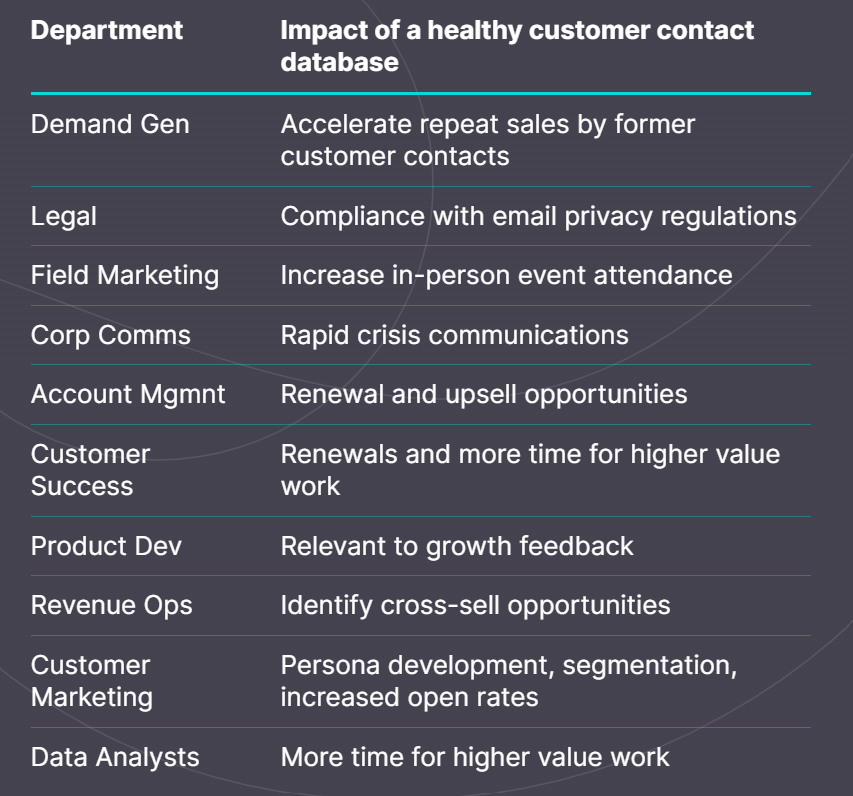
You may think that bad data just impacts CS and a few other groups. However, the graph below shows its impact across the organization. These stakeholders need to have confidence in the data when planning customer communications.
What are the essential datapoints?
1: Employment status: This is the most important. With 20% of people leaving their employer annually, your customer contact may no longer even work there. These ‘warm’ leads may have landed at a company that sales want to know about. Being up-to-date impacts account utilization, the need to find new users, and may be an early churn warning.
2: Title: The title the customer gave you when they first interacted with your company is probably what is still in your CRM. Over time people move within their organization and get promotions. Being up-to-date impacts segmentation, open rates, cross-sell and renewals.
3: Location: Many companies assume the customer contact is located at HQ or where the contract was signed. Pre-pandemic, this may have been a fair assumption, but no longer. Being up-to-date impacts field marketing for events, and legal compliance with email privacy regulations.
4: Role change: Your customer contact has a new role and no longer uses your product, or has moved to a new division that does not have access to your product. This is the toughest to identify and product utilization will help uncover this group. . Being up-to-date may identify a cross-sell candidate and the need to find new users.

Why—and how—CS should take the lead on database health.
Of all the groups that might manage the overall health of the customer contact database, customer success is the best positioned.
Demand gen may maintain the structure and fields in the CRM, but they focus primarily on prospects. They often send customer emails but do not update contact data.
Customer marketing is most often focused on customer advocacy (references, testimonials, and reviews) and generally shy away from the customer contact database.
Revenue/sales ops focuses on account-level information, not individual contact data. The good news is they have the budget and the ear of the CRO or VP of sales. The bad news is many rev or sales ops practitioners do not come from a customer-facing role, so don’t expect them to know or ask what is needed to improve the customer contact database.
For companies with CS ops or a customer success leader with a working relationship with rev/sales ops, customer success is my choice. Ideally, the ownership looks like this:
The role of CS:
- Assess the health of the customer contact database.
- Develop a short-, medium-, and long-term action plan.
- Keep track of the bad data rate by segments and economic impact.
- Own the health of the main points of contact at each account.
The role of operations:
- Delete duplicates and make the data consistent.
- Add fields that will help transform the customer contact database into an advantage.
- Work with the product and data teams to integrate utilization data into the CRM.
- Bring in technology to update and enrich at scale.
Irwin Hipsman is a 4x customer marketing practitioner and most recently was Forrester’s first Director of Customer Marketing. To learn about workshops and services to transform your customer contact database into an advantage, visit Repetitos.