Quick summary: More agent autonomy can give your customer success team time back, or it can add noise. ChurnZero founder YouMon Tsang walks through the five conditions that decide which one you get.
The promise of AI is that if you hand agents more autonomy your customer success team gets more time back. Fewer alerts to chase and fewer tedious tasks mean more room for strategic work. While all of that is on the table, that treats AI like something that arrives ready to go. Whether it ends up making your team’s lives easier or just adds noise comes down to some conditions you set before it ever reaches a customer.
In a recent conversation on the Startup Builders and Backers podcast, YouMon Tsang, founder and CEO of ChurnZero, walked through those conditions. Here’s what he shared and what each one can do to help your customer success team as much as it can. Watch the full interview.
Pair facts with information.
The difference between a successful and unsuccessful AI implementation often comes down to data quality.
“There are really two major pieces of data: one is your facts, and then there’s information,” YouMon says. “It used to be [that] facts were the most important thing. Now you have to add the information.”
CS teams already have facts in their systems or processes. This includes contract dates, pricing, ARR, and points of contact. Information, on the other hand, gives context to the relationship, like call transcripts, email threads, and information about your products and services and how to use them. Feeding your agent both facts and information will help it deliver more strategic, sophisticated recommendations.
Build trust in your agents the way you built trust in automation.
It’s easy to forget that CS teams have been through changes like this not so long ago. For instance, CSMs had to get acclimated to a static message being sent to a customer when they hadn’t used the product for two weeks. Automated outreach had an adoption curve and YouMon points to that time as a helpful playbook for implementing AI agents.
“There may be a time where [AI] could make better decisions than a human can in the moment, because it can absorb so much more information more quickly,” YouMon says. “But until now, I think the comfort level is really what dictates full automation… And that’s different for every organization. Every organization has its level of comfort.”
A good approach for agents could be full autonomy on some actions and an approval step on others. This balance will shift over time as your team’s confidence in the output grows. There’s no fixed timeline for that shift, and it looks different for every team. Treat this as a gradual handoff rather than the flip of a switch.
Match your AI strategy to the outcome you own.
Not every CS team is optimizing for the same result so it is important to identify which one applies to your organization.
“There’s a difference between affecting top-line outcome and impacting the profit margin, the expense line,” YouMon says. “I think both are really important. I wouldn’t say one is better than the other…Depending on what your department’s goals are, your AI has to service that goal.”
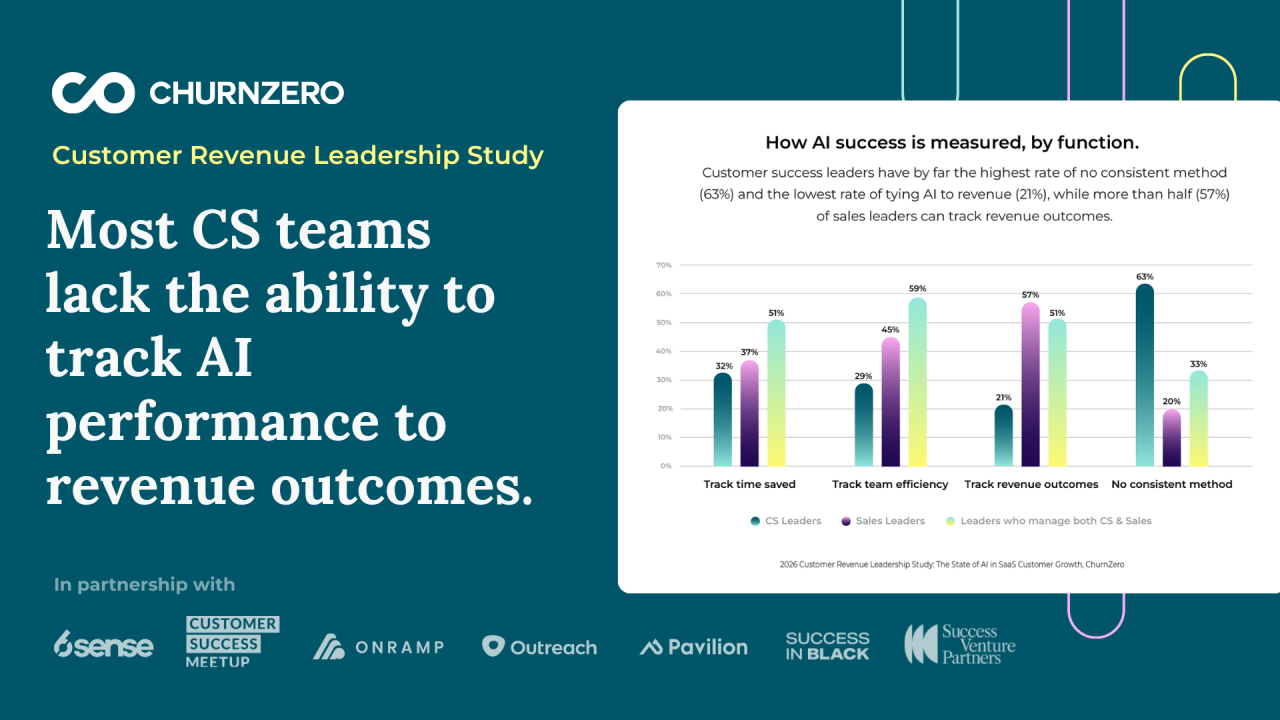
If your team isn’t expected to directly bring in revenue, your goal is to support customers. The better approach is then to focus on efficiency so that could mean automating tickets and reducing manual work. Teams measured on growth should focus on retention and expansion like catching churn risk early, spotting upsell opportunities, and strengthening relationships. Get clear on which one describes your team first. That’s what your AI strategy should be built around.
Fix timing and empathy will follow.
CS leaders worry that automated outreach loses the empathy a CSM would convey. YouMon says this can come down to timing.
“Bad timing is very obvious to see. It’s like, why are you sending me this now?” he says. “If you fix the timing problem, the empathy problem can follow pretty easily.”
AI can already customize language for a given situation. Timing is more difficult, because it depends on the system having the right information like previously mentioned. While you can’t necessarily program empathy into a system, fixing the timing of outreach can ensure that customers are treated with sensitivity.
Free your CSMs to do the job you hired them for.
Gaining more time doesn’t do much on its own, so leaders have to point their team toward what fills it. CSM job descriptions say they are looking for new hires to be consultative and curious but that rarely is what they end up being used for. The day-to-day defaults to admin work and routine follow-ups that don’t leave much time to be strategic.
“We should be hiring exactly the same way we’ve always wanted to hire, this aspirational hire,” YouMon says. “With AI handling the routine things, it’s up to the humans to do the work we hired them for to begin with.”
AI adoption doesn’t change what a CS job calls for. It finally lets team members spend their time on the work the role was supposed to be about.
What to do next.
Here are three places to look before you expand what your agents are allowed to do:
- Check what’s feeding your CS platform. If it’s contract and usage data alone, your agents are working with facts but no information. That puts the quality of their recommendations at risk.
- Figure out where your CSMs are spending too much time. This could be a tedious routine or reactive work. See if it could move to an agent with an approval step. That’s the fastest way to free up time for the relationship-building work that is more impactful.
- Determine if your CS team is geared toward servicing the customer or being growth-focused. If your AI roadmap doesn’t already reflect that, it could be optimizing for the wrong thing.